Two neighbors
Demerara Rum and the dispute over Barbados rum
Demerara Rum from Guyana is registered in the EU register as a geographical indication, with fixed rules on territory, strength, body classes and a sugar limit of 20 grams per liter. Barbados rum, by contrast, isn't in the register; a dispute over a dedicated origin rule has been ongoing there for years.
What makes a rum Demerara Rum?
The name belongs to a narrow strip of coastal land. According to the specification, the area lies in the coastal plain of Demerara County, between the Boeraserie River to the west and the Abary Creek to the east. Molasses or other sugarcane products serve as raw material. Fermentation runs at around 32°C and ends at 6 to 8% ABV. Bottling takes place at a minimum of 40% ABV.
Maturation usually takes place in white oak casks, at 24 to 32°C and around 70 percent humidity. Blending with rum from other countries is prohibited. Sweetening is allowed up to 20 grams per liter, matching EU law. Rums labeled "Cask Aged", "Special Reserve" or "Grand Special Reserve" must be bottled in Demerara. Demerara Rum has been protected in the EU register since June 28, 2018, and the name was formally registered in 2021.
Light, medium, heavy: the body classes of Demerara Rum
The classification by body is unusual. The specification measures congeners in grams per hectoliter of pure alcohol. "Light" denotes a rum with fewer than 30 grams of congeners and under 10 grams of esters. "Medium" falls between 30 and 300 grams, with 10 to 50 grams of esters. "Heavy" starts above 300 grams of congeners and over 50 grams of esters.
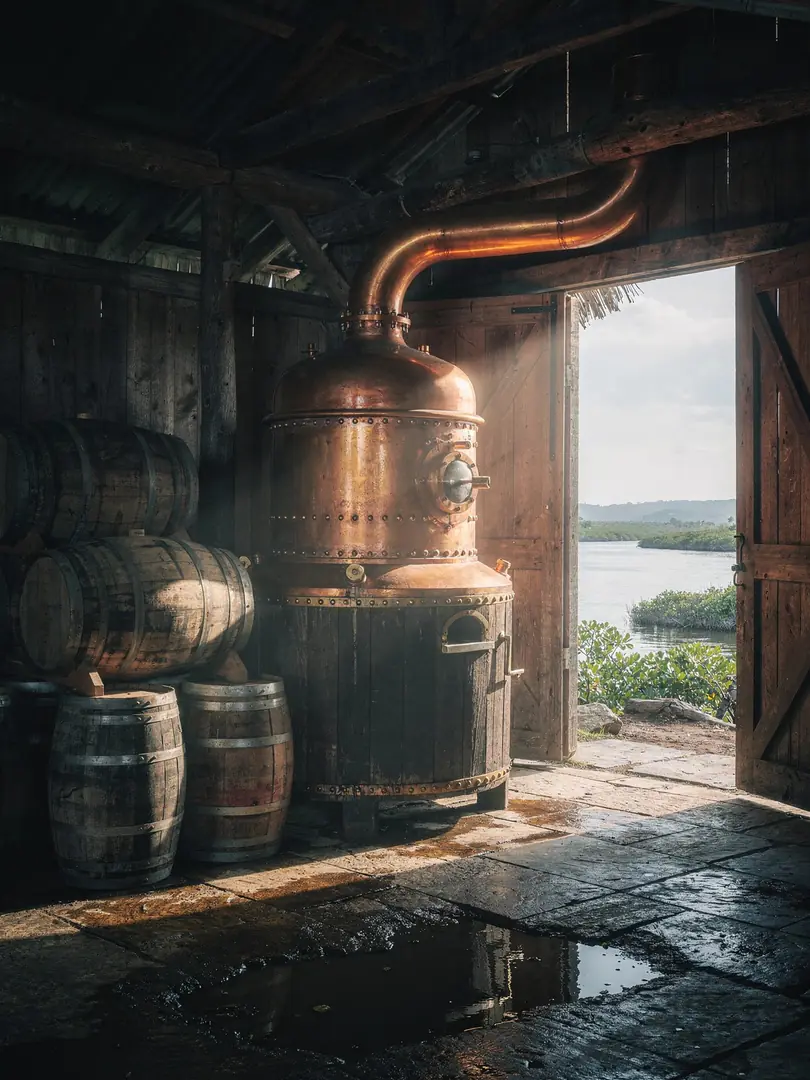
These classes are closely tied to the type of still. Light and medium rums come from column stills with two to five columns, while heavy rums come from single or double pot stills. The stills may be made of copper, steel or greenheart, a hard wood from the Amazon region. Each still produces its own "marque", essentially its own distillate type. Today, only the Diamond distillery, operated by Demerara Distillers, still works in Guyana, with the last wooden stills of their kind. Their technique is described in the themed journey "Distilling Rum".
Why doesn't Barbados have a protected rum origin?
Rum as we know it first became known as a sugarcane spirit on Barbados in the 17th century. Even so, there's no registered protection for Barbados rum, and the EU register contains no entry either. In 2019 and 2020, Mount Gay, Foursquare and St Nicholas Abbey put forward a draft for a geographical indication. Together, these three houses reportedly hold, according to trade press reports, over 90 percent of the island's aged rum stocks.
The draft proposed that rum bearing the Barbados name must be matured on the island and made with water from Barbados. It made no stipulation regarding the still. Objections came from the West Indies Rum Distillery, part of Maison Ferrand and maker of the Plantation brand. It wanted to allow Barbados rum to be matured abroad as well, in France, for instance. There's no evidence that a geographical indication for Barbados rum has come into force; what's certain is that the dispute has dragged on for years.
Demerara or Barbados: what the difference means for buyers
A bottle of Demerara Rum carries a verifiable promise: rum from the coastal plain of Guyana, with no foreign blending, and no more than 20 grams of sugar per liter. A bottle labeled "Barbados" carries an origin name without a registered specification. It may well be entirely accurate, but the rules behind it are set by the producer alone. Where the rum was matured and whether it was sweetened is then revealed only by what the producer chooses to disclose.
Lacking a binding law, master distillers created their own order. Luca Gargano of Velier and Richard Seale of Foursquare developed a classification based on the still: Pure Single Rum, Single Blended Rum, Traditional Rum, and Rum. It's a private system, not a legal standard; its details are explained in the themed journey "Distilling Rum." Among these neighboring countries, three different models apply. Guyana has an EU registration, Jamaica has national protection, and on Barbados the rules are set by individual houses.