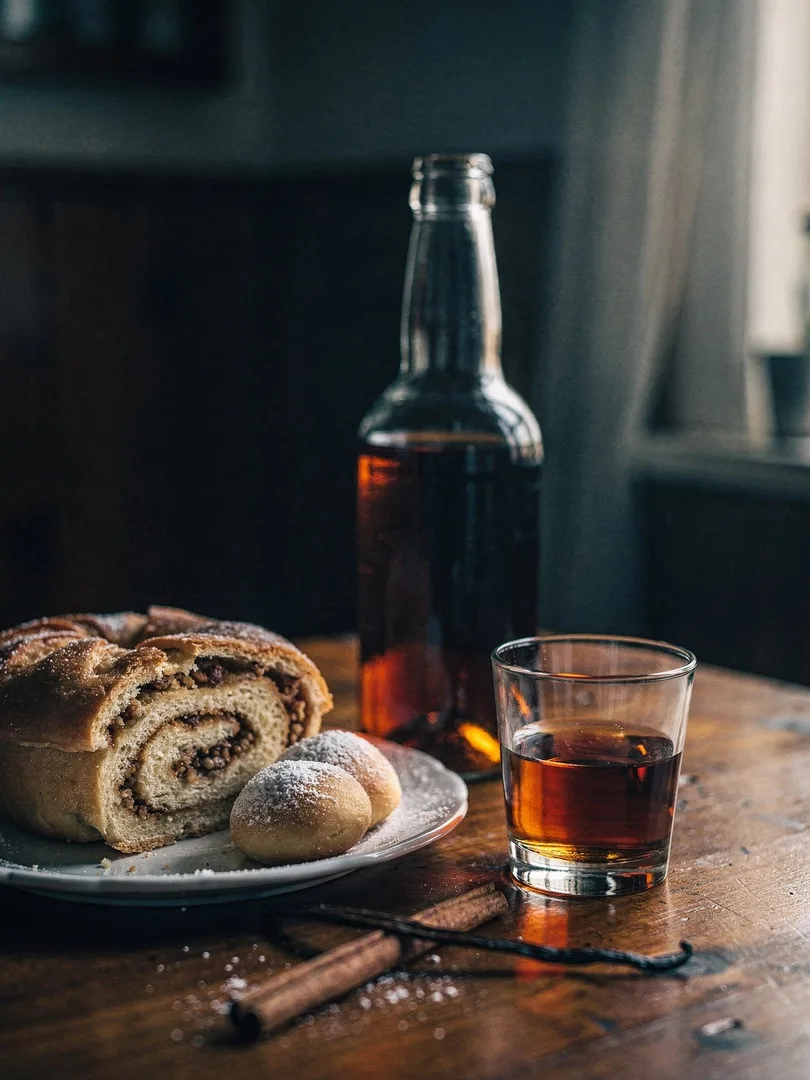
Central Europe's Special Paths
Rum-Verschnitt, Inländerrum, Domači rum, Tuzemák: Central Europe's Special Paths
Rum-Verschnitt, Inländerrum, Domači rum, and Tuzemák are not legally classified as rum. Rum-Verschnitt is a German spirit containing at least 5% rum alcohol; Inländerrum and Domači rum are protected spirits flavored with rum aroma; Tuzemák is made from potato or beet alcohol.
What Is Rum-Verschnitt Legally?
Rum-Verschnitt is governed by Annex II of Regulation (EU) 2019/787, as a designation specific to Germany. It's produced in Germany by blending rum with ethyl alcohol of agricultural origin, that is, neutral alcohol. At least 5% of the alcohol in the finished drink must come from rum. As with rum, the minimum strength is 37.5% ABV.
To ensure no one mistakes the blend for rum, the law even regulates the lettering. The word "Verschnitt" must appear in the same font, size, and color as "Rum," on the same line, and on the front label in the case of bottles. The legally required designation is "Spirituose" (spirit drink). If Rum-Verschnitt is sold outside Germany, the alcohol composition must be stated. It does not appear in the register of geographical indications, since it's a special designation rather than a name of origin. Its history leads back to Flensburg and is covered in the journey "History of Rum."
Inländerrum: Austria's Protected Rum Spirit
Inländerrum has been listed in the EU register since 2008 as a geographical indication, though under the category "Other Spirit Drinks." According to the technical file, it has a minimum strength of 38% ABV, with commercial versions reaching up to 80% ABV. It's made from rum, meaning a distillate from sugarcane-based raw material, and is flavored with Inländerrum essence. This essence is itself derived from rum distillate produced in Austria. Both distillation and finishing take place exclusively in Austria.
A key sentence from the technical file is decisive: all the alcohol in the finished product must be rum alone. Foreign alcohol from beets or potatoes is therefore not permitted. Many retailer descriptions claim the opposite, but they're describing the old-style "Kunstrum" (artificial rum) made from diluted neutral spirit, rum essence, and caramel coloring. Today's rule has applied since the transitional period following Austria's EU accession ended on December 31, 1998. Even so, Inländerrum doesn't qualify as rum under Category 1, since it is flavored. The best-known brand is Stroh from Klagenfurt, with Stroh 80 bottled at 80% ABV.
Domači rum: Slovenia's House Rum
Slovenia, too, has had its special tradition protected. Domači rum, roughly translating to "house rum," has been registered as a geographical indication under the category "Other Spirit Drinks" since 2008. It's made from a distillate of molasses or sugarcane juice, blended with rum flavorings and coloring. Its strength ranges from a minimum of 37.5% ABV up to 80% ABV. The technical file describes its aroma as reminiscent of "punch with vanilla."
Domači rum is mainly used in baking, for example in potica and doughnuts. Like Inländerrum, it originated in Austria-Hungary, an empire without its own sugarcane colonies. Due to its added flavorings, it too is not legally classified as rum.
Tuzemák: Why It Hasn't Been Called Rum Since 2003
Until December 31, 2002, the Czech drink was called "Tuzemský rum," meaning domestic rum. Since January 1, 2003, EU law has prohibited it from being called rum, so it's sold as "Tuzemák" or "Tuzemský." The reason lies in the raw material: Tuzemák is made from potato or sugar beet alcohol with rum essence. Sugarcane is completely absent, and it's not a geographical indication either.
Market figures show how easily the boundary blurs. The brand Božkov appears in rankings of best-selling rum brands with 1.4 million cases, yet it's legally not rum. Ronmiel de Canarias, a protected rum-honey spirit from the Canary Islands, is in a similar position. The same rule applies to the label in all these cases: what matters is the legal designation, not how the name sounds.