The Law in Brief
What Can Legally Be Called Rum? The EU Definition Explained
In the EU, rum may only be called rum if it's distilled exclusively from fermented molasses, cane sugar syrup, or sugar cane juice, distilled to under 96% ABV, and bottled at a minimum of 37.5% ABV. Added alcohol and flavorings are forbidden; caramel coloring and a touch of sugar are allowed.
What Can Rum Be Made From?
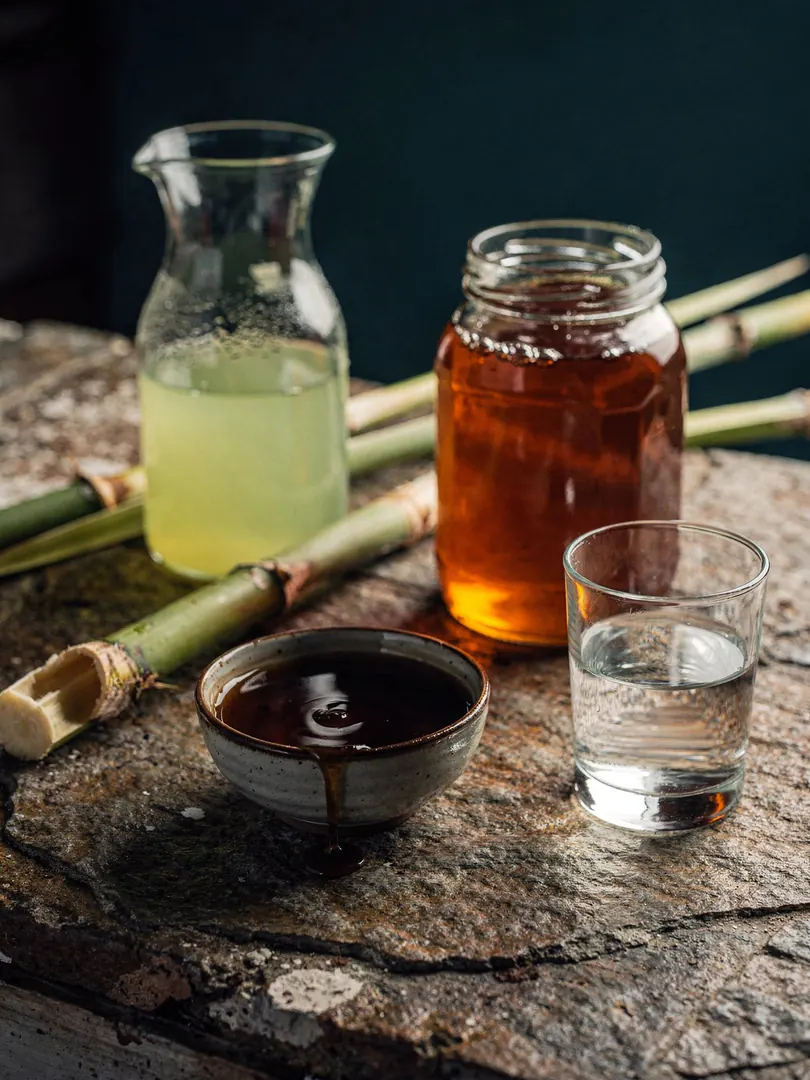
The governing EU regulation is the Spirit Drinks Regulation (EU) 2019/787, Annex I, Category 1. It permits exactly three raw materials: molasses from cane sugar production, syrup from cane sugar production, and sugar cane juice. Molasses is the thick, dark residue left over once the sugar has been crystallized out at the sugar factory. Syrup is concentrated juice and can be stored. Fresh juice, on the other hand, spoils quickly and is therefore only fermented during harvest and close to the fields.
The small word "exclusively" carries the entire definition. A spirit made from beet sugar, honey, or grain can never be rum, even if it's brown and smells of vanilla. Chemically, beet sugar is the same substance as cane sugar, but the law asks about the plant of origin. Whether molasses or juice is fermented, however, determines the style. Molasses supplies the vast majority of rum worldwide, while juice gives us the French rhums agricoles. How cane becomes molasses is explained in the themed journey "Sugar Cane & Molasses."
Why Must Rum Be Distilled Below 96 Percent?
The higher a distiller takes the proof, the purer the alcohol becomes. Near 96% ABV, what's left is almost pure ethanol, a neutral spirit with no trace of origin flavor. That's why the EU draws the line just below that mark. In addition, the distillate must "perceptibly retain the organoleptic characteristics of rum." In other words, a rum should taste of sugar cane, molasses, and fermentation, not of plain spirit.
In practice, distilleries vary enormously. The Creole column still on Martinique, under the rules of the local designation of origin, produces a distillate of 65 to 75% ABV. Cuba distills its base spirit, the "aguardiente," to 74–76% ABV and later blends it with a higher-proof distillate under 96% ABV. The lower the distillation proof, the more congeners remain in the spirit, things like esters, acids, and higher alcohols. That's why the terms "traditionnel" and "agricole" require a distillation strength below 90% ABV, more on this in Stop 4.
Rum at 37.5% ABV: No Added Alcohol, No Flavorings
In the bottle, rum needs at least 37.5% ABV. If a product falls below that, it can't be called rum, no matter how carefully it was made. Many producers bottle at 40% ABV. For AOC Rhum from Martinique and for Demerara Rum from Guyana, 40% ABV is actually mandatory.
Adding alcohol, whether diluted or undiluted, is forbidden. If someone stretches rum with neutral spirit, it legally stops being rum. This is exactly where the distinction lies with German Rum-Verschnitt, a blended product in which only 5% of the alcohol needs to come from rum. The regulation is equally clear on another point: "Rum shall not be flavoured." If vanilla, cinnamon, or coconut are added, the drink becomes a "spirit drink," or a "liqueur" if there's enough sugar. A spiced rum is therefore, legally speaking, a spirit drink based on rum.
Two interventions remain permitted. Caramel coloring (E 150a), a dye made from heated sugar, may be used to adjust the color. Rum may also be sweetened "to round off the final taste," up to a maximum of 20 grams per liter, calculated as invert sugar. This limit has applied since May 25, 2021. How much sugar actually ends up in the bottles is covered in the themed journey "Sugar & Additives."
Rum Isn't a Place Name: What the Word Still Protects
Unlike Cognac or Tequila, the word rum says nothing about where it's from. Rum can be made anywhere in the world, from Fiji to Australia to Madeira, as long as the raw material comes from sugar cane and the rules are followed. Origin is only protected once a name has been registered as a geographical indication. Examples include "Rhum de la Martinique" or "Demerara Rum," more on this in Stop 2.
Still, the regulation protects the word itself against imitators. Terms like "rum-style," "rum-type," or "rum-flavored" are not permitted on spirits that aren't actually rum. If "rum" appears in a compound name, the drink's alcohol must come exclusively from rum. The same applies to bottles from overseas: whatever is sold as rum in its country of origin must still meet Category 1 requirements within the EU. Otherwise, it must carry a different sales designation, meaning a different legally required name.
Brazil shows just how narrowly naming law is defined. Cachaça is distilled from sugar cane juice just like rhum agricole, but it's its own designation, reserved for Brazil, with 38 to 48% ABV and its own sugar limits. Same raw material, different name. Anyone wanting to understand what's really in a bottle should read the sales designation first, and the marketing second.