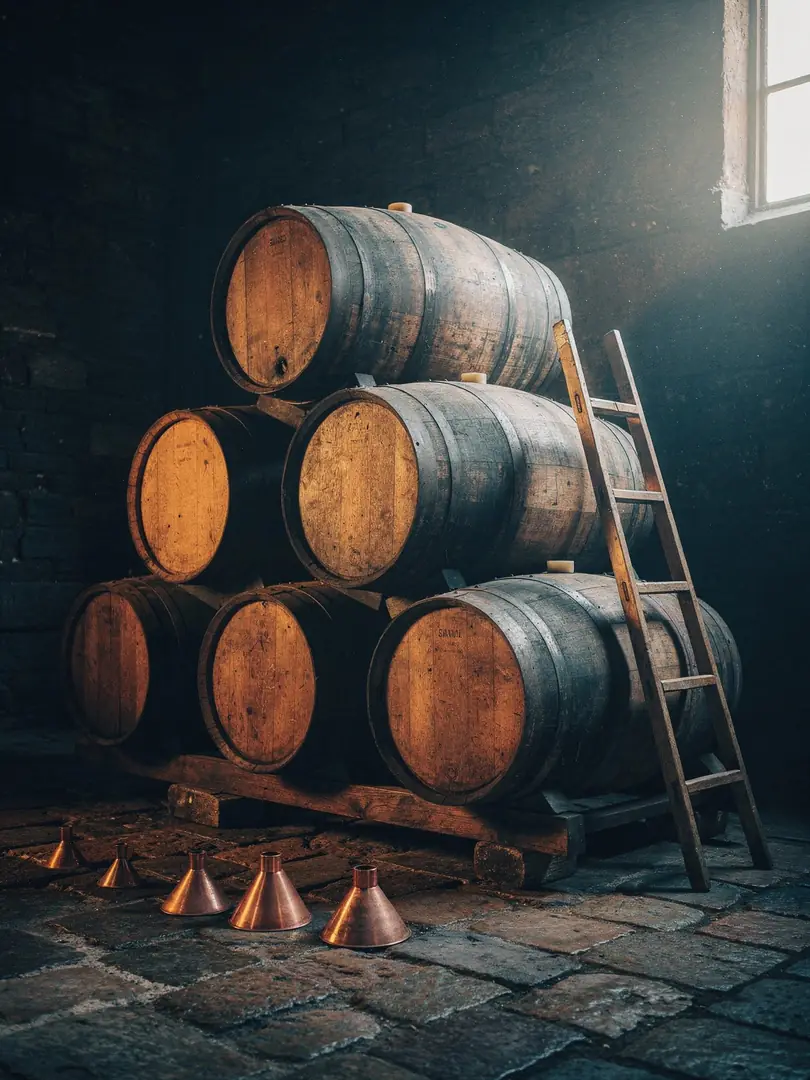
The cask-row system
What does Solera mean on a rum label?
On a rum label, Solera refers to a blending system of cask rows in which older rum is continually topped up with younger rum. The number alongside it usually states the oldest component, not the average, and certainly not a minimum age. It is not an age statement in the sense of EU law.
How does the Solera process work?
The method comes from Sherry production in Andalusia. Picture several rows of casks, traditionally stacked on top of one another. The bottom row is called the solera, from the Spanish word for floor. The rows above are called criaderas, or nurseries. The youngest spirit sits at the top, the oldest at the bottom.
Bottling is always drawn only from the bottom row, and never entirely. A portion is withdrawn, perhaps a quarter or a third. The resulting gap is topped up from the row above, which in turn is topped up from the next row up. Fresh rum is added at the very top. In this way, every drop slowly migrates downward over the years.
The advantage lies in consistency. Because some older rum always remains in every cask, the bottling tastes very similar year after year. The younger rum, in a sense, learns from the older. For brands wanting a fixed house style, this is convenient.
How old is a Solera rum really?
This is almost impossible to say precisely, and that's the problem. A solera set up twenty years ago theoretically still contains traces from its very first year. But with every withdrawal and refill, that oldest component gets diluted further. After many cycles, it's only a tiny fraction.
The best-known example is Zacapa from Guatemala. For a long time the bottle carried the number 23, and many read this as 23 years. In fact, the rum is a blend of rums ranging from roughly six to 23 years old. The brand later changed the label to read Sistema Solera 23. The 23, then, describes the age of the oldest rum in the system.
The average age of such rums is typically well below the number on the bottle. How far below, producers usually don't say. A Solera rum can still taste great. It just shouldn't be compared to a rum bearing a genuine minimum age statement.
Solera numbers and EU law: why it isn't an age statement
EU Spirit Drinks Regulation 2019/787 allows an age statement only if it refers to the youngest alcoholic component. A Solera rum with a large number on the label doesn't meet this, since its youngest component is much younger. Solera numbers, then, are not age statements under EU law.
In the EU, such a number may not be presented in a way that could be mistaken for an age. That's why labels today read phrases like Sistema Solera, Solera number, or Gran Reserva rather than years. Bottles brought in from other markets sometimes still carry figures that look like an age statement.
Vintage-like numbers on some bottles read similarly. They often cite the company's founding year, an anniversary, or the year the solera was established. That is not an age. It helps to check whether the word Years or Años appears next to the number, and whether the figure refers to the youngest rum.
How to recognize a Solera rum
Solera rums come mainly from Latin America and the Spanish-speaking world, where the technique was adopted from Sherry production. They're typically distilled in the lighter Spanish style, meaning column-distilled, and mild in character. The word Solera almost always appears prominently on the label.
Many of these rums are also sweetened, which the EU permits up to 20 grams per liter. For Zacapa, lab analyses from the Finnish monopoly Alko cite figures around 19 to 25 grams. Individual values vary by batch. Those seeking a drier style will more likely find it among rums with a clear age statement from the English or French tradition.