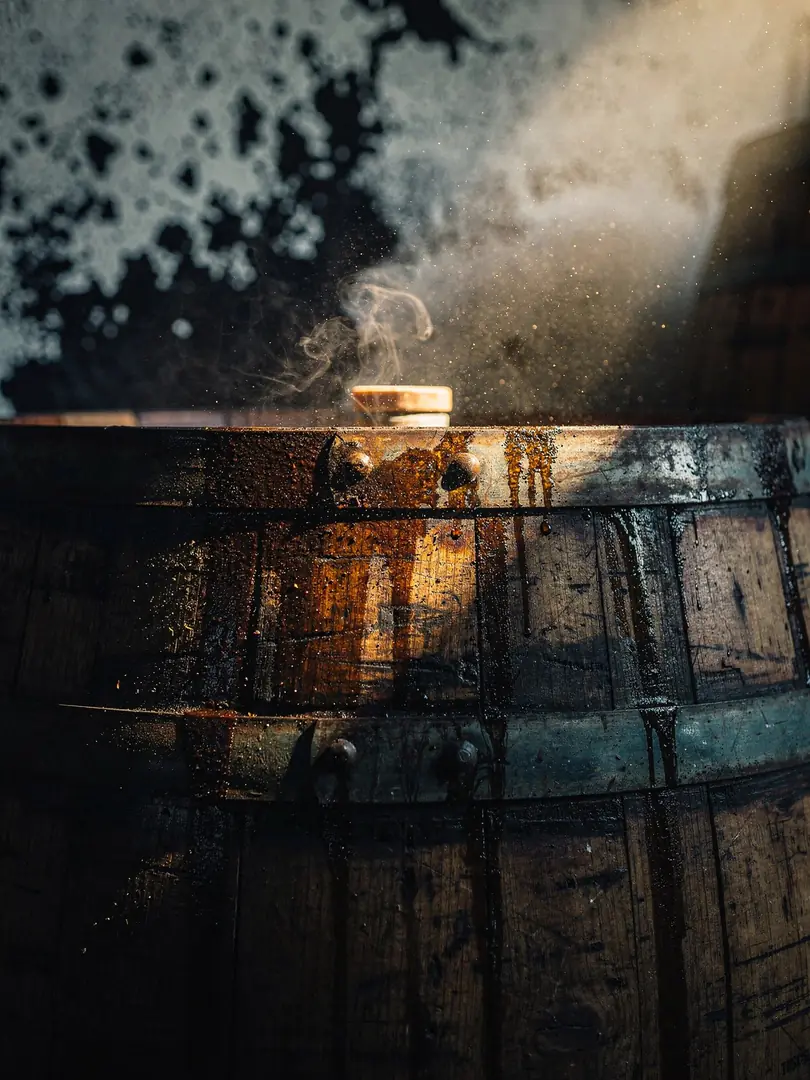
The Angels' Portion
Angel's Share: How Much Rum Evaporates in the Tropics?
In tropical warehouses, according to trade press figures, usually seven to ten percent of a cask's contents evaporate per year, averaging around eight percent. In Scotland it's about two percent. This loss is called the Angel's Share. There's no solid study backing these figures.
Why Does Rum Evaporate Through a Closed Cask?
An oak cask is tight enough that nothing drips out, but it isn't airtight. Wood consists of fine tubes and cell walls through which water and alcohol vapour slowly migrate outward. Some also escapes at the joints between the staves and at the bung hole. Part of the rum also soaks into the wood itself and stays there.
The English name comes from the Scottish whisky world and means, with a wink: whatever's missing, the angels have taken. In French it's called la part des anges. It always refers to the loss during maturation, not to what's spilled during transfer.
How much disappears depends above all on temperature. In the heat, simply more evaporates. Add to that air movement, cask size, wood thickness and position in the warehouse. The trade press cites seven to ten percent per year for the Caribbean. Individual distilleries fall below or above that, because every warehouse is built differently.
A Worked Example: What's Left After Ten and Twenty Years in Cask?
A small calculation shows how strongly the percentages add up. Suppose a 200-litre cask loses eight percent of its respective contents every year. After ten years, around 87 litres remain, less than half. After twenty years, only about 38 litres are left.
The same cask loses considerably less in Scotland at two percent a year. There, around 163 litres would remain after ten years, and about 134 litres after twenty years. The difference between 38 and 134 litres explains more about the rarity of old tropical rum than any marketing copy.
These figures are a model, not a measurement. Real casks lose more in hot years, less in cooler ones, and old casks behave differently from fresh ones. But the principle holds: in the tropics, time devours rum quickly.
Does Alcohol Content Rise or Fall in the Cask?
Water and alcohol both evaporate, but not at the same rate. Humidity is the deciding factor. In humid air, relatively more alcohol escapes, and the rum grows weaker over the years. In dry, hot air, more water evaporates, and the alcohol content can actually rise.
That's why alcohol content usually drops in humid Caribbean coastal warehouses. In dry, hot attics, the opposite can happen. Master distillers measure their casks regularly to track where they stand. A rum that entered the cask at a good 70 percent can be well below that years later.
This matters in the glass because the aroma shifts along with the alcohol content. Cask-strength bottlings show exactly this final figure without any water added. That's why two casks from the same vintage can already differ by several percentage points in alcohol alone.
What the angels' share means for old rums
Because so much evaporates, old tropical-aged casks yield only a few bottles. Distilleries must weigh whether to let a rum age even longer or bottle it while enough remains. Many settle on eight to fifteen years.
Independent bottlers handle this differently. Velier, for instance, reportedly leaves its casks in the countries of origin according to trade press reports, deliberately accepting the heavy loss to capture the character of tropical ageing. Others bring the casks to Europe, where less evaporates.
A special case is the remaining stock from the Caroni distillery in Trinidad, shuttered in 2002. Velier discovered its cask warehouse in 2004 and bought up the remaining stock and the brand. Every bottle of Caroni today comes from these dwindling reserves. No new Caroni rum is being made.