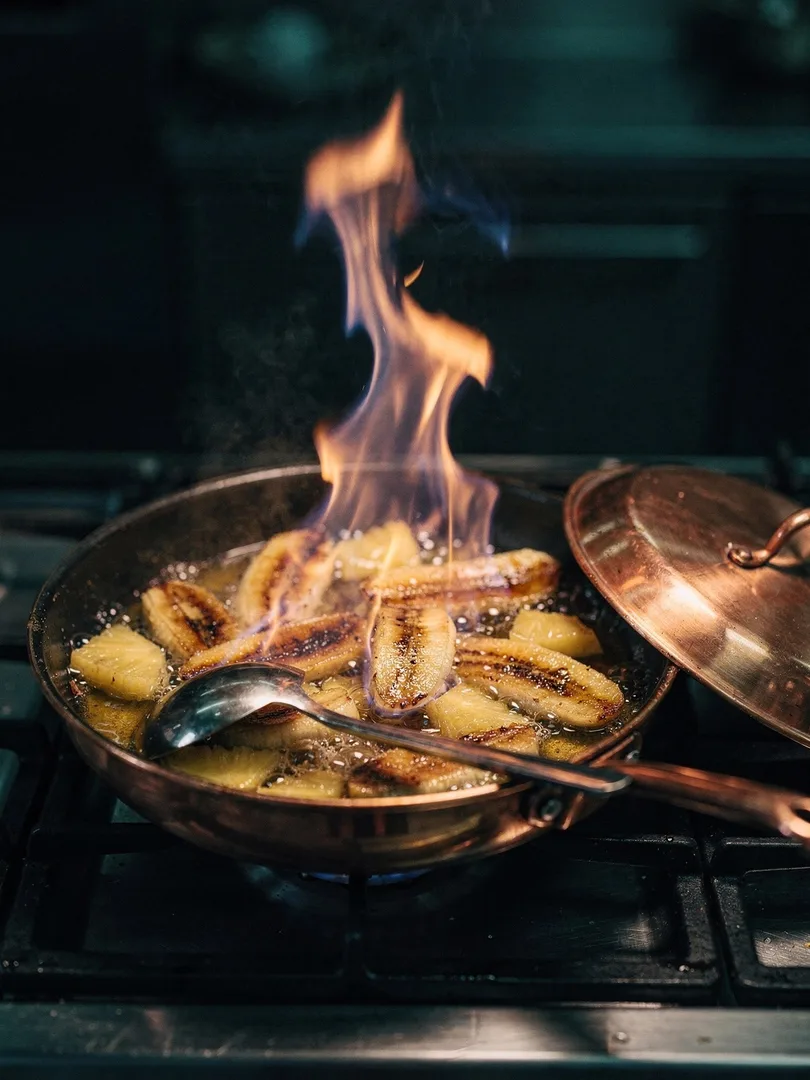
Flame and pan
Flambéing and cooking with rum
For flambéing, rum between 40 and 50 percent works best, gently warmed and never poured straight from the bottle. The flame burns off less alcohol than people assume: according to data from the US Department of Agriculture, about 75 percent remains in the dish when flambéed, and about 5 percent after two and a half hours of simmering.
How much alcohol cooks off when cooking with rum?
The assumption that alcohol cooks off entirely is a stubborn myth. Measurements say otherwise. The US Department of Agriculture (USDA), in its table of nutrient retention when cooking, lists specific figures for alcohol. They come from experiments conducted on actual recipes by researchers at the University of Idaho and Washington State University in the early 1990s.
If alcohol is added to boiling liquid and the pot is taken off the heat immediately, about 85 percent remains. When flambéed, it's about 75 percent. If a dish bakes for 25 minutes without the alcohol being stirred in, about 45 percent remains. Only prolonged cooking with stirring brings the figure down significantly: to about 25 percent after one hour, 10 percent after two hours, and 5 percent after two and a half hours.
For the kitchen, this means: a flambéed dessert retains most of its alcohol. Dishes for children, pregnant women, or people who don't drink alcohol are better cooked without rum, or you should simply say what's in them. How much remains per portion also depends on the amount. Two tablespoons of rum in a braise for six people is a different matter from a generous splash over a single plate.
Flambéing with rum: which rum catches fire, and why?
It's not the liquid that burns but the alcohol vapor above it. At room temperature, a rum at 40 percent gives off little vapor and is hard to ignite. Gently warmed, say in a small pot or a pre-warmed ladle, enough vapor forms. The rum must not boil, or the alcohol escapes before it catches fire.
Overproof rum at 60 to 75 percent ignites immediately and fiercely. This looks impressive, but is needlessly risky in the kitchen, and tastes harsh in the dish. A rum at 40 to 50 percent is entirely sufficient. For desserts, an aged molasses rum with caramel suits well; for shrimp or lobster, an agricole with a fresh, grassy note.
The flame is blue and barely visible in daylight. It goes out on its own once not enough alcohol is evaporating at the surface. Flavor-wise, it takes off the raw alcohol edge and lightly caramelizes sugar at the surface. A good part of flambéing is theater.
Flambéing safely: the key rules
The most important rule: never pour straight from the bottle into a hot pan. The flame can travel back along the stream into the bottle. Measure the rum beforehand and have it ready in a ladle or small pitcher. Pull the pan off the heat, add the rum, and light it at the edge of the pan with a long match or a stick lighter.
Turn off the extractor hood beforehand, so it doesn't draw flames upward. Tie back long hair, roll up loose sleeves, and keep nothing flammable hanging above the stove. Have a matching lid ready, as it smothers any flame within seconds. Burning fat should never be put out with water.
Cooking with rum: marinades, glazes, sauces
Even without flame, rum is a useful ingredient. Alcohol dissolves flavor compounds that don't dissolve well in either water or fat, and it lifts browned bits from the pan bottom when deglazing. Tried-and-true options include a peppercorn sauce for steak, a glaze for ham or ribs made from rum, cane sugar, and mustard, or a marinade for pork with lime, garlic, and rum.
When reducing, everything in the rum becomes concentrated. A sweetened rum with up to 20 grams of sugar per liter makes a heavily reduced sauce noticeably sweeter, and caramel coloring darkens it. For savory sauces, a dry rum is therefore the better choice. Added early to the pot, the rum has time to lose its sharp edge. A splash right at the end brings aroma, but also keeps nearly all its alcohol.