The Big Order
What Rum Types Exist? The Order Behind the Shelf
Rum types are best distinguished by raw material, still type and origin, not by color: molasses or fresh sugarcane juice, pot still or column, English, Spanish or French tradition. With these axes, almost any bottle can be classified.
Why Color Is a Poor Way to Order Rum
In supermarkets, rums are usually sorted by color: white, gold, brown, nearly black. This grouping persists because it seems logical at first glance. But it reveals little. A white rum may have spent several years in the barrel and then been decolorized again with activated carbon, a fine-pored filtering charcoal. A dark rum, on the other hand, may be young and owe its color to caramel coloring, a colorant made from heated sugar that EU law permits for color adjustment.
Experts therefore classify differently. They ask what the rum was distilled from, in which still and in which tradition. These questions explain the flavor far better than any color statement. One more question arises once it comes to the label: is the drink even allowed to be called rum? In the EU, this is regulated by Regulation (EU) 2019/787. It requires sugarcane as the origin and a minimum of 37.5% ABV. Flavorings and added neutral alcohol are prohibited.
Molasses or Sugarcane Juice: The Raw Material Decides First
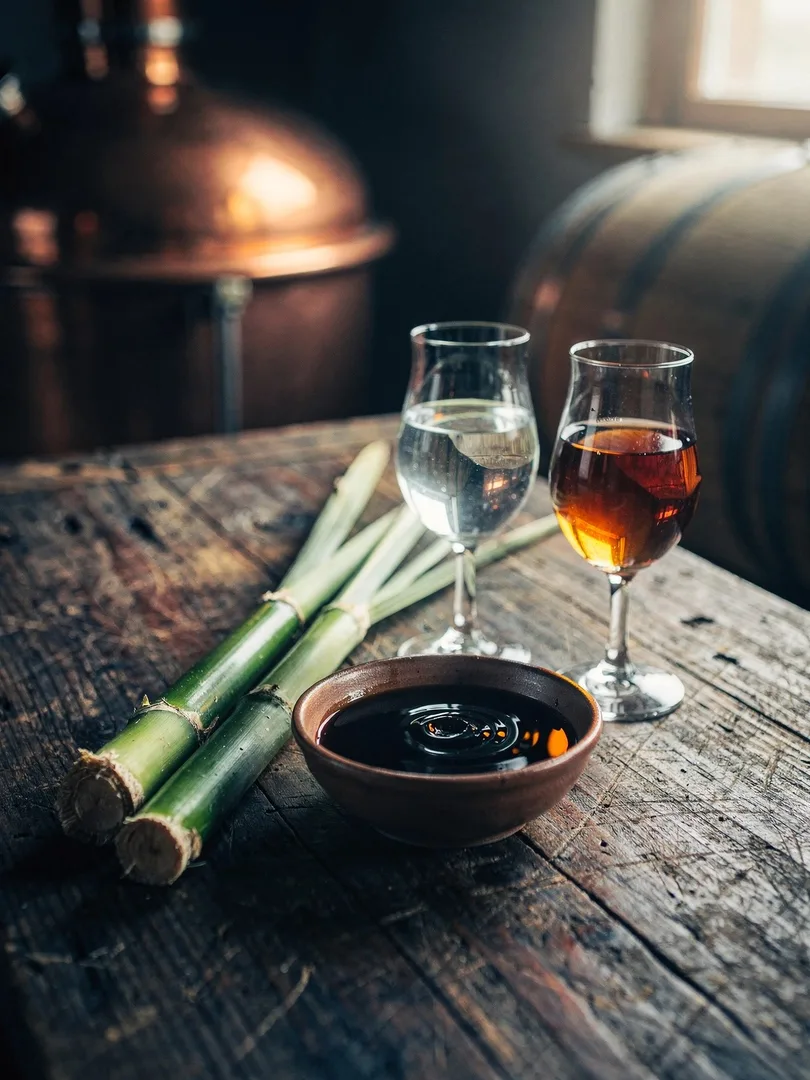
Most of the world's rums are made from molasses. This refers to the thick, dark syrup left over from sugar production once the sugar has crystallized out. Molasses can be stored and shipped. This means a distillery can operate year-round, even without its own sugar factory. Molasses rum tends to taste rounder and deeper, with notes of caramel, dried fruit or banana, depending on how long it ferments and which still it's made in.
Fresh sugarcane juice behaves quite differently. It spoils quickly and must be fermented immediately after harvest. That's why juice-based rum is only made near the fields and only during harvest season. It tastes greener, with notes of freshly cut grass, pepper and citrus. On Martinique, Guadeloupe and Madeira it's called Rhum agricole, in Brazil Cachaça, in Haiti Clairin. In between lies thickened juice, sugarcane syrup, from which rum is distilled in, for example, Guatemala.
Pot Still or Column: What the Still Changes in Rum
Next comes the still. A pot still, called Kesselbrennblase in German, works in batches: fill the kettle, heat, draw off the distillate, empty it. In this process, many congeners—aromatic compounds alongside the alcohol—remain in the distillate. The result is heavy, oily, often fruity to wild. Jamaica is the most famous example of this style, and Barbados and Guyana also distill in pot stills.
A column still, also called a continuous still, works without interruption. Fermented mash flows in at the top while steam rises to meet it from below, and across many plates the alcohol gradually separates from water and heavier compounds. The higher a still distills, the lighter and more neutral the distillate becomes. EU rum must stay below 96% ABV so that the rum character is preserved. Many houses blend both, combining heavy pot-still and light column distillate in the same bottle.
English, Spanish, French: The Three Rum Traditions
There's also a cultural axis. The former colonial power shaped how rum was distilled on a given island, and that imprint can still be tasted today. English style stands for molasses, pot still and bold aroma. Spanish style stands for molasses, column still, filtration and smooth Ron. French style stands for fresh juice and the creole column still. This classification is a rule of thumb with exceptions: Haiti, for instance, double-distills juice in pot stills modeled after the Cognac region.
In recent years, a classification by distillation method has also emerged, developed by Luca Gargano and Richard Seale. It distinguishes, for example, Pure Single Rum—pure pot-still rum from a single distillery—from Single Blended Rum, made from pot and column distillate at the same distillery. This classification is private and has no legal standing. But it shows where connoisseurs look: at the method rather than the color. The following stops go through each tradition individually and end with drinks that only sound like rum.