Heat as the Pacemaker
Fermentation
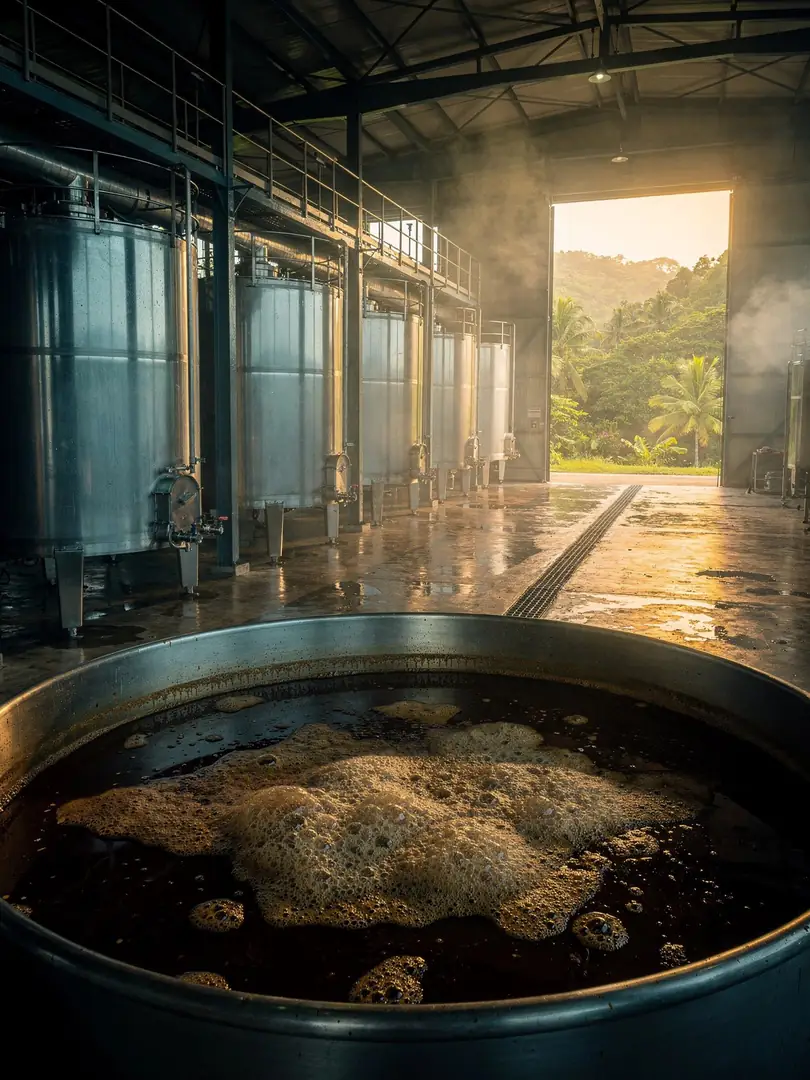
In the vats at La Miel, the yeast works faster than it would in Europe, for a simple reason: heat. With daytime temperatures of 30 to 31 degrees, the fermenting mash heats itself up. If it gets too hot, the yeast dies off or produces flavors nobody wants. Cooling is therefore part of the craft.
The mash is the mixture of diluted molasses, water, and yeast. The yeast converts the sugar into alcohol and carbon dioxide. For lighter rums this is often done within one to two days, while heavier rums are given more time. As the foam builds on the surface, so does the aroma: sweetish, bready, with a touch of fruit.
There are two paths to yeast. Wild yeasts come from the air and from the raw material itself, and the result varies and is often distinctive. Cultured yeasts are propagated in a lab and deliver the same flavor batch after batch. Brands aiming for a consistent taste worldwide usually rely on cultured yeast, since variation on the shelf stands out.
Crucial to the aroma are esters, compounds formed from acids and alcohol that smell of fruit: banana, pear, pineapple. Long fermentation and high acidity produce many esters, while short, clean fermentation produces few. This is how the same molasses can yield either a light or a heavy rum. According to trade press, Mantuano consists of roughly 40 percent heavy rum and 60 percent light and medium-bodied rum.
Then there's the raw material itself. The molasses comes from three factories and is never quite identical, sometimes retaining more sugar, sometimes more ash. A distillery compensates for this by diluting the molasses before fermentation and adjusting it to a fixed sugar content, so each batch starts off similarly.
Rum from La Miel therefore usually doesn't taste of wild fruit the way Jamaica's heavy rums do, but comes across clean and rounded. That's not a weakness but a strategy: fermentation lays down a calm foundation on which the cask can later build. Where esters are lacking, the wood takes over as the flavor-giver.