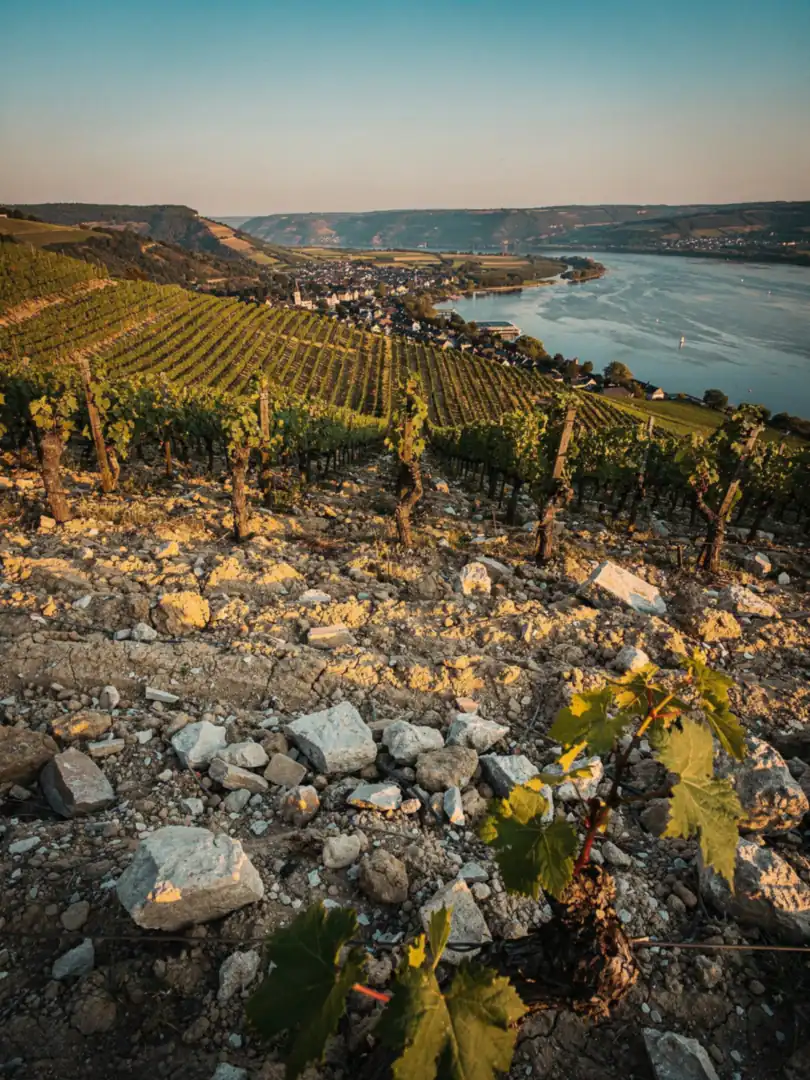
Limestone by the River
Soil & Climate
On what soil does Crémant de Luxembourg grow? On limestone and marl. Along the Moselle, over roughly forty kilometers between Schengen in the south and Wasserbillig in the north, the vines lie in a narrow strip on the left bank, in some places only three hundred to four hundred meters wide.
The subsoil consists mainly of shell limestone, a marine limestone from the Triassic period, and the colorful marls of the Keuper, a mix of limestone and clay. Slate, which defines the landscape further downstream on the Moselle, is absent here. Limestone produces wines with clear, firm acidity—exactly what a base wine destined for a second fermentation in the bottle needs.
The climate on the Moselle slopes is cool enough to preserve acidity yet warm enough to ripen grapes. For sparkling wine, this is an advantage: harvest begins early, the grapes bring little sugar but plenty of freshness, and the base wine's alcohol stays low.
The vineyard sites are small and numerous: around a hundred vineyard names are recorded along the river. Still wines carry classifications such as Premier Cru and Grand Premier Cru, as seen in a Riesling from the Côtes de Grevenmacher produced by the house of Bernard-Massard. For the cooperative's Crémant, grapes from many growers and villages come together.
Then there's the cellar. Bernard-Massard built its own directly on the Moselle bank in 1921, and the same principle applies to every house: the cooler and calmer the bottles rest, the more slowly the yeast works, and the finer the bubbles become later on.
At the southern end, around Schengen, Remerschen, and Wellenstein, lies the Obermosel, the heartland of the acid-driven Elbling grape. There the variety grows on limestone and retains a freshness well suited to base wines for sparkling production.