From Auxerrois to Elbling
Grape Varieties
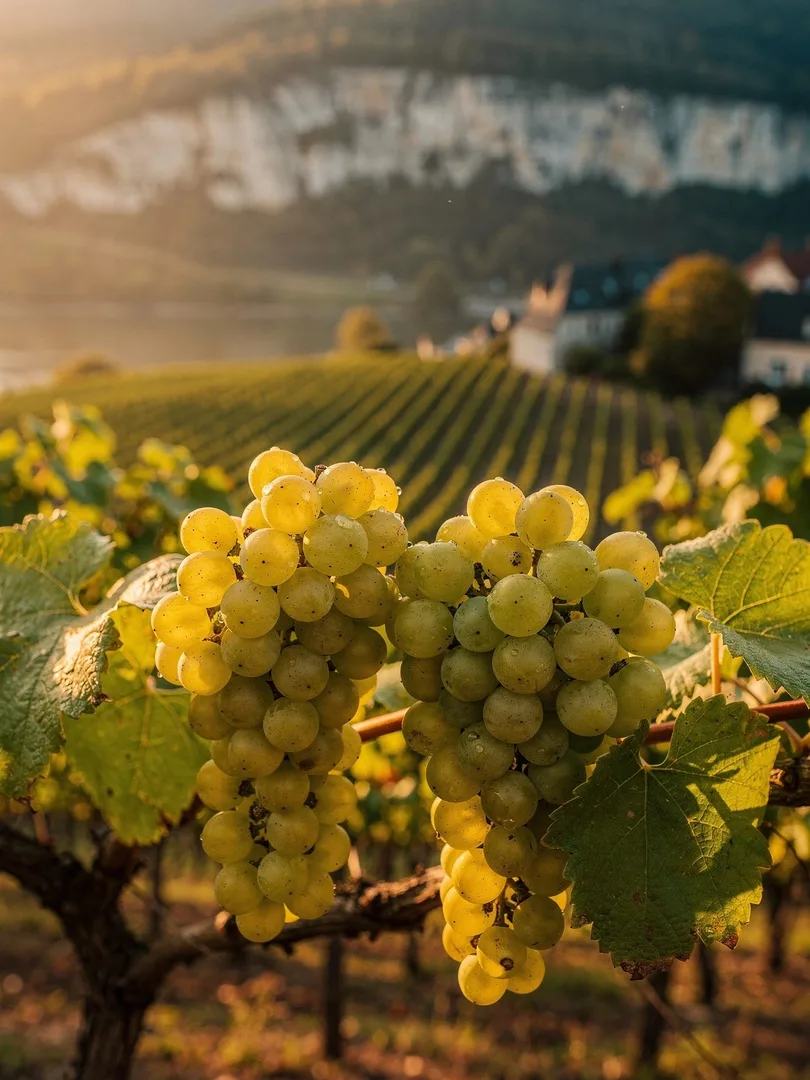
Which grape varieties go into Crémant de Luxembourg? The rules are broad: winemakers may use any variety authorized in the country. Most commonly blended are Pinot Blanc (Weissburgunder), Chardonnay, Pinot Noir (Spätburgunder), Pinot Gris (Grauburgunder), Auxerrois, and Riesling.
The breadth of the selection shows in the 2022 vineyard figures: Rivaner, the common Luxembourg name for Müller-Thurgau, covers 316 hectares, Pinot Gris 196, Auxerrois 190, Riesling 162, Pinot Blanc 160, Pinot Noir 121, and Elbling 86 hectares.
Auxerrois lends roundness. It tastes of ripe apple and pear, carries mild acidity, and gives the blend a soft middle. Chardonnay and Pinot Blanc add citrus and fine finesse, while Pinot Noir contributes body and a hint of red fruit. Depending on the house, the result is a Crémant that leans creamy or crisp.
Riesling and Elbling form the opposite poles of the Luxembourg Moselle. Riesling, grown on 162 hectares, lends citrus fruit and tension to the Crémant wherever it enters the blend. Elbling, the smaller variety at 86 hectares, is considered one of the oldest grapes on the Moselle. It is light, delicately fruity, and highly acidic; as a still wine it is often tart, but it provides base wines mainly destined for Crémant.
Luxembourg's Belgian neighbor takes a stricter approach. Crémant de Wallonie, recognized as a protected designation in 2008, may be made only from Chardonnay, Pinot Noir, Pinot Blanc, and Meunier. The grapes must come from Wallonia, with winemaking and bottling carried out in Belgium.
Luxembourg, by contrast, embraces diversity: one house might bottle a Crémant from a single variety, another a blend of five, both under the same designation of origin.