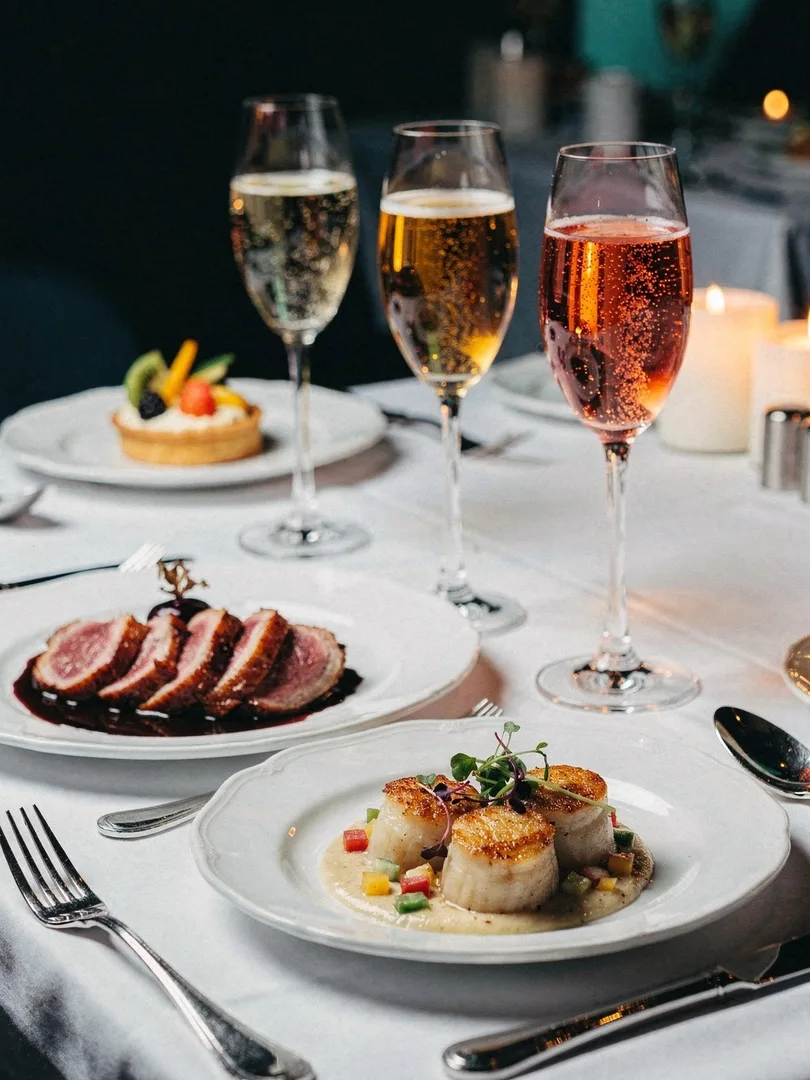
A Menu Built on Bubbles
Sparkling Wine Through the Whole Menu: From Starter to Dessert
A whole menu built around sparkling wine works when the wine moves from light to full-bodied and from dry to sweet: Blanc de Blancs with the starter, Blanc de Noirs or an aged Brut with the main course, Rosé with dark meat, and a Demi-Sec with dessert.
Can You Drink Sparkling Wine Through an Entire Menu?
Yes, and it works better than many people think. Sparkling wines vary so widely that there's a fitting style for almost every course. The range stretches from lean Blanc de Blancs to robust wines made from Pinot Noir all the way to sweet Demi-Sec. Acidity and carbonation keep the palate fresh through many courses. And the alcohol level usually stays lower than it would through a sequence of heavy red wines.
The same rules apply to the order as with still wine. Young wines come before old, light before full-bodied, dry before sweet. A mature vintage Champagne after a young Crémant tastes deeper and more complex. Conversely, the young wine suddenly tastes thin after the old one. The dosage too—the sugar the cellar master adds before corking—should rise over the course of the evening and never drop again. Anyone who wants to open just one style for the whole evening is best off choosing a mature Brut or a Blanc de Noirs. Both are robust enough for the main course and fresh enough for the starter. Only at dessert does such a wine reach its limit.
Aperitif and starter: lean and dry
The opening act calls for a light, dry sparkling wine. A Blanc de Blancs, a Crémant made from Chardonnay, or a Riesling Sekt Brut whets the appetite without filling you up. Stick with this style for starters with fish, such as scallop carpaccio, ceviche, or smoked trout. With vegetable starters featuring asparagus or peas, a Pinot Blanc sparkling wine works well. Its softer acidity doesn't mask the delicate sweetness of the vegetables.
Soups are a special case, since liquid meets liquid. A clear broth or a shellfish bisque can handle a sparkling wine with some age and body. Creamy soups with cream benefit from the acidity of a young Brut, which cuts through the fat. Cold soups like gazpacho bring plenty of tomato acidity. These pair best with a fruity rosé, which offsets that acidity with some fruit.
Main course: Blanc de Noirs, rosé, and mature Champagnes
The main course calls for a wine with more power. A Blanc de Noirs is a white sparkling wine made from red grapes such as Pinot Noir or Meunier, pressed quickly and gently. It has more body than a Blanc de Blancs and suits veal, poultry in cream sauce, or fish fried in butter. A vintage Champagne with notes of brioche and hazelnut pairs beautifully with mushroom dishes, truffles, or risotto.
For red meat, a white sparkling wine is rarely enough. This is where rosé comes in. Rosé sparkling wine may be made by blending white and red wine; this is permitted for sparkling wine but forbidden for still wine. A robust rosé with a high proportion of red wine can handle duck, lamb, or a beef fillet cooked medium-rare. The rustic version is a dry Lambrusco, usually a red frizzante, served with roast pork, sausage, or pasta with ragù.
Cheese and dessert: saving the sweetness for last
In many menus, cheese comes before dessert. A mature Champagne or Winzersekt pairs well with hard cheese, while a rosé suits stronger varieties. After that, the sweetness level rises. Fruit or light creams call for a Demi-Sec with 32 to 50 grams of sugar per liter. For very sweet desserts, reach for a mild sparkling wine with more than 50 grams, or an Asti made from Muscat.
With a long menu, it pays to keep portions small. A splash of five to eight centiliters per course is enough to let each wine show what it contributes to the dish. Water should always be on the table. There's a physical reason for this too: according to a small study, carbonation speeds up the absorption of alcohol into the bloodstream. Anyone driving or wanting to drink less can be offered an alcohol-free sparkling wine, which also carries well through the menu.