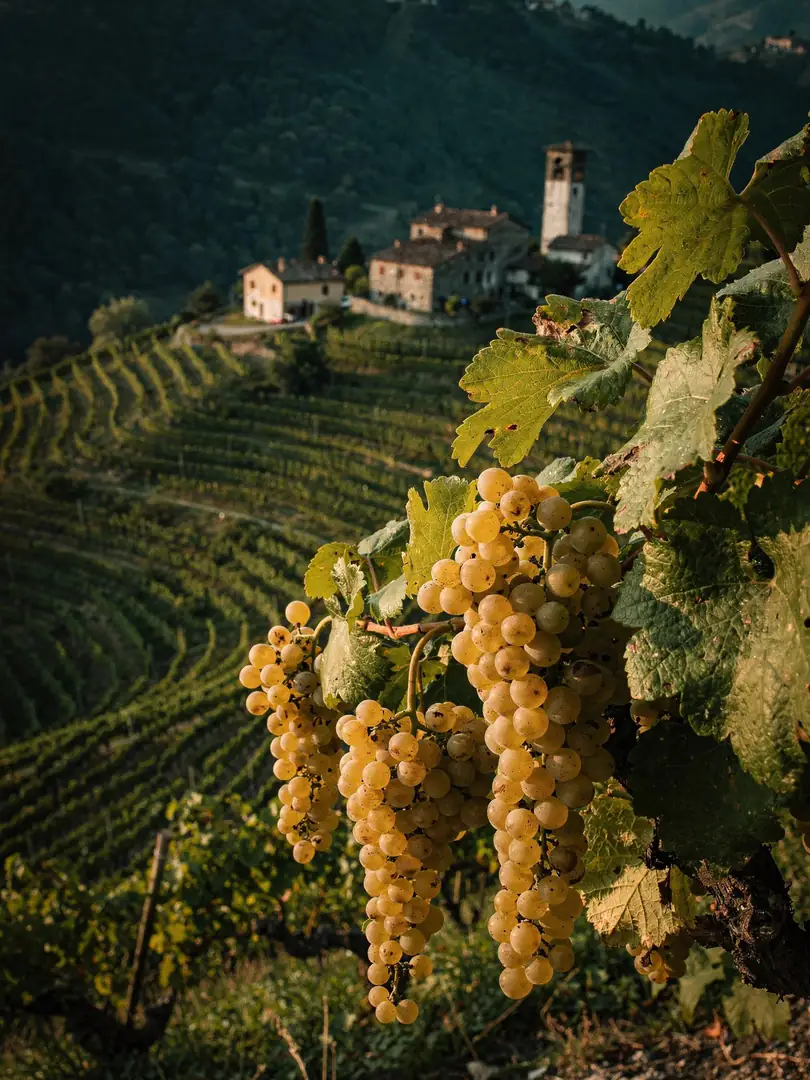
Veneto's Sparkling Wine Grape
Glera: The Prosecco Grape
Glera is the grape variety used to make Prosecco: it makes up at least 85 percent of every Prosecco DOC blend. Until 2009, the grape itself was called Prosecco; since then, the name refers only to the protected origin from Veneto and Friuli-Venezia Giulia.
Is Prosecco a Grape Variety?
Until 2009, Prosecco was both a place of origin and a grape variety. That made the name vulnerable: a grape variety can be grown and named on the label anywhere in the world, but a protected origin cannot. Italy therefore renamed the variety by ministerial decree on 17 July 2009, effective 1 January 2010. Since then, the grape has been called Glera within the EU, and only wine from the delimited area may be called Prosecco.
The name wasn't entirely new, as Glera had already been used as a regional synonym for the variety. The place name Prosecco, in turn, belongs to a village in the province of Trieste, at the far eastern edge of today's growing area. The theme journey on law and labeling tells how this case shaped origin protection for sparkling wine. Here, the focus is on the grape itself and why Prosecco tastes so different from a sparkling wine made from Chardonnay or Riesling.
What Does Glera Taste Like?
Glera belongs to the semi-aromatic varieties. It has a less intense aroma than Muscat, but noticeably more than Chardonnay. Typical notes include pear, green and yellow apple, and white blossoms like acacia and wisteria, sometimes with a hint of citrus. The acidity is fresh but rarely sharp, and the body is light. This suits a sparkling wine meant to be young and easygoing. In the glass, Glera is often recognizable by its aroma alone; a sparkling wine made from Chardonnay, by contrast, smells more restrained and more of yeast.
In the vineyard, Glera is vigorous, thin-skinned and late-ripening. It's a heavy bearer, and that's exactly what determines quality. On the plains, where yields are high, it loses aroma and becomes neutral. In the steep hills between Conegliano and Valdobbiadene, where yields are lower and much work is done by hand, it stays more aromatic and refined. This explains a good part of the difference between simple Prosecco DOC and the Superiore from the DOCG, with its 43 Rive and the Cartizze site.
Why Is Glera Usually Fermented in Tanks?
Glera's aromas are delicate and fleeting. In tank fermentation, known in Italian as Metodo Martinotti, the second fermentation takes place in large pressurized tanks, and the wine is ready within weeks to a few months. This preserves the grape's fresh fruit character. Extended lees aging, as with Champagne, would cover it with bread and nut notes without adding much to the variety.
EU law accommodates the grape. A special rule allows Glera from Veneto and Friuli to be made into aromatic quality sparkling wine, a category otherwise reserved for Muscat varieties and similarly fragrant grapes. There's also an exception for Prosecco regarding the minimum alcohol content of the blend: 8.5 percent instead of 9 percent by volume. Both suit a grape that yields light, fragrant wines with moderate alcohol. Bottle-fermented Prosecco does exist, but it remains a niche.
Which Grape Varieties Besides Glera Are Allowed in Prosecco?
At least 85 percent of a Prosecco DOC blend must be Glera. For the remainder, old regional varieties such as Verdiso, Bianchetta Trevigiana, Perera and Glera lunga are permitted, along with Chardonnay as well as Pinot Blanc, Pinot Gris and Pinot Noir, the latter vinified as a white wine. The old varieties contribute acidity or aroma, while Chardonnay and the Pinots add a bit more body. How much of these actually goes into the wine rarely appears on the label.
Since 2020, there has been Prosecco DOC Rosé. Here, Pinot Noir is explicitly required at 10 to 15 percent and provides the color. The rosé must ferment in tank for at least 60 days and always carries a vintage. In 2025, 60.4 million of the 667 million bottles of Prosecco DOC sold were rosé. This style doesn't exist for the DOCG Conegliano Valdobbiadene, where Glera stands alone, with only small amounts of the old companion varieties.