Varieties without any mandate
Riesling, Weißburgunder, Grüner Veltliner: Sekt varieties in Germany and Austria
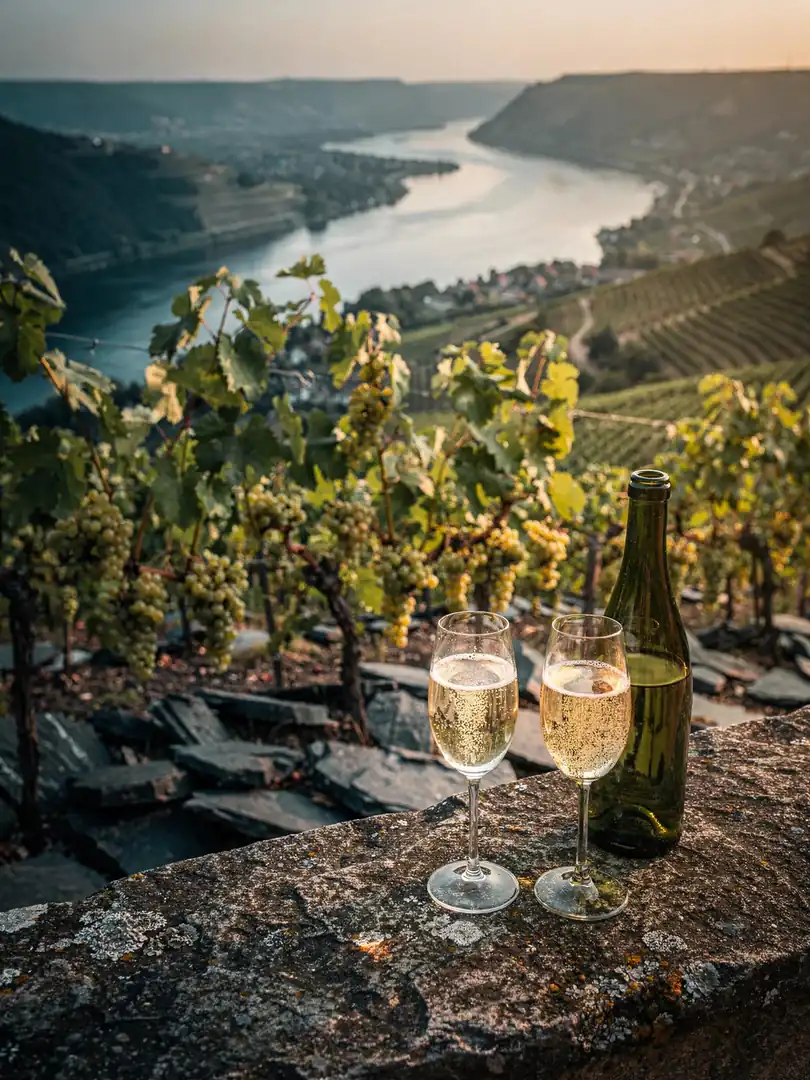
For Sekt in Germany and Austria, the law does not prescribe any grape varieties. Typical choices in Germany are Riesling and the Pinot varieties along with Chardonnay, while in Austria Grüner Veltliner and Welschriesling are also common. Unlike Champagne, each producer decides for itself which grape goes into the bottle.
Which grape varieties are permitted for Sekt?
There is no fixed list like in Champagne in the German-speaking world. A Sekt b.A. comes from one of Germany's 13 wine-growing regions and may be made from any variety permitted there for quality wine. Austrian Sekt g.U. follows the same logic: the grapes must be quality wine varieties, and at the Klassik level must come from a single federal state. Then there are the many Sekts without a stated origin, whose base wines can come from anywhere in Europe.
This freedom shifts attention to the label. For Winzersekt, stating the grape variety and vintage is mandatory, along with the name of the winery. A quality sparkling wine with a stated grape variety can, on request, receive an official German testing number even if it is not a Sekt b.A. For German and Austrian Sekt, then, the variety is often the most important promise made to the buyer—more important than with many sparkling wines whose origin already dictates the grapes.
Riesling Sekt: what does Sekt made from Riesling taste like?
Riesling is the variety that most clearly sets German Sekt apart from Champagne. Even at good ripeness it retains strong acidity and brings a distinctive aroma of its own: citrus, green apple, peach, and in cool sites, herbs as well. While Chardonnay in sparkling wine leaves room for yeasty notes, Riesling remains recognizable. Even after several years on the lees, you can still taste the grape variety coming through.
High acidity has two sides. It keeps Riesling sparkling wine fresh and capable of long aging, but can seem sharp when young. Many producers balance it with the dosage, the sugar added after disgorgement. Because acidity masks sweetness, Riesling sparkling wine often tastes drier than its sugar level would suggest. Classic Riesling regions for sparkling wine are the Rheingau, Mosel and Pfalz, where cool, often steep sites yield lean base wines. If the grapes come from vineyards with at least 30 percent slope, a Sekt b.A. may state this as a steep-slope site on the label.
Pinot Blanc, Chardonnay, Pinot Noir: Sparkling Wine in the Champagne Style
Anyone looking for a sparkling wine that resembles Champagne ends up with the Pinot family. Pinot Blanc, called Pinot blanc in France, is subtle in aroma, has mild acidity and takes on yeast aromas well. Pinot Gris adds more body but is used less often for sparkling wine. Chardonnay and Pinot Noir bring the same qualities they have in Champagne, just grown on different soils and under a different climate.
Many long-aged sparkling wines from the Pfalz, Baden, Rheinhessen or Franken are therefore made from Chardonnay, Pinot Noir and Pinot Blanc. Here too, Pinot Noir provides Blanc de Noirs, while Pinot Blanc and Chardonnay make Blanc de Blancs. The difference from the French model lies less in the grape than in soil, climate and length of lees aging. Sparkling wines made from Elbling on the Obermosel take their own path: a very old variety with high acidity and low alcohol that would often be too thin as a still wine, but comes across as fresh precisely for that reason as a sparkling wine.
Grüner Veltliner and Welschriesling: Austrian Sparkling Wine Varieties
In Austria, Grüner Veltliner is the most widely planted grape variety and is also common in sparkling wine. It brings green apple, citrus and a slightly peppery note that winemakers call Pfefferl. In sparkling wine, this comes across as spicy and fresh. Welschriesling, despite its name unrelated to Riesling, is more neutral and acid-driven. It's considered a reliable base wine for sparkling wine, especially from Styria and Burgenland.
For the upper tiers of Sekt g.U., technique matters more than variety. Reserve and Große Reserve require hand harvesting, whole-cluster pressing, traditional bottle fermentation and at least 18 or 30 months on the lees respectively, plus no more than 12 grams of sugar per liter. At these levels, alongside Grüner Veltliner, you'll also find Chardonnay and Pinot Noir. Muscat, the aromatic special case among the sparkling wine varieties of both countries, gets its own stop on this journey.