Coolness Is Becoming Scarce
Climate Change and Sparkling Wine: Why England and Tasmania Are Catching Up
Sparkling wine needs grapes with high acidity and low sugar, and these grow best where it's cool. As Champagne warms, harvest dates are shifting earlier. England, Tasmania, and other cool regions, meanwhile, are now harvesting grapes ripe enough for high-quality sparkling wine.
Why Does Sparkling Wine Need a Cool Climate?
A good base wine for sparkling wine would often be too acidic as a still wine on its own. It needs high acidity, low alcohol, and a restrained aroma. The acidity carries the sparkling wine through years on the lees, while the low alcohol leaves room for the second fermentation. Under EU law, the dosage that triggers this fermentation may raise the alcohol content by no more than 1.5% by volume. A heavier base wine would therefore result in a heavier sparkling wine.
Such grapes grow where sun and warmth are just sufficient. In warm regions, sugar levels in the berries rise faster than the aromas can develop, and acidity breaks down. Harvesting can happen earlier there, but at the cost of flavor depth. In cool regions, grapes ripen slowly, and acidity, aroma, and sugar stay in balance. That's why Champagne lies at the northern edge of viticulture, and why sparkling wine producers in Germany usually harvest their grapes earlier than for still wine.
What Is Climate Change Changing in Champagne?
In Champagne, the warming trend is visible on the calendar. According to the Comité Champagne, the region's trade association, the vines have been flowering around two weeks earlier since the 1990s, and the harvest has shifted forward accordingly. A harvest start in August, once a rare exception, has occurred several times in recent decades. At the same time, the natural alcohol level in the grapes is rising, while acidity is falling.
So far, the region has tended to benefit, as ripe vintages have become more common. Producers are nonetheless preparing for hotter decades ahead. Trials include later-ripening clones, canopy management that gives grapes more shade, and larger reserves of reserve wines from cooler years. With Voltis and the candidates Serelis and Orellis, the appellation is also testing new varieties. The goal is always the same: to preserve acidity and freshness even as summers grow hotter.
English Sparkling Wine: Chalk and Champagne Varieties
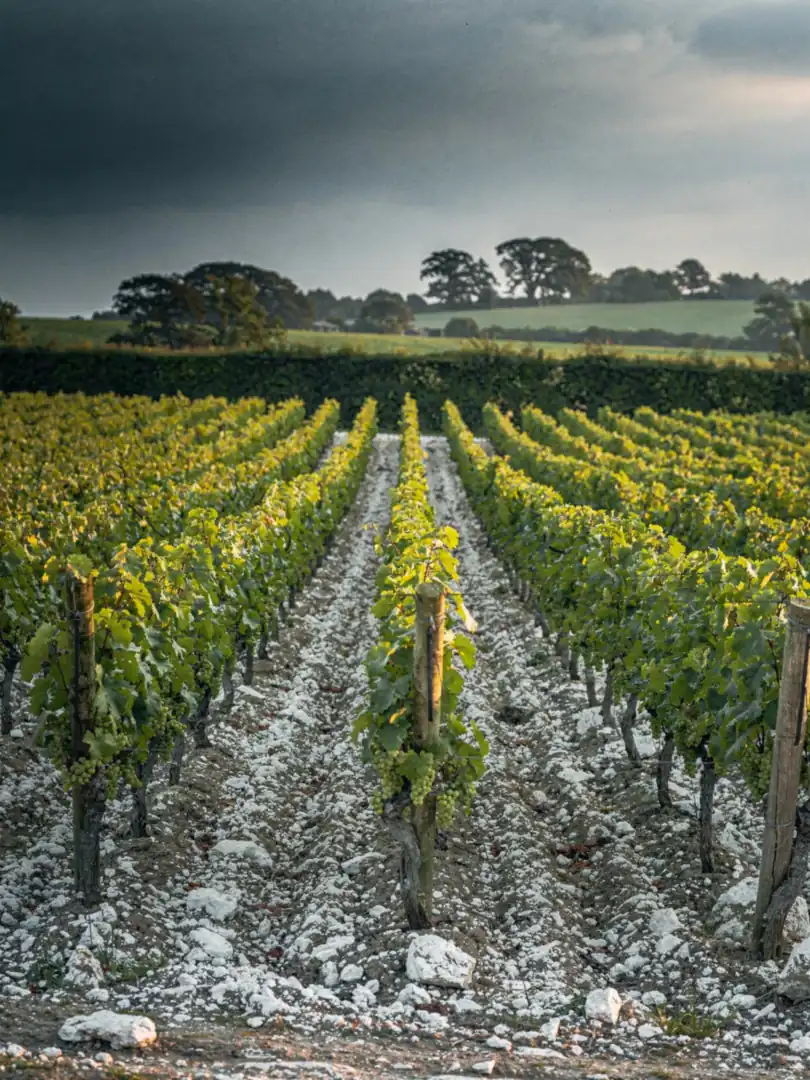
Southern England was long considered too cool for wine. Over the past few decades, Chardonnay, Pinot Noir, and Meunier have ripened reliably enough there for sparkling wine. The counties of Sussex, Kent, and Hampshire also offer chalk soils geologically related to those of Champagne. According to WineGB's 2025 industry report, Chardonnay accounts for 33% and Pinot Noir for 30% of British vineyard area. 69% of production is sparkling wine, 91% of which is made by traditional bottle fermentation.
Nyetimber, which today farms 425 hectares across West Sussex, Kent, and Hampshire, was the first English producer to rely exclusively on the three Champagne varieties. Champagne houses are now investing as well: Taittinger released the first bottles of its Domaine Evremond in Kent in April 2025. Since 2022, Sussex has held protected designation of origin status. English sparkling wine typically shows strikingly high acidity, which producers often balance with extended lees aging and carefully calibrated dosage.
Tasmania and Other Cool-Climate Sparkling Wine Regions
In the Southern Hemisphere, Tasmania plays a similar role. The island south of the Australian mainland has a cool, maritime-influenced climate rarely found on the hot continent. Chardonnay and Pinot Noir ripen slowly there and retain their acidity. Australian wineries have therefore sourced grapes or base wines from the island for decades for their bottle-fermented sparkling wines.
For similar reasons, mountain sites such as those in Trentino are considered well positioned, and winegrowers are planting sparkling wine varieties in areas once thought too cold. Winners and losers have yet to be determined. Champagne has chalk, experience, and reserve wines; the younger regions have cooler weather. For the grape varieties themselves, this means Chardonnay, Pinot Noir, and Meunier will remain the leading sparkling wine grapes for now, but they are migrating to wherever their acidity can be preserved.