Old and new varieties
Arbane, Petit Meslier, Erbamat, Voltis: rare sparkling wine grape varieties
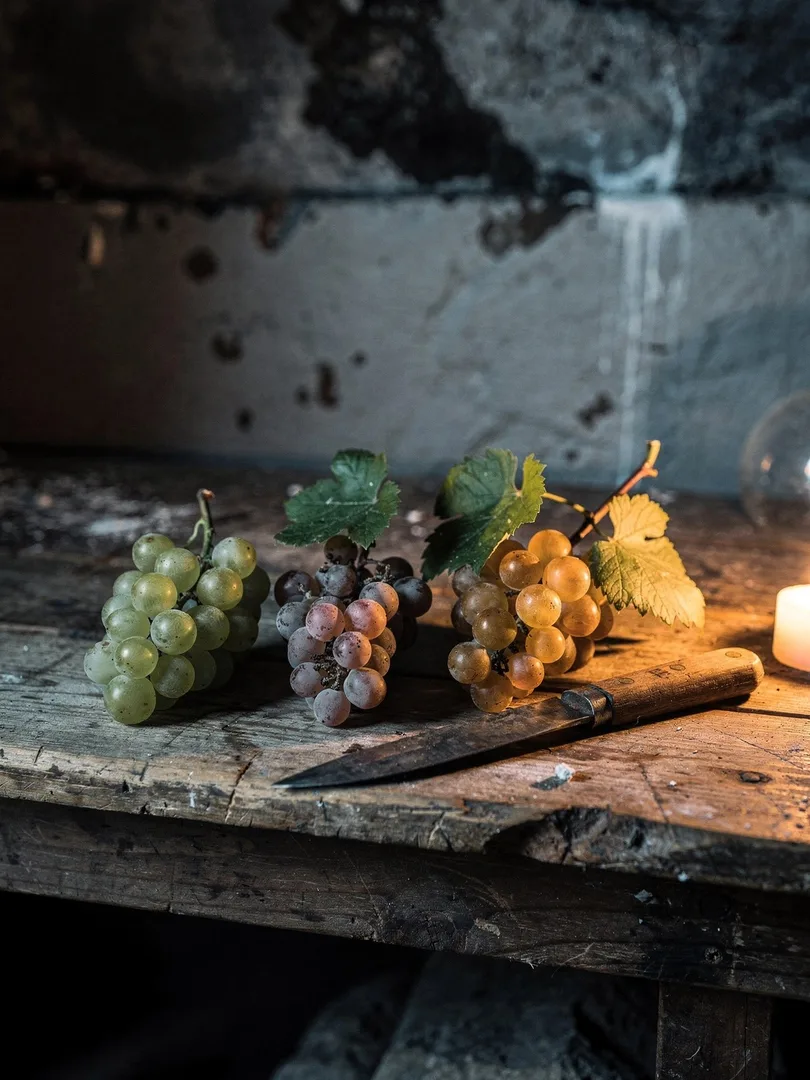
Arbane and Petit Meslier are old Champagne varieties that have survived on tiny plots of land. Erbamat is a rediscovered grape from Franciacorta, while Voltis is a new, fungus-resistant hybrid. All four are intended to help sparkling wine cope better with heat and reduce the need for plant protection.
Arbane and Petit Meslier: the old Champagne varieties
Before the phylloxera crisis, far more varieties grew in Champagne than today. Arbane and Petit Meslier are among the few that the regulations still permit. Together with Pinot blanc and Pinot gris, these four old varieties cover less than 0.3 percent of the planted area, according to the Champagne Bureau. Arbane is found mainly in the south, on the Côte des Bar in the Aube département. Growing it today is more a labor of love than an economic factor.
According to DNA analysis, Petit Meslier is a descendant of Gouais blanc and Savagnin. The variety ripens late and retains plenty of acidity even in warm years; Arbane is likewise considered acid-driven. Both yield little, are prone to rot, and ripen unevenly, which is why they were barely replanted during the postwar rebuilding after phylloxera. Today a handful of producers deliberately cultivate them and bottle cuvées that include all the old and more common varieties together. With warmer summers, their acidity is becoming interesting again.
Pinot blanc, Pinot gris and Chardonnay rose in Champagne
Pinot blanc and Pinot gris are also permitted in Champagne, though rare. In the Aube, Pinot blanc is traditionally known as Blanc vrai, while Pinot gris went by the old regional name Fromenteau. Both ripen earlier than Arbane and Petit Meslier and lend richness rather than acidity. In Champagne they usually appear only as a small component, occasionally forming the base of a special cuvée. As a result, their names rarely show up on labels.
Chardonnay rose is not strictly speaking a separate variety. It is a variant of Chardonnay with pink-skinned berries that release little color during rapid pressing. The regulations list it separately, though the area planted is small. The long list mainly illustrates one thing: the image of Champagne made from just three varieties is a habit of the past hundred-odd years, not a rule. Within the appellation, producers are free to blend far more broadly if they wish.
Erbamat: Franciacorta's answer to the heat
In Franciacorta on Lake Iseo, producers are drawing on a variety from their own history. Erbamat hails from the province of Brescia and, according to trade press, was already mentioned in the 16th century before nearly falling into obscurity. Since 2017 it has been permitted in Franciacorta cuvées, up to a maximum of ten percent. It is not mandatory; each producer decides for themselves whether to plant it.
What makes it interesting is its calendar. According to the trade press, Erbamat ripens more than a month after Chardonnay and the Pinot varieties. It has noticeably higher acidity, low alcohol, and a neutral aroma. This makes it a useful complement to base wines that become overripe too quickly in hot summers, without altering their flavor. It isn't intended as a substitute for Chardonnay and Pinot Nero, but rather as an acid donor in the blend, similar to Petit Meslier in Champagne. Whether this proves successful will only become clear in future vintages.
Voltis, Serelis, Orellis: New Varieties Against Mildew
Voltis pursues a different goal. The white variety is a new crossing, developed according to the trade press by the French agricultural research institute INRAE together with the German Julius Kühn Institute. Over several generations, noble European vines were crossed with resistant wild species. The result withstands downy and powdery mildew, two fungal diseases that otherwise often require spraying by winegrowers in the humid north.
Since 2022, Voltis has been approved in Champagne as a variety for climate adaptation. The limits are tight: no more than five percent of a producer's vineyard area, no more than ten percent of a blend, and no Champagne made purely from Voltis. On June 18, 2026, the relevant committee of the INAO, the French appellation authority, approved two further candidates, Serelis and Orellis; formal confirmation was still pending at that point. Whether the new varieties will change the flavor profile remains to be seen in the coming years.