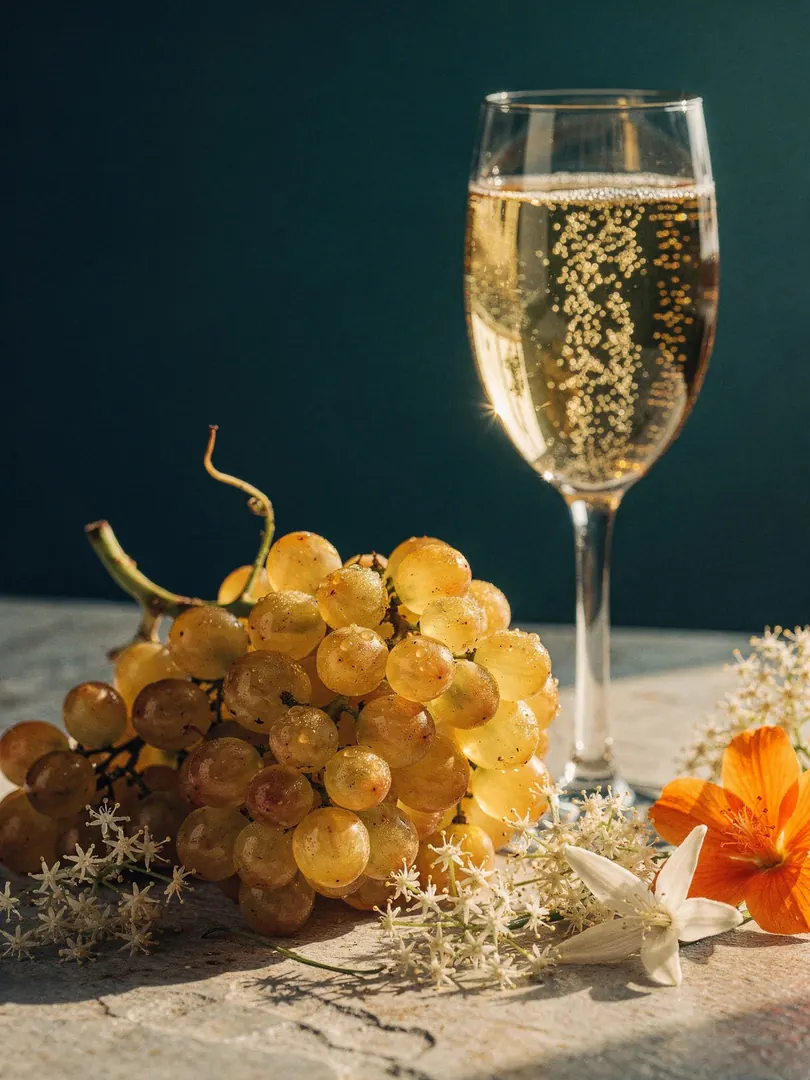
The Aroma of the Grape
Muscat and Moscato: Aromatic Sparkling Wine
Muskateller and Moscato are the same grape variety, internationally known as Muscat blanc à petits grains. It's one of the few grapes whose wine smells like fresh grapes themselves, and it's the basis for Asti, Moscato d'Asti and Muskateller sparkling wine, often sweet, sometimes completely dry.
Are Muskateller and Moscato the Same Grape Variety?
In Germany and Austria, it's called Gelber Muskateller, in Italy Moscato bianco, and in France Muscat blanc à petits grains, meaning Muscat with small berries. It's one of the oldest known grape varieties in Europe. It shouldn't be confused with Muscat d'Alexandrie, a large-berried relative, nor with Muskat-Ottonel, a younger crossing also used for sparkling wine in Austria. In the vineyard, the small-berried variety is demanding and needs warm, sheltered sites.
What unites the family is the aroma. Muscat varieties contain many terpenes, aromatic compounds like linalool and geraniol that are already present in the berry. This is why a Muskateller smells of grapes, elderflower, orange blossom and nutmeg even before yeast ever comes into play. For sparkling wine, this has two sides. The aroma is there right away and needs no long aging. But it also can't tolerate extended lees aging and doesn't keep in the bottle for many years.
What Is an Aromatic Quality Sparkling Wine?
EU law has created its own category for such grapes. An aromatic quality sparkling wine may only be made from the must of certain aromatic varieties listed in a regulation. It requires a minimum pressure of 3 bar instead of 3.5 bar as with ordinary sparkling wine, at least 6 percent actual alcohol and 10 percent total alcohol. Total alcohol refers to the alcohol that would result if the remaining sugar were also fermented. For sweet Muscat sparkling wines, the actual alcohol is therefore often well below the total alcohol.
Production is also specifically regulated. A dosage, meaning sugar added afterward, is prohibited. The sweetness must come from the grape juice itself and is preserved by stopping fermentation through cooling; other interventions to control fermentation are only permitted if they're physical in nature. The wine may be sold after just one month of production. These rules protect what makes these varieties special: the aroma of fresh grapes, which would be lost with extended aging.
Asti and Moscato d'Asti: Muscat from Piedmont
The best-known aromatic sparkling wines come from Piedmont. Asti DOCG and Moscato d'Asti DOCG are made entirely from Moscato bianco. The growing area was delimited in 1932, and the DOCG has existed since 1993. Both are produced through a single fermentation in a pressurized tank: the must is kept cold, begins to ferment, and fermentation is stopped while a lot of sugar still remains. The carbon dioxide from this fermentation stays in the wine.
Asti is a fully sparkling wine, while Moscato d'Asti is only lightly fizzy and very light at around 5.5 percent alcohol. Both taste sweet because a large portion of the grape sugar remains unfermented, and both are meant to be opened young, while the aroma is still fresh. The theme journey on production methods describes how this technique differs from Pét-Nat and the méthode ancestrale.
Muskateller Sparkling Wine: Dry or Sweet?
Muskateller sparkling wine comes in both styles. As an aromatic quality sparkling wine, it's made like Asti through a stopped fermentation and stays sweet. As an ordinary sparkling wine, it undergoes a second fermentation, and the producer can choose any dosage level, from Brut Nature to mild. Many winemakers then finish it dry or brut. The grape's aroma remains either way, and on the palate the sparkling wine comes across as surprisingly lean: the nose promises sweetness that the tongue barely finds.
To keep the aroma from fading, Muskateller sparkling wine is usually aged on the lees for a shorter time than one made from Chardonnay or Pinot Noir. In the glass, this creates a clear contrast with Champagne. There, the aroma comes from yeast and aging; with Muskateller, it comes from the grape itself. No Muscat variety is permitted in Champagne. Anyone wanting to properly read the sugar levels on the label, from Brut to mild, can find these ranges explained in the theme journey on sweetness and dosage.