Related, Not Agave
Agave & Soil
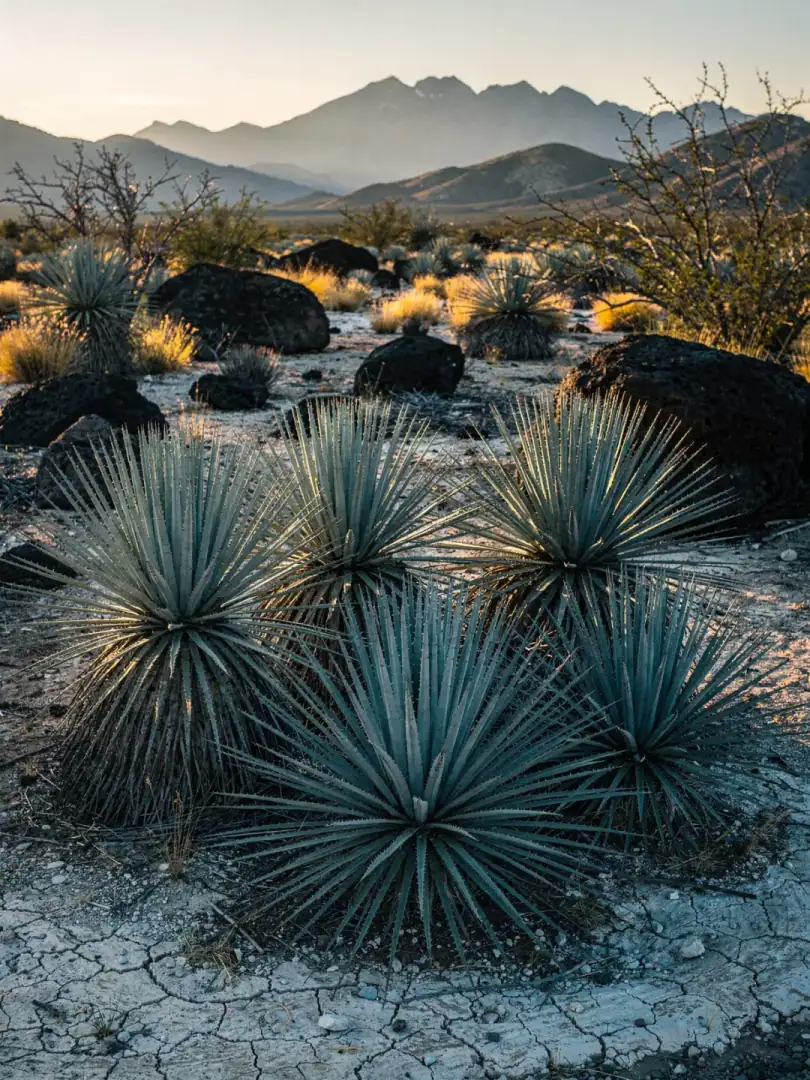
This stop is called "Agave & Soil," yet not a single agave grows in the Chihuahuan Desert: at the center stands Dasylirion, popularly known as the desert spoon or sotolín, a spiny rosette that emerges from the dry rock.
Botanically, Dasylirion is related to agave, but is not an agave: both belong to the plant family Asparagaceae, yet agave falls under the subfamily Agavoideae, while Dasylirion belongs to the subfamily Nolinoideae. Only their shared ancestry explains why the two plants look so similar in deserts and arid regions.
Even so, people classify Sotol among the agave spirits: it's harvested, cooked, fermented, and distilled much like mezcal, just from a different plant family. That's why it may be called neither tequila nor mezcal, since both names are reserved for specific agave species from their own designated regions.
Two species grow wild in the Chihuahuan Desert: Dasylirion wheeleri, with blue-gray, finely serrated leaves, and Dasylirion leiophyllum, whose leaves are smoother and narrower. Both develop a thick, bulbous trunk above the root over the years.
By common estimates, it takes a plant twelve to fifteen years to reach maturity. To this day, nearly all Sotol comes from wild harvesting rather than cultivated plantations. Collectors known as tumbadores cut out only the heart and often leave the root standing, unlike the jimador, who harvests the entire agave plant.
Beneath these plants lies harsh, rocky desert soil topped with a hard limestone crust that barely lets water through. This combination of dryness and a hard crust forces the plant to grow slowly and store sugar over many years. This station's soil cross-section shows exactly what these layers look like.
Loose, rocky sand that lets rain drain through instantly.
The root: The plant's shallow roots absorb every drop right away.