Wild Yeasts, Copper
Fermentation & Distillation
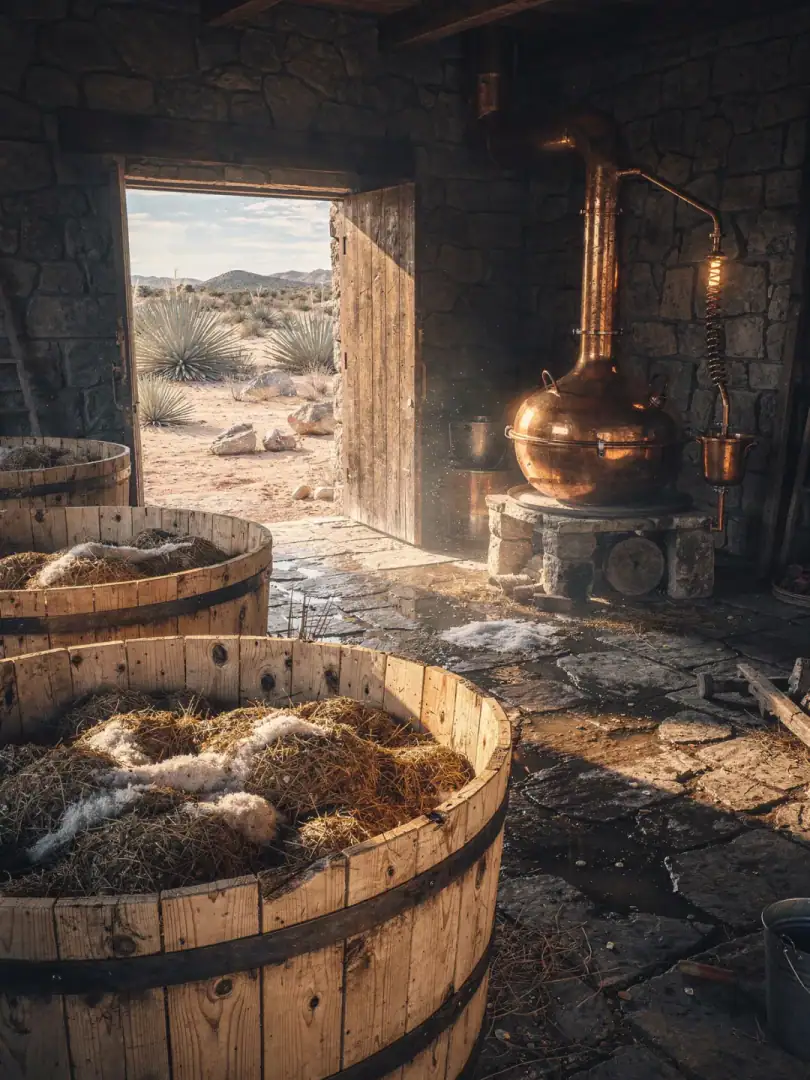
After cooking, the fibrous pulp, often along with its liquid, goes into open vats made of pine wood. Depending on the operation, these can hold up to a thousand liters. Typically nothing is added. Wild yeasts from the surrounding air take over fermentation on their own, since the Chihuahuan Desert carries its own native yeast strains.
At Sotol Por Siempre, for instance, the mash ferments in the open. This takes four to eight days, depending on the current temperature. The fibers remain in the vat throughout, giving the fermentation more contact with the plant and more depth of flavor than a filtered mash would.
Distillation follows, done twice, in copper alambiques. These are often handmade and vary slightly from operation to operation. Larger houses like Hacienda de Chihuahua sometimes use double copper columns. For certain bottlings, they even distill up to three times for extra purity.
The result is a distillate typically bottled at just under forty percent alcohol by volume, a standard figure across Mexican agave spirits generally. Copper and pine wood, rather than clay or steel, shape Sotol's distinctive mineral character.
Anyone who distills twice in a copper still here is entitled to call what they make Sotol. Despite the similar technique, they may not label it Mezcal Artesanal, since the plant and the region don't match. Tequila is even further out of reach, since that name is reserved exclusively for Blue Weber Agave from Jalisco and its neighboring states.
Cooperatives like Clande show just how different the path to the same destination can be. Each family brings its own recipe for fermentation time and distillation length, yet the result remains unmistakably Sotol.