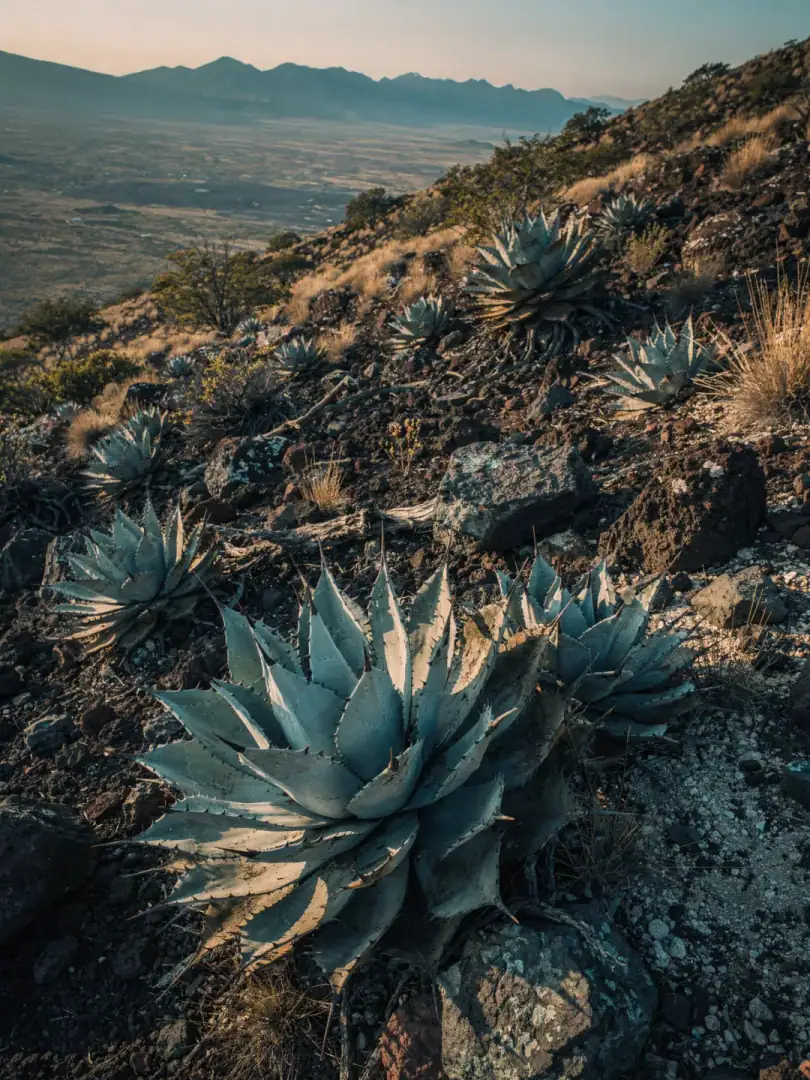
Cenizo in Lava Country
Agave & Soil
Anyone searching for agave in the hills around Nombre de Dios or Mezquital will mostly find one kind. Its botanical name is Agave durangensis, known locally as Cenizo. The name comes from its ashy grey color, which the leaves take on as they age, having started out blue-green.
The Cenizo here mostly grows wild in the highlands of the Sierra. It stands scattered among boulders, not in orderly rows like the blue Weber agave used for Tequila. It takes ten to fourteen years to ripen enough for the oven, almost double the time of most cultivated agaves.
At harvest, the jimador strips the spiny leaves from the Cenizo, using the coa, a broad, sharp spade on a long handle. What remains is only the heart of the plant, the piña. A single liter of Mezcal requires around fifteen to eighteen kilograms of it, a clear sign of how much hand labor goes into every bottle.
The roots of the Cenizo cling to volcanic rubble, widespread across Durango's high plateaus. A few kilometers away, often on the very same slope, an entirely different plant grows, giving rise to an entirely different drink: Dasylirion, the base for Sotol. It is not an agave and is protected under its own separate rules.
Alongside the Cenizo, the O'dam, the Tepehuán people of the south in Mezquital, gather other wild agave species for their Mezcal. Their ethnobotanical knowledge lists nine different agave species in this one region alone. For our journey of discovery, the Cenizo matters most. It defines Durango's Mezcal labels like no other plant.
Splinters of weathered volcanic rock, with a thin layer of sand in between
The root: The Cenizo's shallow roots wedge between the stones, anchoring the plant even on steep slopes.