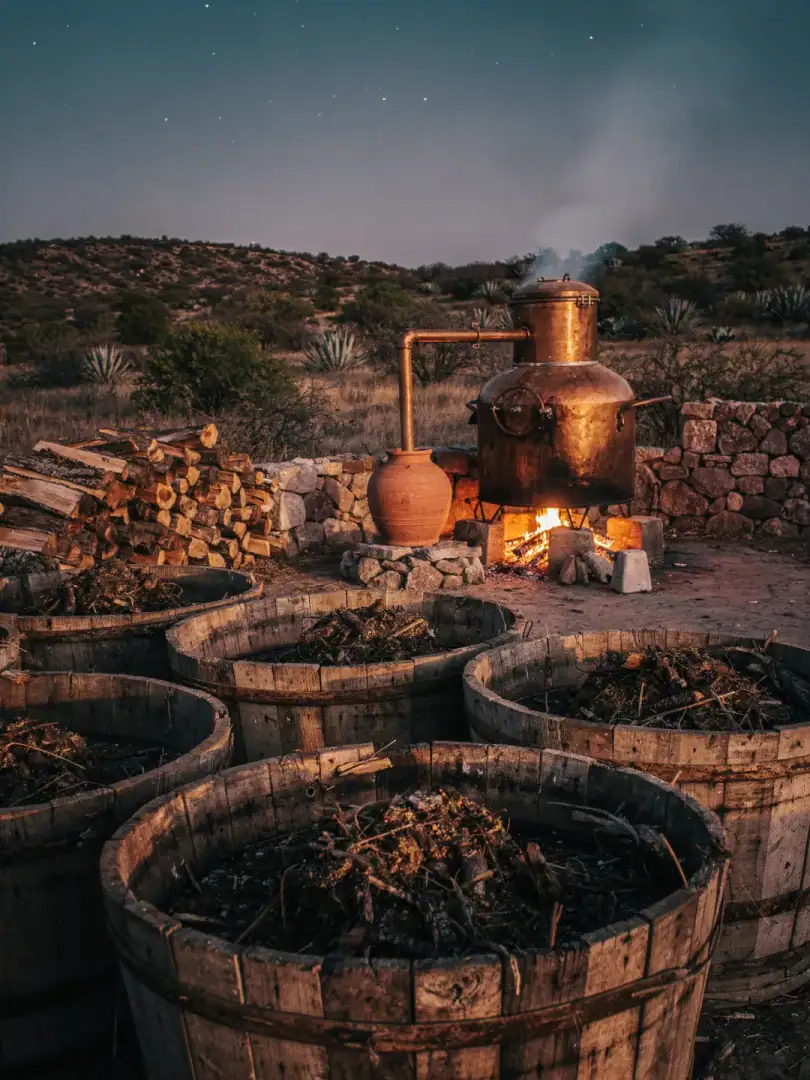
Vats and Stills
Fermentation & Distillation
The pressed agave juice from Pénjamo usually ferments in large steel tanks. Cultured yeasts are often added deliberately, so every batch of Tequila tastes consistent. Distillation follows in two passes. Destrozamiento is the first, rough run. Rectificación is the second, which brings finesse and purity.
Distillation happens in copper pot stills or stainless-steel columns, both permitted in Pénjamo. Bottled Tequila from the region usually sits between 38 and 40% ABV, standard for the category.
In San Felipe and San Luis de la Paz, by contrast, the crushed Salmiana often ferments together with its own fibers. This happens in open wooden vats or hollowed-out stone troughs, with no added yeast at all. Wild yeasts from the air and the wood do the work instead, taking more time but giving the result more character of its own.
Distillation here also happens twice, but in copper or clay pot stills over an open wood fire, never in a column still. The brief time in the earthen pit's fire is enough to lend the finished Mezcal a delicate smokiness, without masking the fruity side of the Salmiana.
Both methods lead to a clear difference in the glass. Tequila from Pénjamo comes across smooth and consistent. Mezcal from the north shows small variations from batch to batch, variations connoisseurs prize precisely for that reason.
If a distiller in San Felipe were to use an industrial column still instead of a traditional copper pot, the result could still be called Mezcal. But it would no longer qualify as Mezcal Artesanal under the NOM-070 standard. The name on the label depends not only on where the agave comes from, but also on the still in which it ultimately vaporizes.