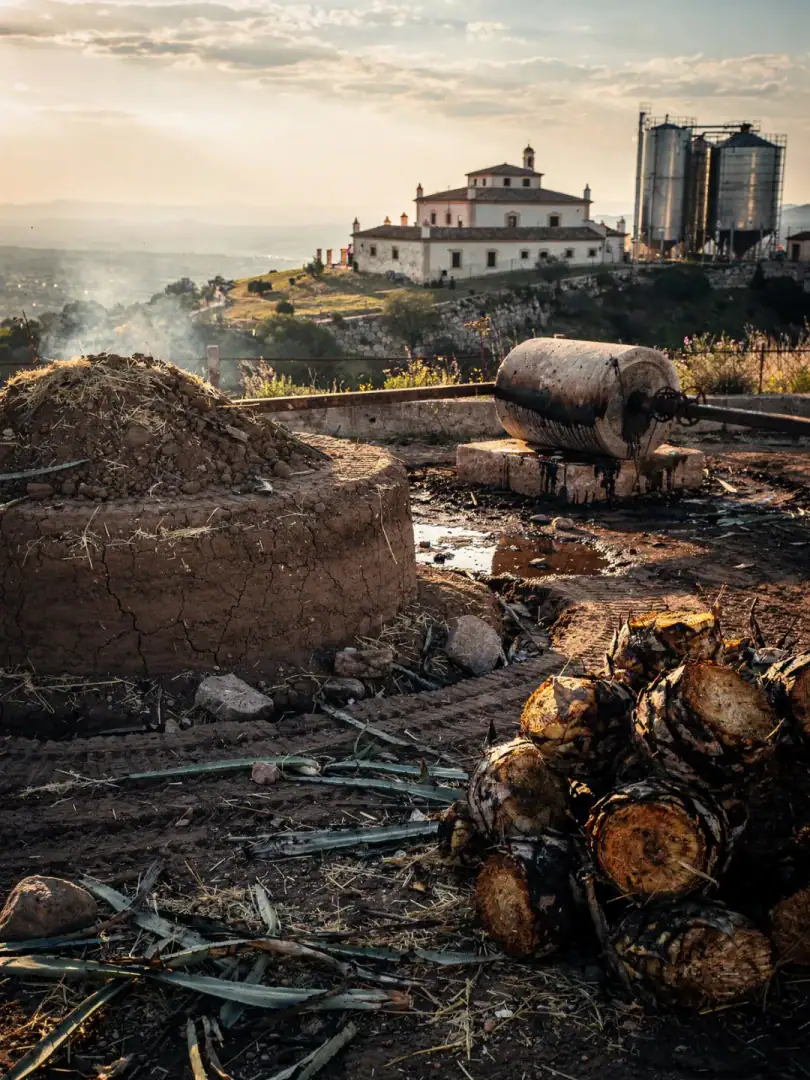
Autoclave and Earthen Pit
Cooking & Milling
In the large Tequila operations around Pénjamo, steel autoclaves now typically cook the sliced piñas, often in just a few hours. A traditional stone oven, by contrast, needs one to three days. Some houses in the region still hold onto the horno de mampostería, believing that slow steam-cooking brings more caramelized roasted notes into the agave.
After cooking, a mechanical mill crushes the softened piñas in the larger operations, pressing out the sugary juice, the aguamiel, for fermentation. Anyone who cooks in an autoclave and mills mechanically may call the result Tequila. They may never call it Mezcal Artesanal.
In San Felipe and San Luis de la Paz, mezcaleros still cook their Salmiana hearts in the earthen pit, the horno de pozo. This is a stone-lined hole in the ground where firewood and hot stones roast the piñas over several days, picking up a hint of smoke along the way.
Milling is done by hand or with animal power. The tahona is a stone wheel pulled by mule or horse. It crushes the cooked hearts, as does the simple wooden mallet, the mazo. It's precisely this method, earthen pit plus tahona or mazo, that permits the label to carry the word Artesanal.
So two communities within the same state cook and mill in almost opposite ways. Autoclave and steel mill stand for speed and consistency in Pénjamo. Earthen pit and tahona stand for smoke and handwork in San Felipe. There, an entire category explicitly forbids industrial methods.
Diffusers extract sugars chemically rather than through steam heat. They're permitted for Tequila and also for industrial Mezcal. For the Artesanal or Ancestral categories, though, they're strictly off-limits, as practiced in San Felipe and San Luis de la Paz. The difference between the two origin regions, then, begins right at the oven.