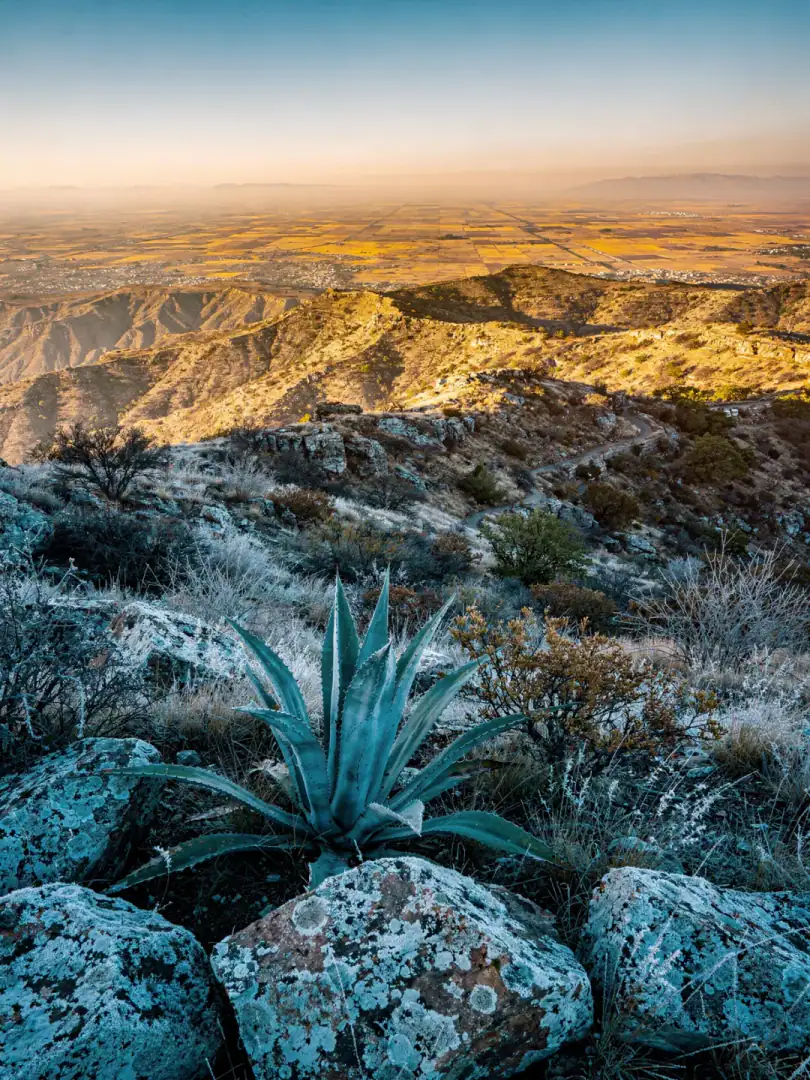
Bajío and High Desert
Altitude & Climate
Pénjamo sits in the Bajío at roughly 1,700 to 1,800 meters above sea level. It's a wide, warm plain, one the Spanish once prized as the granary of New Spain for its fertility. Most rain falls between June and September, followed by months with almost none.
San Felipe and San Luis de la Paz lie further north and considerably higher. They sit on a dry plateau at the edge of the Sierra Gorda. Rain there is rarer and lighter than in the Bajío. Nights cool sharply, and light frosts are not uncommon in winter.
For Blue Weber in the warm Bajío, this means abundant water and sun in a short span of time. It fills with sugar comparatively fast. After six to eight years, the resulting piña tastes soft and mildly sweet once cooked.
Salmiana in the cold, dry north has it harder and therefore needs far more time, since cold and scarce water slow its growth. Over the years, though, it concentrates sugars into a smaller, denser heart. That's what later gives the Mezcal its earthy intensity.
In spring, just before the rains, temperatures in both regions often climb past thirty degrees Celsius. In the dry nights of the north, they then drop sharply again. Mezcaleros consider this daily swing between heat and cool one of the reasons wild agaves in the north ripen with such aroma.
The Bajío, by contrast, sees hardly any of this temperature swing. Its mild nights give Blue Weber less time to build up aromatic compounds. In exchange, it grows more reliably and quickly. That's one reason Pénjamo suits Tequila, while the same plant would barely survive in the dry north.