Wild Yeast, Copper
Fermentation & Distillation
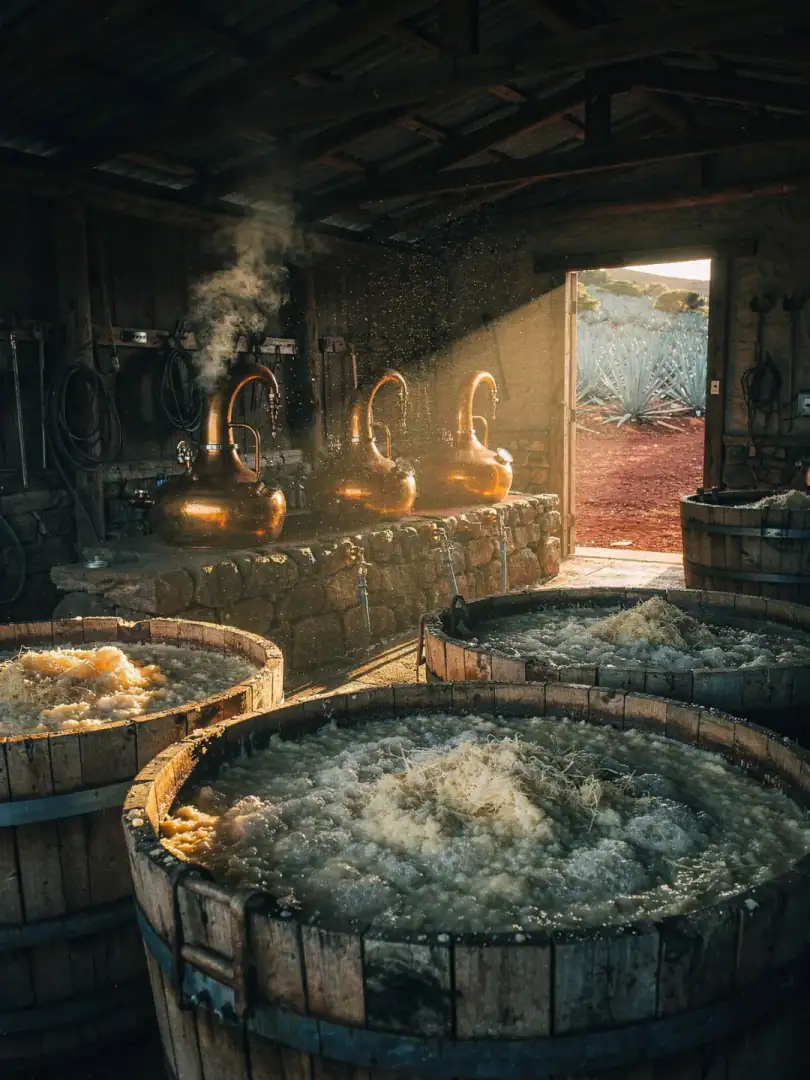
The smaller of the two Siete Leguas facilities is called El Centenario. There, the mash still ferments today in open wooden vats, with the agave fibres left in rather than filtered out. Many larger operations abandoned this method long ago, since it takes longer and is harder to control—precisely what sets it apart from many neighbouring producers.
Distillation happens twice, in small copper pot stills, as tequila law requires for every tequila. After the first run, the destrozamiento, the liquid is still cloudy and weak. Only the second run, the rectificación, separates heads, hearts and tails, turning it into a drinkable tequila.
Other producers in the region rely instead on added cultured yeasts, which work more consistently and quickly than wild airborne yeasts. That matters when, as at Patrón, large volumes need to move through the facility every day. The G4 brand from Arandas, by contrast, markets itself explicitly on the opposite approach, working entirely without additives such as caramel or glycerine—substances the law would otherwise permit after distillation.
Wooden vat or steel tank, copper pot still or modern column: none of it changes the territory or the agave. Anyone distilling here can call the result Tequila, whatever the equipment—but only because it happens in Jalisco, using blue agave. A few hundred kilometres south, in the mezcal territory of Oaxaca, that same copper still would be in the wrong place for that name.