Salt, Mixteca, Protection
Region & History
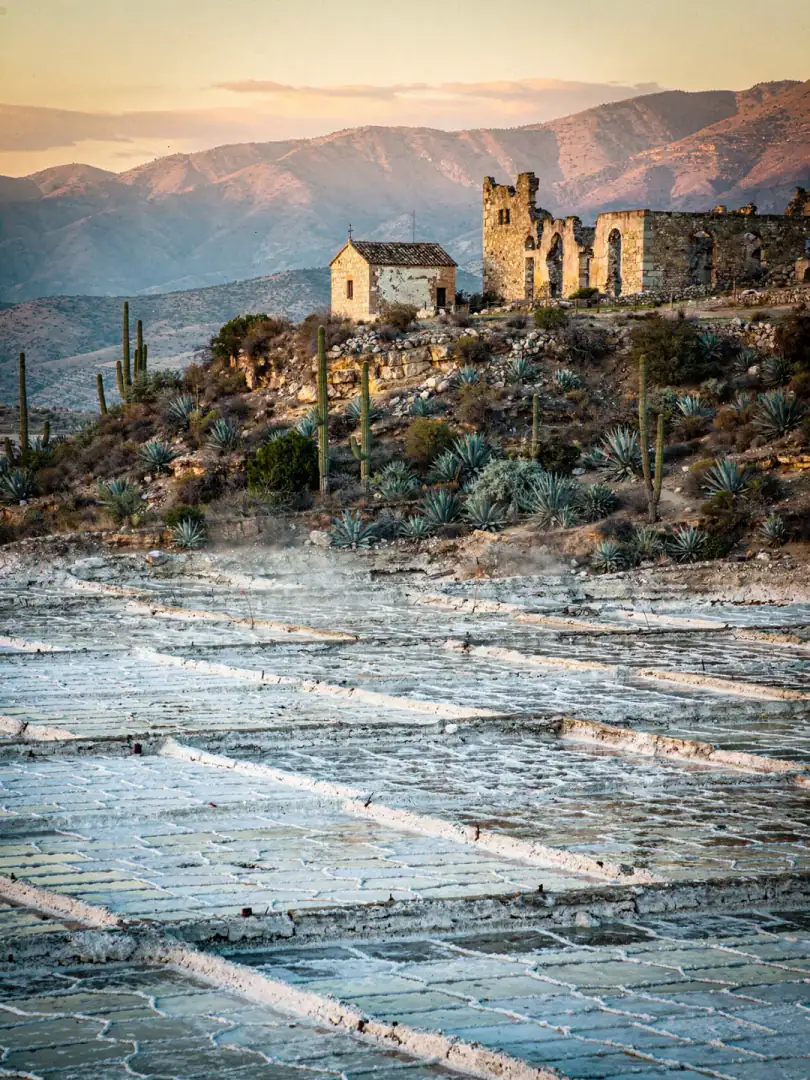
Between Tehuacán and Caltepec lies a valley that tastes of salt before it smells of agave. In Zapotitlán Salinas, water from underground springs has evaporated into white salt basins since pre-Hispanic times. All around, candelabra cacti and wild agaves grow out of the dry rock. Here, in the Mixteca Poblana and the Tehuacán-Cuicatlán Biosphere Reserve, Mezcal has been distilled for generations.
Older than any spirit is Pulque. This is a milky, sour, mildly intoxicating drink made from the fermented sap of the agave, already known to the Nahua before the Spanish arrived. Pulque isn't distilled, only fermented — the same plant, a completely different drink. In many villages of the Mixteca, people still drink it alongside Mezcal today, as two separate traditions from the same agave.
With the Spanish came the pot still. With it came taxes and bans that pushed the craft into small, often hidden workshops for centuries. From these beginnings grew the palenques of the Mixteca and the Sierra Negra, often in Mixtec communities. There, family businesses passed down their knowledge over generations, long before anyone spoke of protected designations of origin.
The name has only been officially protected since December 24, 2015. On that day, the Denominación de Origen Mezcal, regulated under standard NOM-070-SCFI-2016, took in the state of Puebla with 116 municipalities. These are spread across five regions, including the Mixteca Poblana and the zone around the Tehuacán-Cuicatlán Biosphere Reserve. Puebla is thus today Mexico's second-largest Mezcal producer after Oaxaca. Between 5,000 and 8,000 families depend directly on the agave for their livelihood.
The protection here means one thing above all: what comes from Zapotitlán Salinas or Caltepec may be called Mezcal, but never Tequila. That's simply because Puebla lies outside Tequila's territory, which covers Jalisco, Guanajuato, Michoacán, Nayarit, and Tamaulipas. And unlike Tequila, Mezcal knows no Mixto: every drop must come one hundred percent from agave sugar.