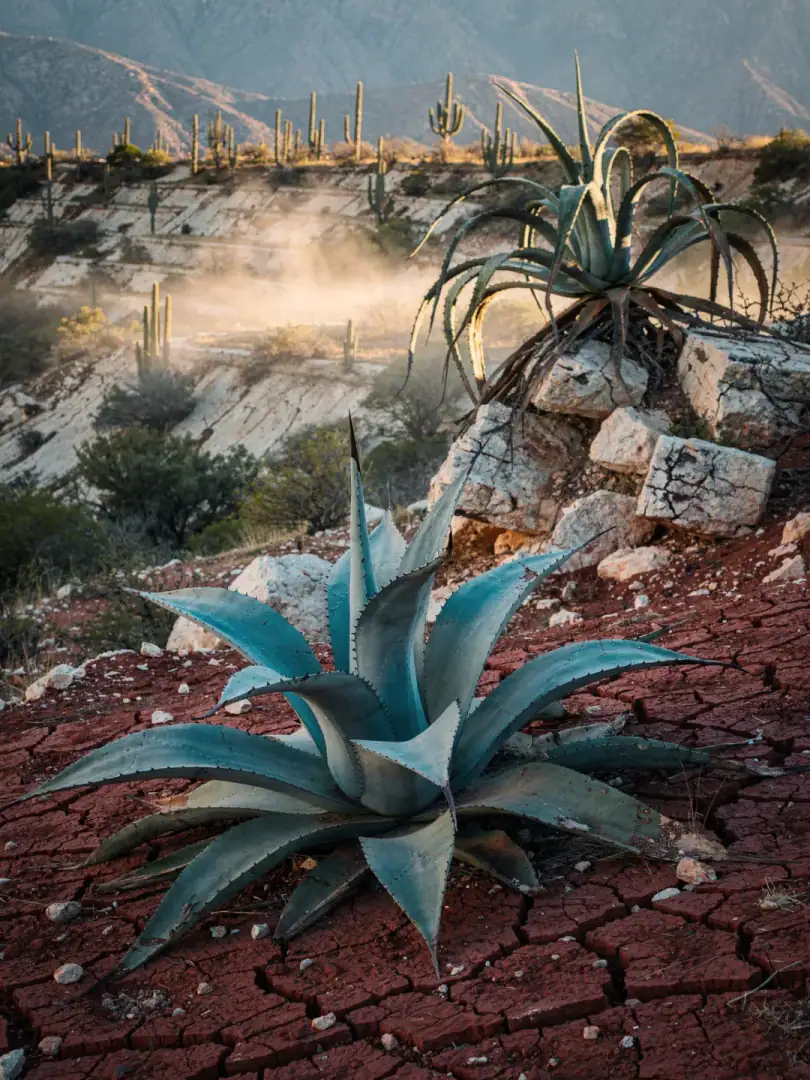
Papalometl and Pitzometl
Agave & Soil
It's not one single agave that carries Mezcal here, but at least three, and each brings its own character. The best known is Papalometl, botanically Agave potatorum. Its Nahuatl name means "butterfly agave" — the leaf shape really does resemble wings.
Papalometl grows wild and slowly in the hills of the Mixteca. Its range barely extends beyond Oaxaca and southern Puebla. Just as wild, but even more patient, is Pitzometl, botanically Agave marmorata, also called Tepeztate elsewhere. Its name comes from the Latin word for marble, because the plant prefers to root between stones and rock crevices. It can take decades for a wild Pitzometl to become ripe enough to harvest.
Alongside these, many families also grow Agave angustifolia, popularly known as Espadín. It grows faster and is therefore more reliable than the wild varieties. Under cultivation, it's usually ready to harvest after six to eight years. Papalometl needs more like twelve to fifteen years, and Pitzometl considerably longer still.
The harvest itself lies in the hands of the jimador. Using the coa, a flat, sharp blade on a long handle, he cuts away leaf after leaf. What remains is the piña: the heavy, pineapple-shaped heart of the agave, where all its sugar collects.
The soil beneath is no ordinary one: the valley of Zapotitlán Salinas sits on the bed of a primeval sea. Gypsum, limestone, and thin red earth alternate. It's precisely this scarcity that forces the wild agaves to grow slowly, concentrating sugar and aroma as they do.
Thin, reddish earth directly above the rock, low in nutrients but well-drained.
The root: The agave anchors itself shallowly, since there's barely any soil deeper down.