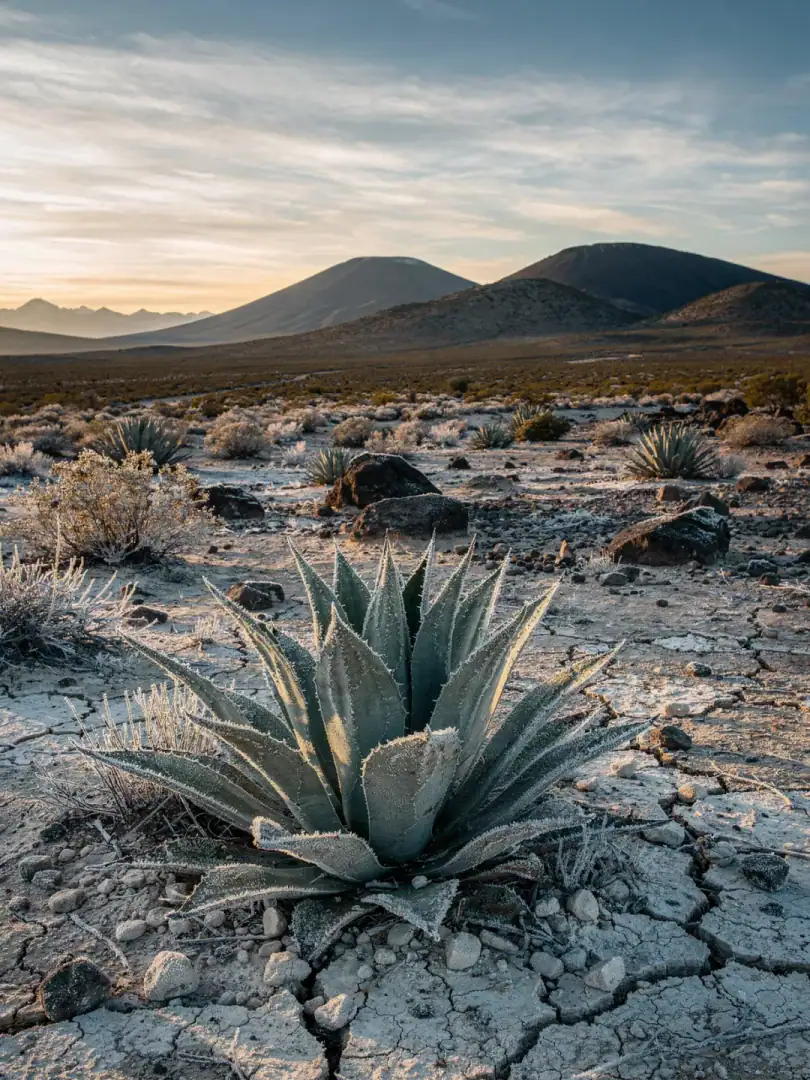
A Dry Highland Plateau
Altitude & Climate
Maguey Salmiana grows here on the Altiplano Potosino, one of the driest highland plateaus in Mexico, at roughly two thousand meters above sea level. The air is thin, the sun burns fiercely by day, and temperatures drop quickly again at night.
Rain falls mainly in summer, brief and often intense, in showers that pass just as quickly as they arrive. Long, dusty-dry months without any meaningful rainfall follow. For a plant that stores water like a sponge, this is exactly the foundation of its survival: brief abundance, long deprivation.
In winter, nighttime temperatures on the plateau often drop below freezing, and frost is no rarity in Charcas. In summer, by contrast, daytime temperatures often climb well above thirty degrees Celsius, while the air stays dry. Between these extremes, the maguey grows noticeably more slowly than in milder, more humid regions farther south.
This slow growth concentrates sugars in the leaves instead of burning them off in rapid green growth. At the same time, the plant develops more essential oils and resinous aromatic compounds, its response to cold, heat, and drought all at once.
These very extremes explain why mezcal from the Altiplano often tastes bolder and earthier than mezcal from warmer, more humid valleys farther south. What makes survival hard for the plant later gives the spirit its character.
Frost is no minor concern for farmers here: if it strikes a young agave, growth can be set back by years, and sometimes the plant dies outright. Only fully mature specimens survive several such winters unscathed. Anyone growing or harvesting agave here doesn't count in weeks, but in decades of sun, drought, and occasional frost.