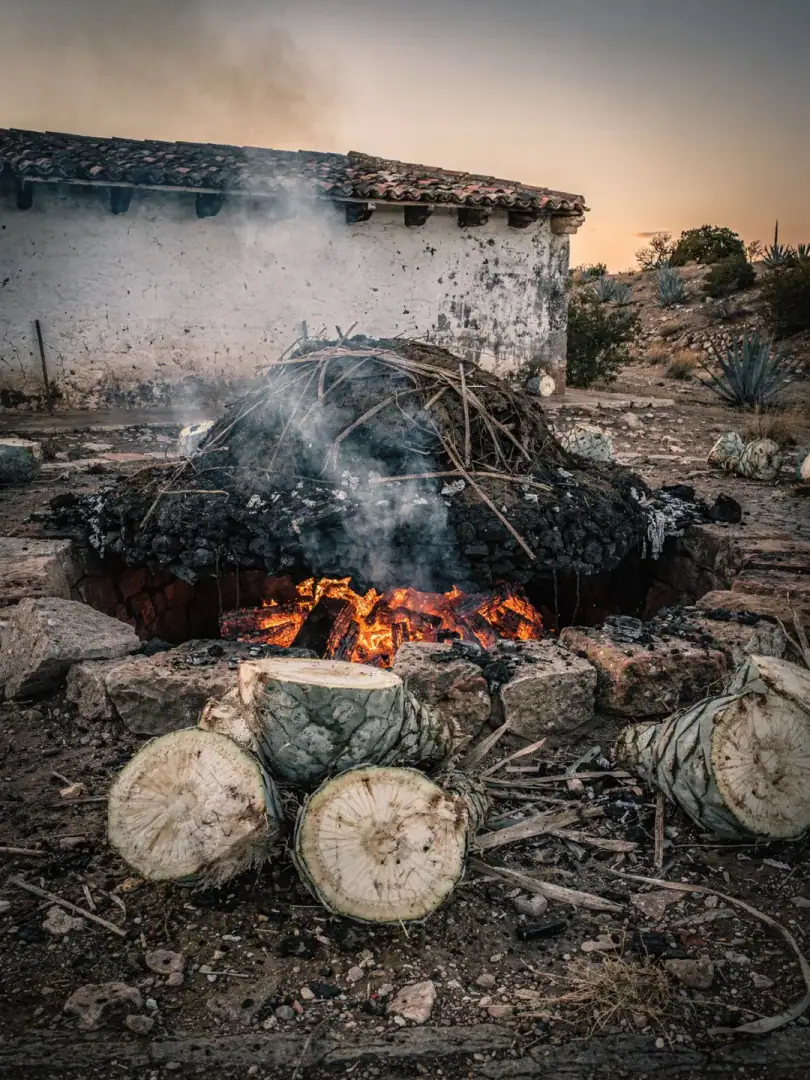
Earthen Pit and Tahona
Cooking & Milling
On the haciendas of the Altiplano Potosino, work is still carried out according to old methods. They date back to the 18th and 19th centuries, semi-industrial, yet without modern chemistry. No additive lends a hand; the process remains deliberately simple.
Anyone wanting to produce Mezcal Artesanal, as is customary here, cooks the piñas in an earthen pit or a masonry oven. Autoclaves and diffusers remain reserved for the industrial category. In the Altiplano they are barely used. The heat converts the agave's complex sugars into simple, fermentable sugars. This is what creates the smoky-sweet base note found later in the bottle.
After roasting, the soft, caramel-scented piña is crushed. Permitted methods include the Tahona, a millstone pulled by animals, the hand mallet known as the Mazo, or a mechanical crusher. All three methods are also provided for under the standard for Mezcal Artesanal.
On the old haciendas in Charcas, animals once did the work at the Tahona. Today, machines assist in some places too. This changes little about the basic principle: the fibers are broken open, the juice released, but not fully pressed out.
The result is a fibrous, sweet mash. It moves, along with its fibers, into the fermentation vats. It is right here, at the threshold between cooking and fermentation, that much of the mezcal's later character is already decided.
This sequence is crucial: earthen pit or masonry oven, then crushing by Tahona or Mazo. This is precisely what marks a spirit here as Mezcal Artesanal, rather than as Tequila or as an industrial mezcal from an autoclave.