Wild Diversity
Agave & Soil
In the forests around Sola de Vega and Candelaria Yegolé, no agave grows that bears the region's own name. Instead, several species thrive here in a density rarely found elsewhere. Botanically, the most common agave is karwinskii. Villagers call the same plant by different names depending on its growth form and cultivation: Cuishe, Barril, Madrecuixe, Tobaziche.
Cuishe has a short stalk and narrow leaves. It takes 12 to 18 years to reach harvest and tastes dry, almost peppery. Barril is named for its barrel-shaped piña, the heart of the plant. It matures faster, in 10 to 14 years, yielding a sweeter, honey-like spirit. Madrecuixe can grow to over 90 kilograms if given up to 20 years. A few villages over, the very same plant might be called Barril instead. The boundaries between varieties are fluid, a matter of family tradition rather than botanical rule.
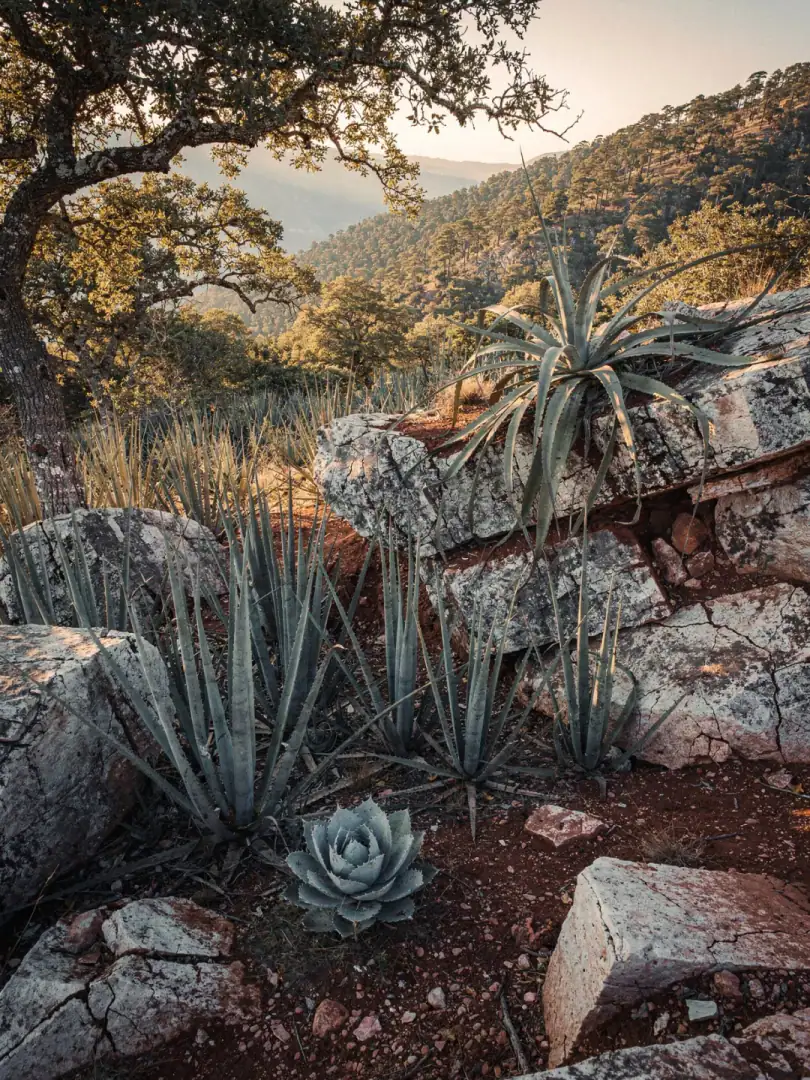
Alongside these grows the wild, painstakingly foraged Tobalá, botanically Agave potatorum. It doesn't need open farmland but rather the shade of oaks and rocky ravines, found between 1,760 and 2,300 meters in elevation. It takes 10 to 15 years to flower. Because it can barely be cultivated, jimadores, the harvesters, gather it plant by plant across the mountains.
Even more patient is the Tepeztate, botanically Agave marmorata, with its unwieldy, sprawling leaves clinging to steep rock faces. Some palenqueros in the Sierra Sur let it grow for 25 to 30 years before harvesting, longer than any other agave used for Mezcal here. Yet the harvesting tool remains the same everywhere: the coa, a spade with a round, sharp blade. With it, the jimador cuts away the leaves and pries the piña from the rocky ground.
A thin, humus-poor layer of weathered limestone and rubble.
The root: Lets rainwater drain away quickly, keeping the agave compact and slow-growing.