Copper & Clay
Fermenting & Distilling
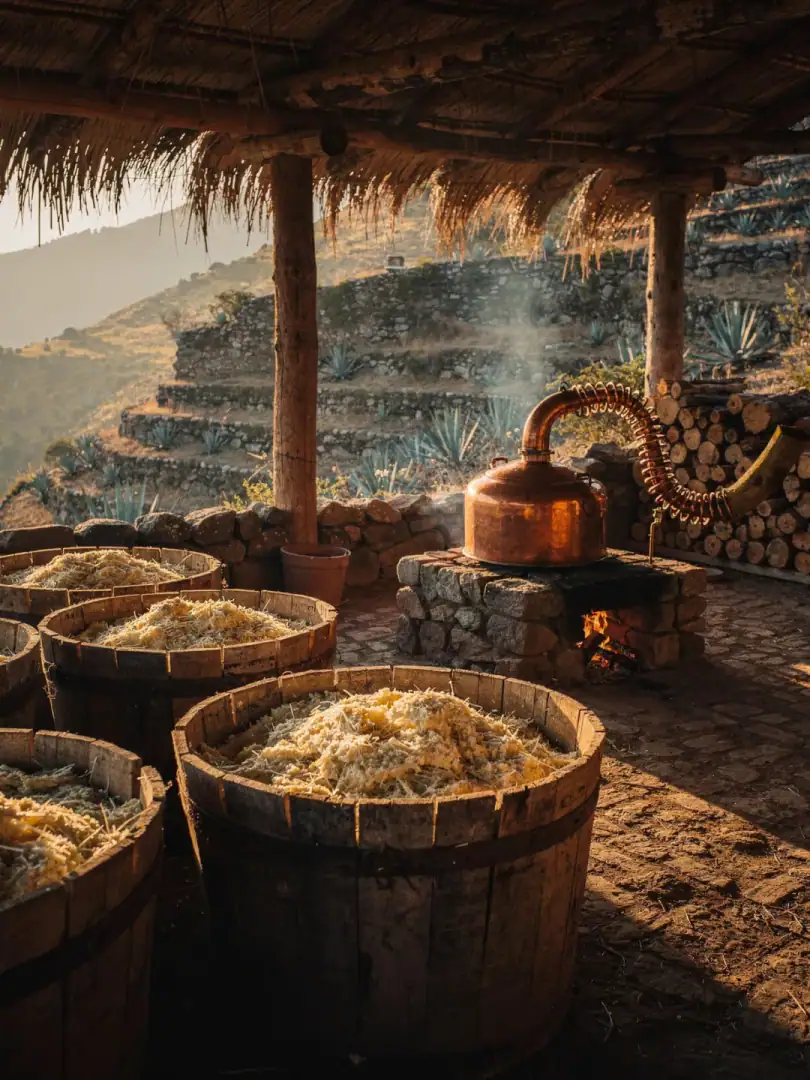
The milled mash of fibers and juice moves into vats made of pine wood, sometimes stone, where it begins fermenting on its own. No one in the palenques of the Sierra Sur adds cultivated yeasts. Wild yeasts from the air, the wood, and the agave fibers themselves do the work. Depending on the weather, this process takes five to eight days.
Distillation usually happens twice, in small copper stills with a capacity of 200 to 250 liters. This is how Aquilino García López works in Candelaria Yegolé: wood fire below, copper cooling coil on top. He deliberately distills his mash before fermentation is fully complete, allowing more residual sugar into the first run and giving the Mezcal a rounder character.
Around Sola de Vega, by contrast, the memory of clay pot stills has endured. These fired-clay stills were already in use for fermented agave before Spanish colonial times. Romulo Sánchez Parada of Rey Campero, also from Candelaria Yegolé, rebuilt one such clay still for a special release. In everyday production, though, he works with copper. This shows how closely both techniques sit side by side in this area. Both methods demand years of experience with fire and time.
At the end of the second distillation run, the mezcalero separates the heads, hearts, and tails of the run by hand, judging solely by smell and taste, without any measuring device. What remains is a spirit typically at 45 to 50% ABV, noticeably stronger than most Tequilas.