Oven & Tahona
Cooking & Milling
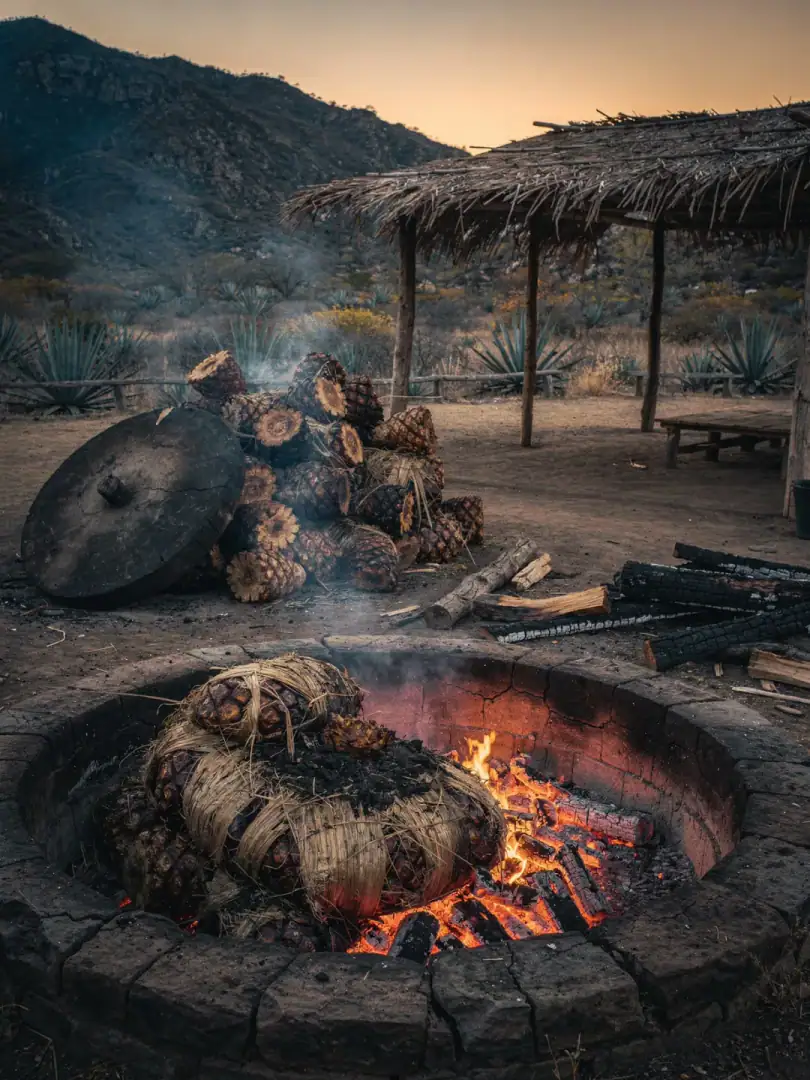
Before a piña becomes Mezcal, it must first turn sweet. In the Sierra Sur, this happens almost everywhere the same old way. The pit is called a horno, or conos. Palenqueros dig a round pit and layer in glowing stones. They lay the halved piñas on top and cover everything with agave fibers, earth, and leaves. This technique has been passed down through generations.
The hearts roast for three to five days in their own steam and smoke, fueled by firewood gathered locally. Direct fire and a simple earthen or masonry pit oven, rather than an autoclave or diffuser, are exactly what's required for the "Artesanal" classification. This construction method is simple, but effective.
After roasting comes milling, and here too the Sierra Sur holds fast to handwork. Many palenques crush the roasted piñas with a tahona, a heavy stone wheel. A horse or mule drags it in circles around a paved pit. Others reach for the mazo, a simple wooden mallet, to beat the fibers apart by hand. It's slower, but gentler for the small quantities of rare wild agaves like Tobalá or Tepeztate. Both methods have belonged to the daily life of the palenques for generations.
Which agave gets milled which way often simply depends on the day's volume. A tahona isn't worth firing up for a few dozen kilos of Tobalá, but it is for several tons of Espadín. So the size of the harvest in the Sierra Sur shapes the method just as much as tradition does. Both paths lead to the same end: milled agave for the fermentation vats.