Blanco to Añejo
Aging
With Bacanora too, the standard distinguishes four aging stages, quite similar to Tequila, just under different names. Blanco comes straight from the condenser, crystal clear and unaged. It may also rest briefly in a neutral glass or steel container.
Oro or Joven refers to a Blanco with a bit of added color and aroma. This usually happens through brief barrel aging or a splash of already-aged Bacanora.
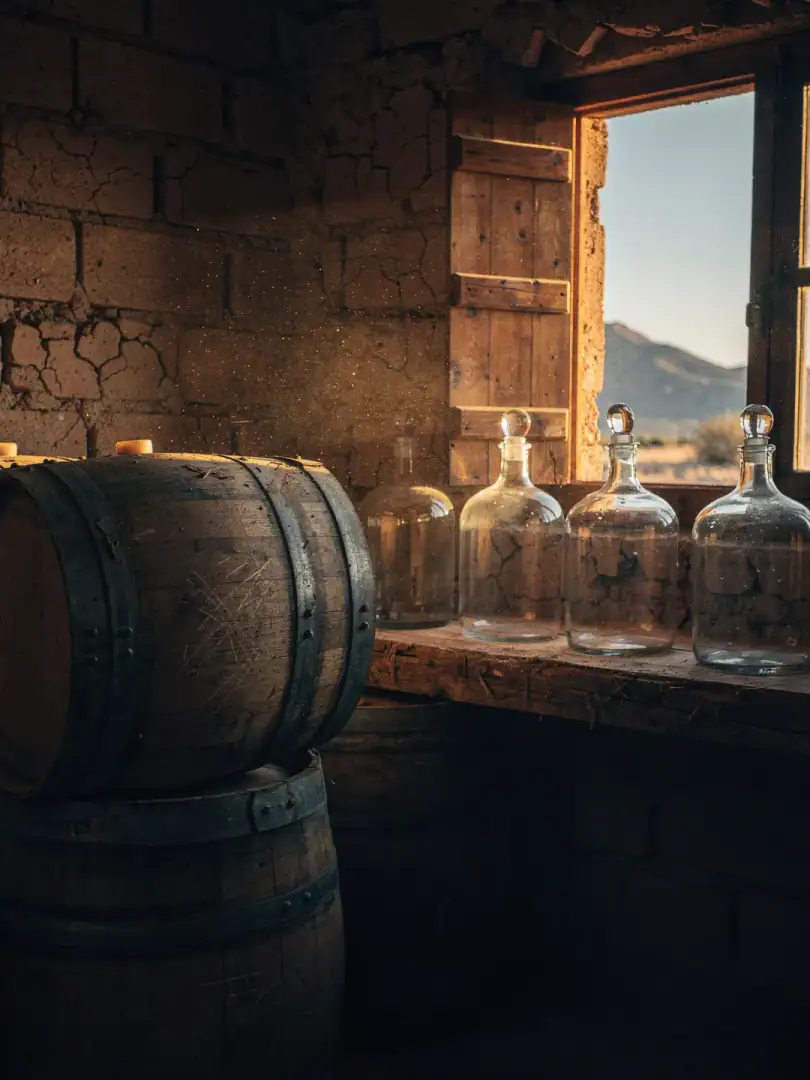
Reposado requires at least two months of uninterrupted contact with oak. Añejo requires at least a full year. The barrels may hold at most 200 liters, notably smaller than the 600-liter barrels used for Tequila. The smaller the barrel, the more wood surface touches the Bacanora, and the faster it takes on color and vanilla notes.
In the Sierra, much stays at the Blanco stage. In the view of many distillers, a clear, smoky, earthy Bacanora doesn't need barrel aging to show its character. Reposado and Añejo do exist nonetheless, often from the somewhat larger Vinatas that also sell outside Sonora.
The label must state which class is in the bottle, along with the designation Denominación de Origen Bacanora. Only this makes clear that both the agave and the process genuinely come from Sonora, and not from a Mezcal region.
The names Blanco, Reposado, and Añejo are familiar from Tequila. With Mezcal, comparable stages are often called Joven, Reposado, and Añejo, with their own rules on glass aging. Bacanora uses Tequila-like terms but remains its own distinct spirit with its own origin.