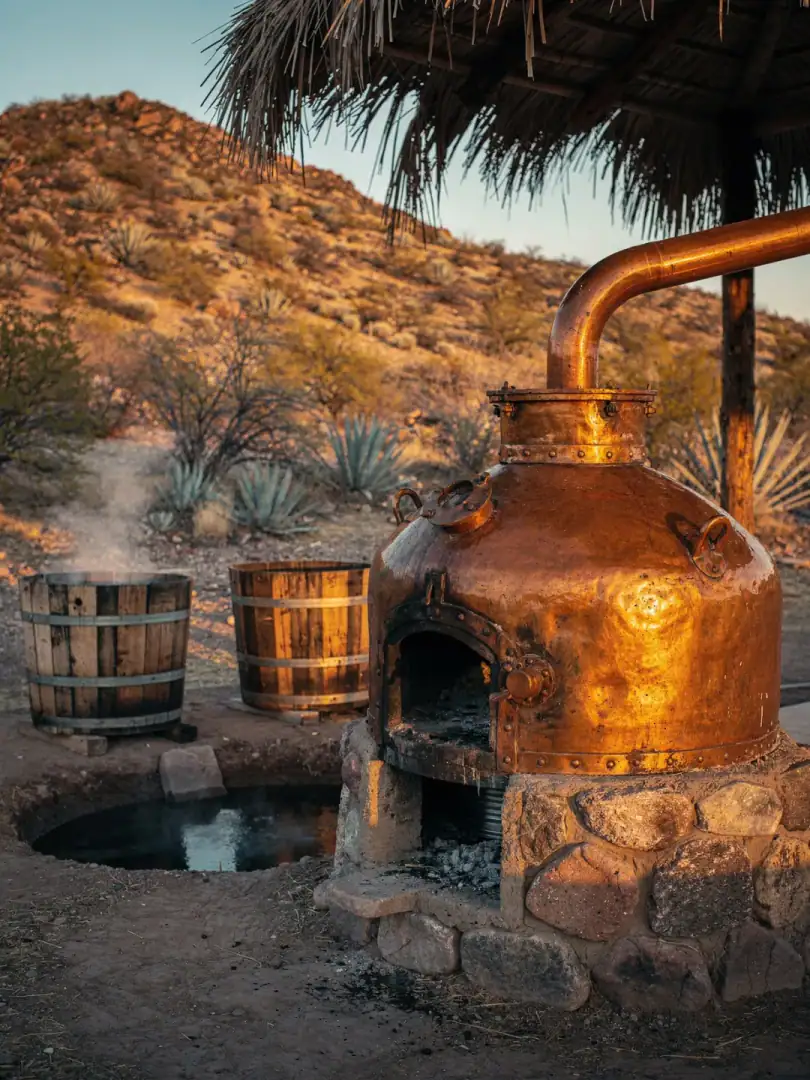
Tren and Resaque
Fermenting & Distilling
The juice from the mill often travels in Sonora straight into a second earthen pit or into wooden vats. There, wild yeasts from the air and from the agave itself take over fermentation. Added cultured yeasts are rare. Most Vinatas trust what grows naturally in the mash. Some leave the pressed agave fibers in the pit, others sieve them out beforehand. This influences how intensely the mash smells and tastes.
Depending on the weather, fermentation takes six to twelve days, going faster in the hot summer. In the cooler winter, the mash needs more patience before it smells properly of ripe fruit and little sweetness.
Distillation happens in the tren, a copper kettle whose outer wall is enclosed in stone and clay like a small oven. Here too, mesquite wood heats from below. The vapor rises through a copper pipe, the gargantón, to the condenser.
A single pass isn't enough, so after the first, rough distillation comes the resaque, the second round. In it, only the already-gathered alcohol is vaporized again and collected. Only this re-distillation turns the raw distillate into clear, robust Bacanora.
By the end of the second distillation, the alcohol content usually sits well above drinking strength. It is diluted only shortly before bottling. Here, distillation happens twice in a copper kettle, not in a column, using agave from Sonora and nowhere else. That's why the result may be called Bacanora, not Mezcal, not Tequila.