Just One Agave
Agave & Soil
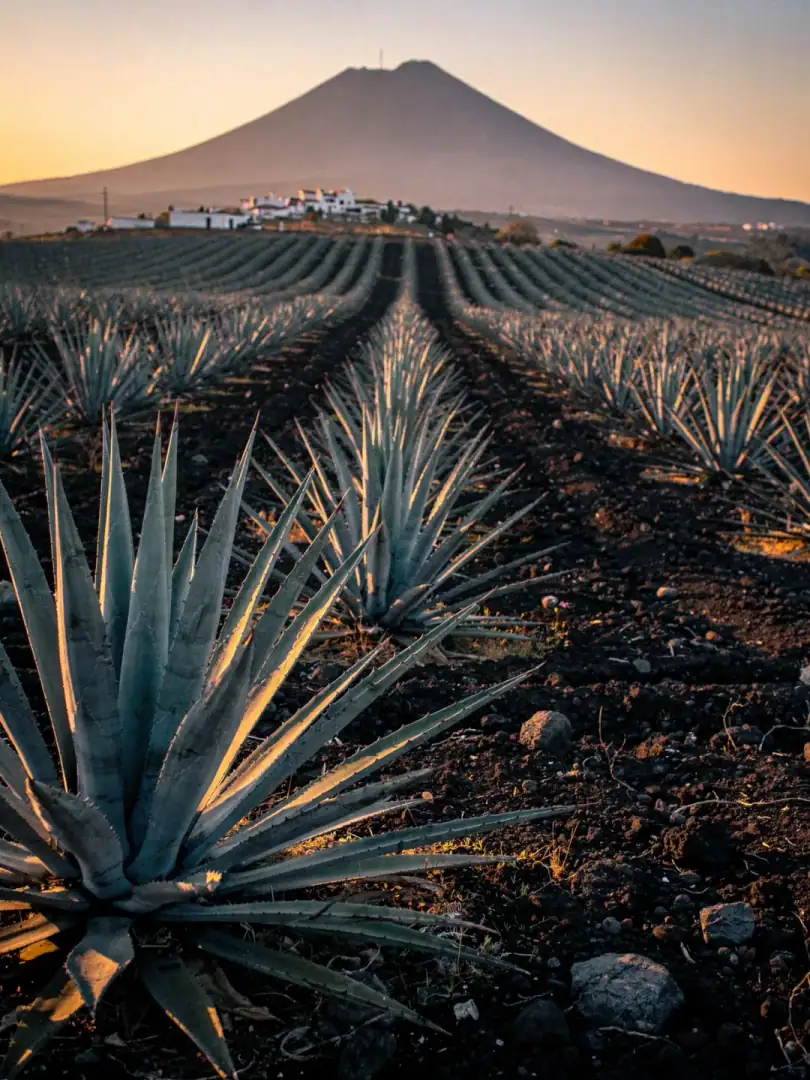
In the Valle de Tequila, only a single type of agave grows: Agave tequilana Weber, variety Azul, commonly known as Blue Agave. Mezcal, depending on the region, permits a dozen different species. For Tequila, the law leaves no choice: only this one plant may give up its sugar. It barely grows wild here anymore—nearly every plant between Amatitán and El Arenal is cultivated. It belongs either to a distillery or to a contracted farmer.
In the valley, a plant typically takes six to eight years to mature. That's faster than in the cooler highlands further east, since the heat here accelerates growth. You can tell when it's ripe by its shape: the pointed leaves, called pencas here, curve downward, revealing the heart of the plant.
At harvest time, the jimador arrives with the coa, a round, sharply honed blade mounted on a long pole. With a few precise strokes, he separates the leaves from the stalk. What remains is the piña, the cone-shaped heart of the agave. In the valley, it often weighs forty to eighty kilograms. This work has barely changed since Cenobio Sauza's time—only the trucks hauling it to the distillery are new.
Beneath the roots lies the ground that gives the valley its character. It's volcanic earth, dark and mineral-rich, deposited by an eruption of the Tequila volcano roughly 200,000 years ago. It differs markedly from the red clay soil of the highlands. This gives the local agave an earthier, spicier character, long before it ever reaches the still.
A loose, humus-rich layer of ash from more recent eruptions, dark and crumbly.
The root: Rain filters through quickly, giving the agave moisture without letting the roots rot.