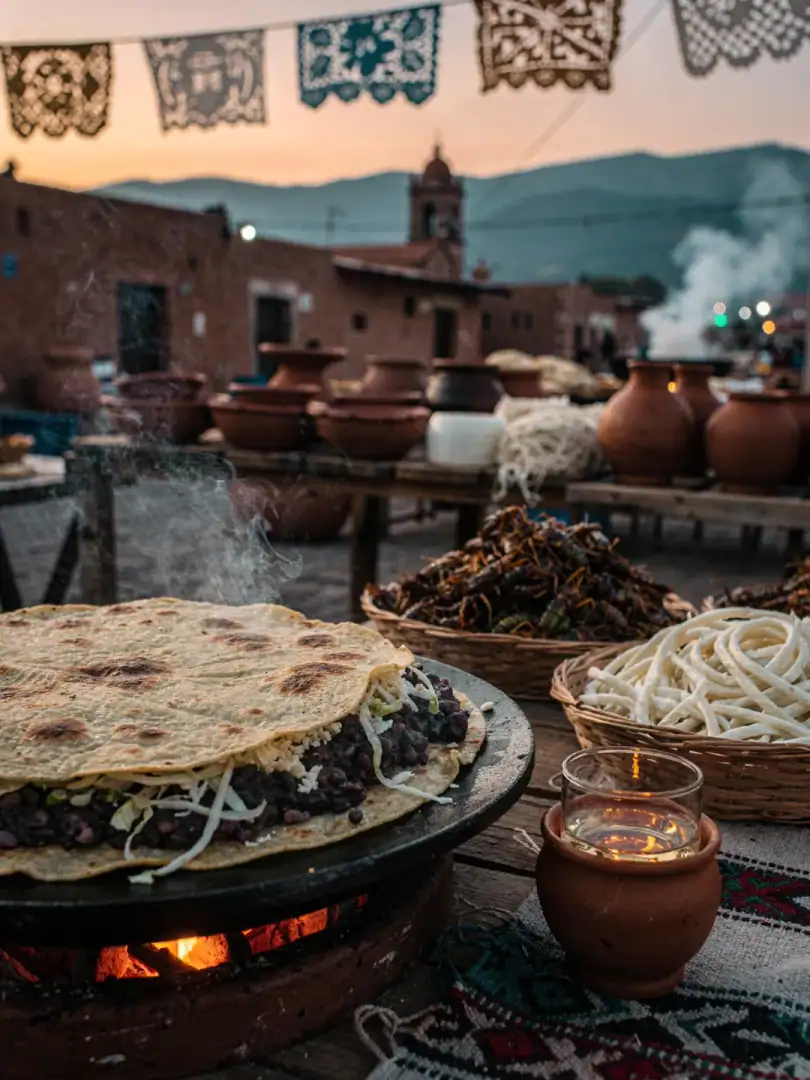
Tlayuda & Fiesta
Food & Drink
On Sundays, Tlacolula de Matamoros transforms into one of the oldest markets in Mesoamerica. The Tianguis spreads out around the Mercado Martín González. Vendors sell Tlayudas straight off the clay comal. Alongside, you'll find Chocolate de Agua and Pan de Yema, a yeasted bread rich with egg yolk.
The Tlayuda itself is a large, crispy tortilla topped with bean paste, cabbage, Quesillo, and often a bit of grilled meat. It's regarded as the street food of the Valles Centrales, and it pairs almost effortlessly with a glass of Espadín.
In San Dionisio Ocotepec, known here simply as the Mezcal village, festivities traditionally bring Mole de Guajolote or Mole de Masa to the table. Higaditos, a hearty dish made with pork liver, also belongs to this tradition. Chapulines, roasted grasshoppers with lime, chili, and salt, are another regional staple, often served alongside Mezcal.
Mezcal here isn't drunk alone or in a hurry. At family celebrations, weddings, or the village patron saint's festival, the bottle passes from hand to hand. Everyone pours their own from the jícara before passing it along.
If you're a guest in Santiago Matatlán or Santa Catarina Minas, you'll likely drink your Mezcal between courses. It serves neither as an aperitif nor a nightcap. It accompanies the entire meal, just as families here have done for generations.
At the close of a feast, one last round of Mezcal often makes the rounds, usually alongside fresh Quesillo or a slice of orange with a touch of Sal de Gusano. This marks the end of the meal, not the start of a long night of drinking.