Palenques & Protection
Region & History
Long before distillation arrived here, the Zapotecs of the Valles Centrales drank pulque, the mild fermented juice of the agave. Distillation only came with the Spanish, who during parts of the colonial era banned distilling, preferring to sell their own wine and brandy from Spain instead. Anyone who distilled anyway did so in secret, often at night, in small earthen pits away from the villages.
This game of hide-and-seek grew into a craft tradition that families still pass down through generations today. In Santa Catarina Minas, it traces back to Don Francisco Ángeles, known as "Papá Chico." In 1978, his descendants Lorenzo Ángeles and Candelaria Carreño officially founded the brand Real Minero from this legacy. Today, the daughters Graciela, Adriana, and Miriam Ángeles Carreño carry it on. In San Baltazar Chichicápam, Faustino García Vásquez and his son Maximino have been distilling Mezcal for decades, just as their fathers did before them.
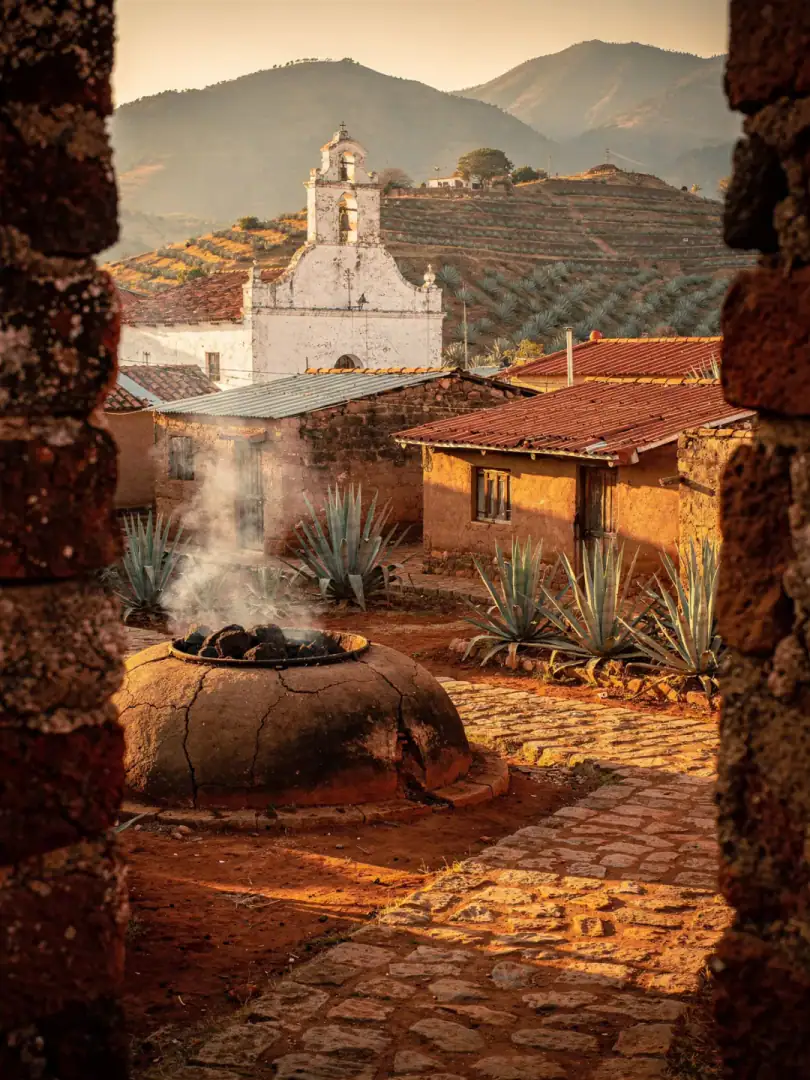
You won't find grand haciendas here like those in Jalisco's Tequila country. Mezcal has always remained the domain of small palenques, open-air distilling huts on the edge of the village, where one family shoulders every step from harvest to bottle.
Since 1994, a denomination of origin has protected the name Mezcal, and since 2016 the standard NOM-070-SCFI-2016 has precisely defined what may carry that name. The Consejo Regulador del Mezcal oversees this, known until roughly 2018 as COMERCAM, and abbreviated as CRM. The protected zone now spans twelve states and, since 2021, parts of Sinaloa as well. The CRM itself views this expansion with some skepticism.
For the Valles Centrales, the heart of this region, one basic rule holds firm: Mezcal must always be made from 100% agave. Unlike Tequila, the law here has no concept of a "Mixto." The standard also distinguishes three tiers by production method: Mezcal, Mezcal Artesanal, and Mezcal Ancestral. Only those who distill using clay and open fire, as they do in Santa Catarina Minas, may put "Ancestral" on the bottle—something never permitted with an autoclave.