Espadín & Wild Agaves
Agave & Soil
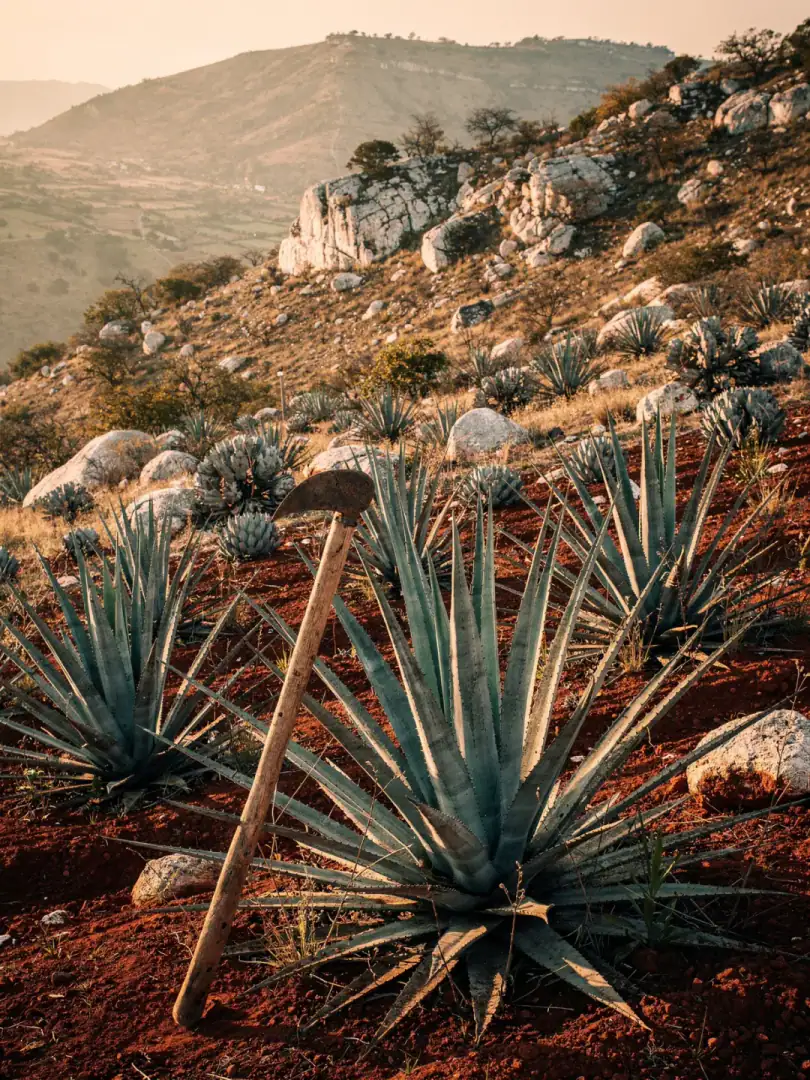
In the Valles Centrales, a single agave dominates the landscape: Espadín, botanically Agave angustifolia. Around Santiago Matatlán, it makes up nine out of ten plants growing here. Unlike the Blue Weber Agave used for Tequila, Espadín is hardier. It tolerates drought and poor soils better and can be grown almost anywhere across the valleys.
Farmers plant Espadín in rows between corn and beans, or in dedicated plots on the hillsides. After six to eight years, the plant is ready for harvest. The jimador reads this from the leaf formation. Using the coa, a sharp, curved blade on a long pole, he cuts away leaf after leaf. What remains is the piña, the heavy heart of the agave.
Alongside Espadín, two wild agaves grow in the steep hills around San Baltazar Chichicápam and San Dionisio Ocotepec that no one cultivates. These are Tobalá, botanically Agave potatorum, and the rarer Tepeztate, Agave marmorata. Both take considerably longer to mature than Espadín and typically grow alone among the rocks rather than in orderly fields.
This is exactly what sets Mezcal apart from distant relatives like Sotol. There, the raw material comes from Dasylirion, a plant that belongs to the same broader family of succulents but is botanically not an agave. In the Valles Centrales, by contrast, every plant used to make Mezcal is a true agave, whether Espadín, Tobalá, or Tepeztate.
The soil beneath these fields is typically a thin layer of red clay over crumbling limestone, rarely deeper than half a meter. This scarcity forces the roots to spread wide and store water from each rainy season. It's what gives Espadín its earthy, mineral character, one you'll later find echoed in the glass.
Weathered, iron-rich clay mixed with organic remains of decayed agave leaves.
The root: This is where the fine roots sit, absorbing water instantly from the rare rainfall.