Blue and Salmiana
Agave & Soil
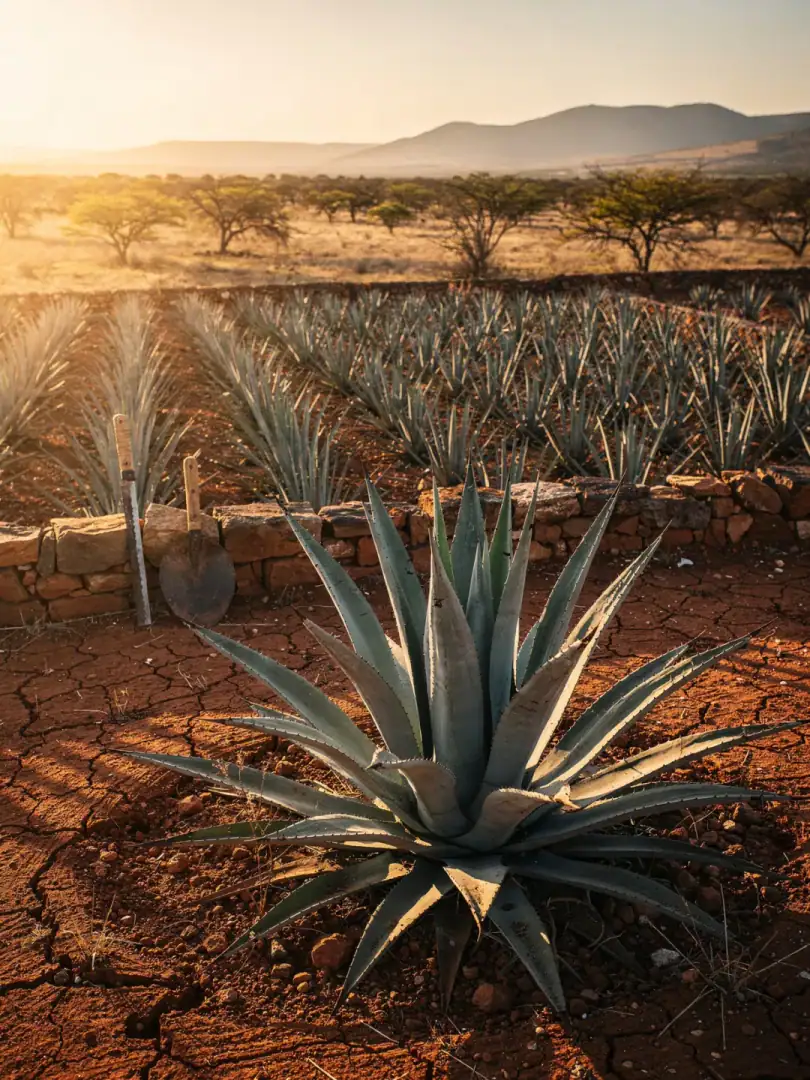
Two agaves share the land without ever meeting. In the south around Huitzila and Teúl de González Ortega grows Agave tequilana Weber, variety Azul. Locally it's simply called Agave azul or Blue Agave. It's the same plant that defines Tequila in neighboring Jalisco. Further east, on the barren plains of Pinos, Agave salmiana dominates. There it's also known as Maguey manso or Maguey verde. Elsewhere in Mexico, the same species is mainly tapped for pulque.
In the south, Blue Agave is typically grown in rows like on a plantation. It usually takes six to eight years to mature, similar to Tequila production itself. Agave salmiana in Pinos, by contrast, often grows semi-wild among cacti and mesquite shrubs. It needs considerably longer, usually ten to fifteen years, before its heart, the piña, is ripe enough for harvest.
Both are harvested by hand. The jimador uses the coa, a long-handled tool with a round, sharp blade, to strip the tough leaves from the plant. What remains is only the piña, the sugar-rich heart from which the mezcal will later be made. With the often enormous Agave salmiana, this is hard labor. Some piñas from Pinos weigh as much as a grown adult.
The soil follows the landscape. In the south, a reddish-brown clay lies over volcanic rock, typical of agave country near the Jalisco border. In Pinos, the ground is more barren, chalkier, and drier, a legacy of the semi-desert that stretches to the borders of San Luis Potosí and Aguascalientes. It's precisely this poor soil that forces Agave salmiana to grow slowly while storing sugar instead of leaf mass.
A narrow band of sand and decomposed plant matter, thinner than elsewhere in Mexico because rain is rare here.
The root: It's just enough for the shallow first roots of young agaves.