Copper and Taberna
Fermentation & Distillation
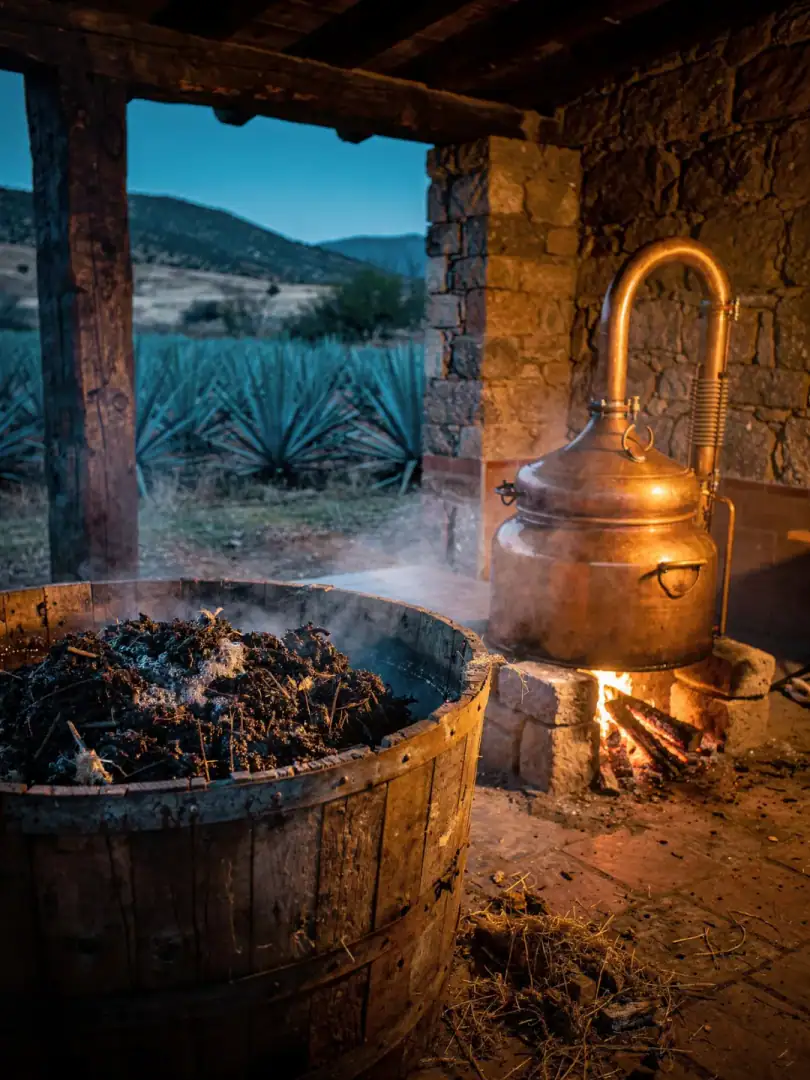
After cooking, the milled agave, often along with its fibers (bagazo), goes into open vats. In the tabernas around Teúl de González Ortega and Huitzila, these are usually wooden vats, though other operations use stone or stainless steel. Wild yeasts from the air of the taberna take over fermentation, with no cultured yeasts added. Depending on the weather, this takes between three days and a week, giving each taberna its own unmistakable character.
Most tabernas distill twice in copper alambiques, much like Tequila on the other side of the border. Unlike Mezcal Ancestral, which uses only clay stills over open fire, copper is the standard in Zacatecas. The first distillation yields a cloudy, low-alcohol "ordinario." The second separates heads, hearts, and tails, producing the clear mezcal that's eventually bottled.
The result usually lands between 45 and 50 percent alcohol by volume. Additives for dilution aren't permitted, a basic requirement of the Mezcal category. In Pinos, the thicker piñas of Agave salmiana bring more fiber and water with them, so fermentation there can sometimes take longer than in the south.
And once again, the boundary between the names applies. Anyone distilling twice in a copper still here needs no permission from Tequila, because Zacatecas has its own designation of origin. But that's exactly why the same Blue Agave, the same copper still, and the same craftsmanship can only end up as Mezcal in the bottle. It may never be called Tequila.