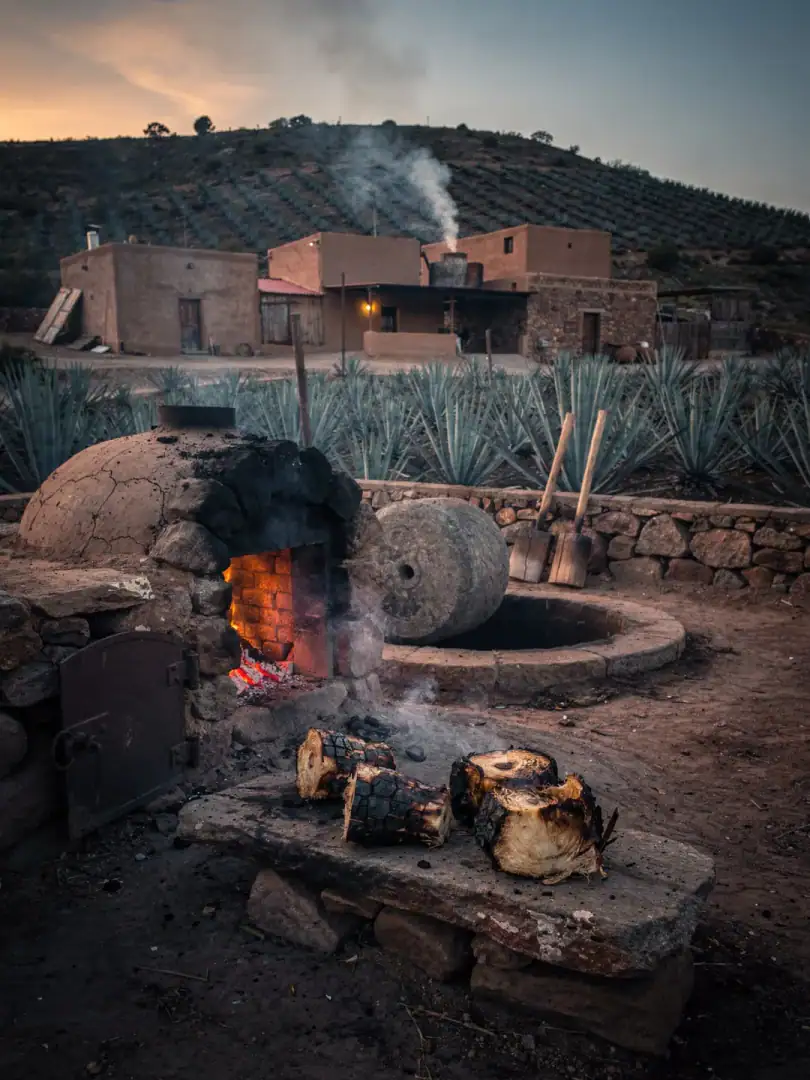
Stone Oven Instead of Autoclave
Cooking & Milling
Walking through Huitzila, you smell the smoke of the stone ovens long before you see the agave. The distillery has cooked its piñas in masonry stone ovens for generations. It's not the classic earthen pit found in parts of Oaxaca, but it's equally direct heat, with no steam boiler involved.
This exact method determines the category on the label. The Mexican standard NOM-070 permits traditional ovens such as earthen pits or stone ovens for "Mezcal Artesanal." It also allows milling with a tahona, a round stone wheel, with a hand mallet (mazo), or with a mechanical shredder. Anyone who steams in an autoclave or extracts sugars using a diffuser instead ends up in the simple "Mezcal" category, the industrial tier, without the word Artesanal on the label.
In the small tabernas around Teúl de González Ortega, the equipment usually stays modest: stone oven, tahona, or mazo, little more. According to its own account, Huitzila now combines this traditional cooking method with additional steps for export. The distillery doesn't give up the Artesanal category in doing so. In Pinos, the sheer size of Agave salmiana makes it harder to process. Cooking in the oven often takes longer there, until even the thickest piñas are fully done.
Cooking is more than just a processing step. Only the heat converts the agave's complex carbohydrates into fermentable sugar. The choice of earthen pit, stone oven, or autoclave later shapes the smoke, sweetness, and earthiness in the glass. Cook in a stone oven and mill with a tahona here, and whatever results may be called Mezcal Artesanal. Cook in an autoclave, and you may still distill Mezcal, but never write the word Artesanal on the label.