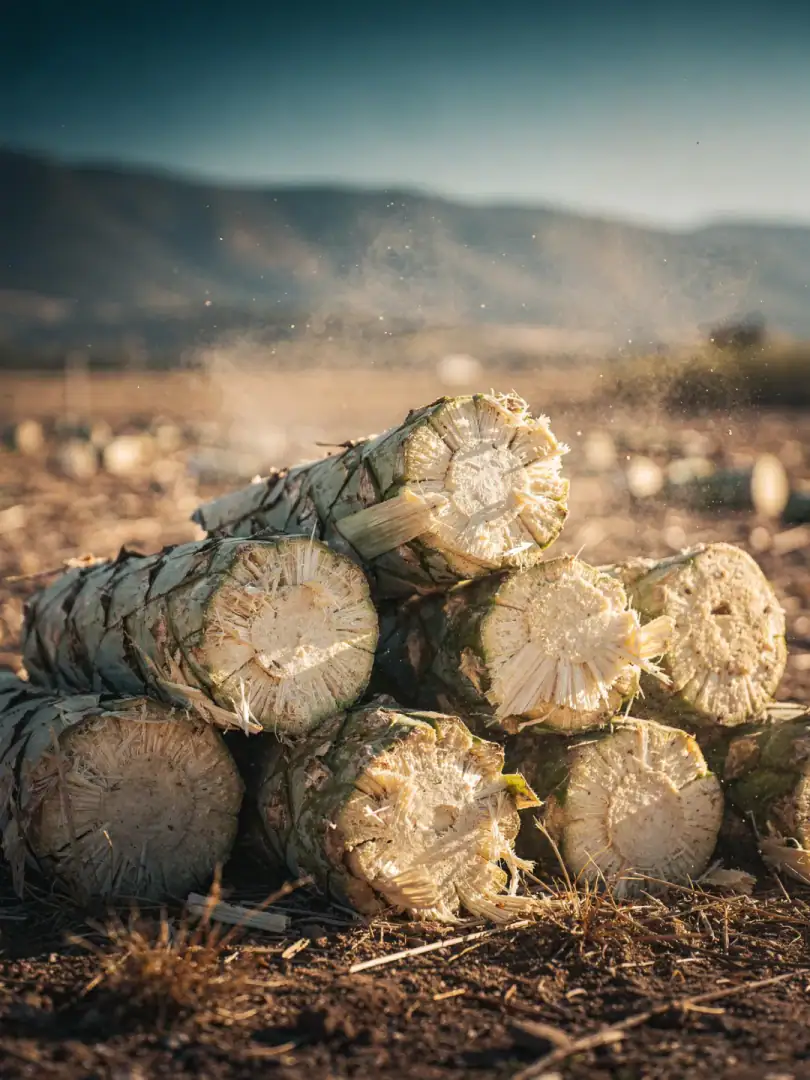
The mezcal agave
Espadín
Espadín is the agave that makes nearly all mezcal possible: Agave angustifolia, growing wild and, for decades, also deliberately cultivated. It's related to the agave from which bacanora is made far away in Sonora, even though the two spirits have almost nothing else in common.
A wild agave becomes the leading variety
Agave angustifolia grows wild from Sonora in the north to the far south of Mexico, making it one of the country's most widespread agave species. In the world of mezcal, it usually goes by the name Espadín, named for the narrow, sword-like shape of its leaves. Because it's hardy and thrives across many climate zones, farmers began early on to plant it deliberately in rows rather than simply gathering it in the wild.
Today, the vast majority of Mexican mezcal comes from Espadín, because it allows large quantities to be produced reliably. This sets mezcal apart from its reputation as a purely niche product made from wild plants: the industry's everyday reality is cultivated Espadín, while the rarer species covered in the next chapter of this journey are what make it special.
Why Espadín matures faster
Compared with many wild agaves, Espadín grows quickly. Depending on soil and climate, a plant is considered ripe enough for harvest after roughly six to nine years, considerably faster than the mountain agaves introduced in the next chapter. This comes down both to the species itself and to deliberate selection that farmers have practiced across generations.
A shorter ripening time means less risk for producers: a plant standing in the field for six years instead of twenty is exposed to weather, pests, and thieves for a shorter period. This very advantage has made Espadín the economic backbone of the entire mezcal industry, while wild agaves remain more the exception and the rarity.
Related to the bacanora agave
In the highlands of Sonora, far to the north, a distinct variety of the same species grows: Agave angustifolia var. pacifica, also called "yaquiana," from which bacanora is made exclusively. Botanically, Espadín and the bacanora agave are siblings, simply adapted to different climate zones and known under different names.
Despite this close kinship, the two spirits cannot legally overlap. Bacanora is bound to Sonora, whereas mezcal belongs to its own, much larger territory spanning twelve states and, since 2021, parts of Sinaloa as well. Anyone distilling in Sonora may not write "Mezcal" on the bottle, even if the plant at its core is the very same species.
Espadín isn't the same as mezcal
Espadín accounts for the largest share of the market, but it's only one of many species permitted for mezcal. The regulation prescribes no specific agave; it only requires that the spirit be made from one hundred percent agave sugar, regardless of species.
This fundamentally sets mezcal apart from tequila, where law and plant coincide exactly. With mezcal, the plant is interchangeable, as long as it's an agave and comes from the protected region. This very openness is what makes mezcal so diverse in flavor, as the next stop reveals.
Why Espadín remains more genetically diverse
Unlike the Blue Agave, Espadín doesn't come exclusively from offshoots. Many mezcal farmers also plant seeds from earlier agaves left to mature and flower before harvest. This takes longer, since seed-propagated plants grow less uniformly than cloned hijuelos. In exchange, the genetic base stays broader than in a field of purely identical clones. When a pest strikes such a population, individual plants are more likely to survive the infestation, since they're not all equally vulnerable.
Espadín also rarely grows in pure row plantations like the Blue Agave. Many producers let it grow among corn, beans, or trees, in a mixed cultivation with a long tradition in Mexico. This protects the soil from erosion and makes the land less vulnerable to a single pest. The difference shows in flavor too: Espadín from the valleys of Oaxaca tastes noticeably different from Espadín grown in Michoacán or Durango, even though botanically it's the same species behind both. Soil, elevation, and climate shape the agave's core long before it ever reaches the oven.