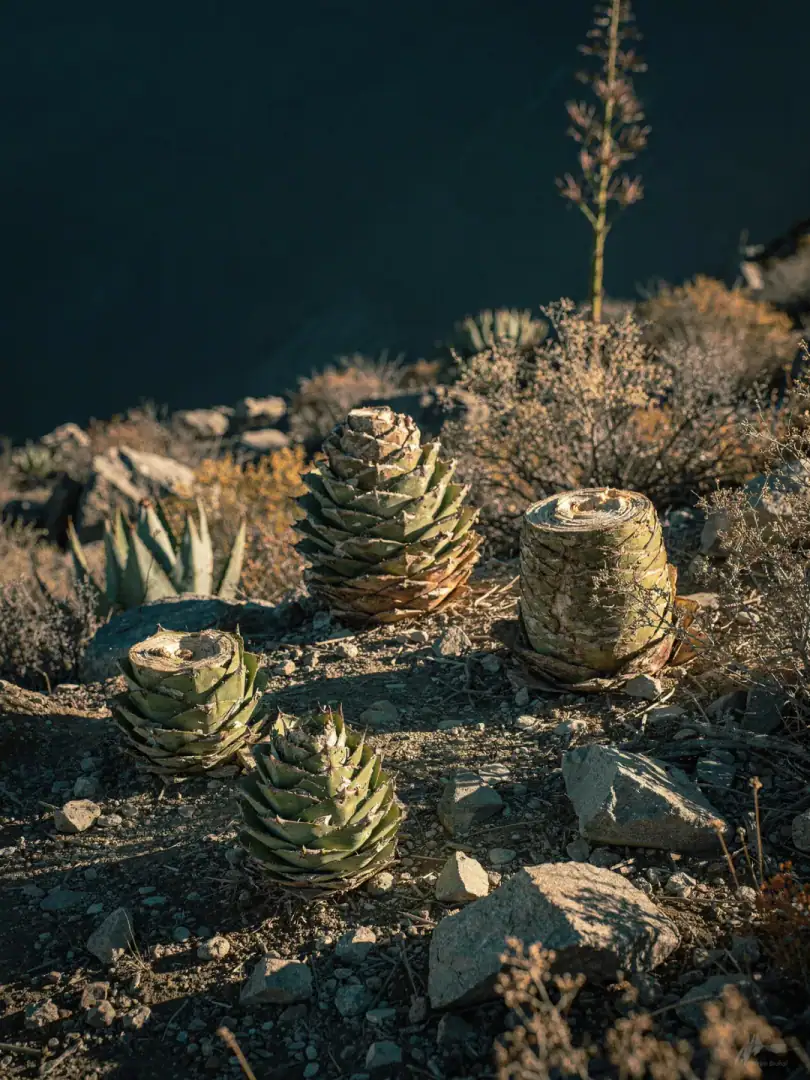
Rare and wild
Wild agaves
Alongside cultivated Espadín, dozens of wild agaves grow in Mexico's mountains, harvested by hand by jimadores from forests and rocky slopes. Tobalá, Tepeztate, Karwinskii, Cupreata, Cenizo, and Salmiana give mezcal its reputation as a spirit with countless faces.
What makes an agave a wild agave
Wild agaves grow without irrigation, without row planting, and without fertilizer, scattered among rocks, beneath trees, or on steep slopes. No one sows them deliberately; they arise from natural propagation through seed or occasional offshoots. Jimadores must search for them across the landscape, often far from any road, and harvest far smaller quantities than on an Espadín field.
This effort comes at a price: mezcal made from wild agaves usually costs considerably more than the Espadín standard. Many connoisseurs view it as an expression of a specific place, since each species occurs only where the soil and climate suit it. Buying a bottle bearing the name of a wild agave means buying the landscape it came from too.
Tobalá and Tepeztate: slow rarities
Tobalá, botanically Agave potatorum, typically grows in the shade of trees and among rocks, often at higher elevations in the mountains of Oaxaca. Because it grows so scattered and so slowly, it needs a good ten to fifteen years to mature and can hardly be harvested in large quantities. It's said to carry a particularly floral, concentrated aroma, which is why it ranks among the most expensive mezcal agaves.
Tepeztate, botanically Agave marmorata, takes this even further: growing on steep, rocky slopes, it often needs twenty to thirty years before it's ripe enough. Because it can be harvested so rarely without depleting wild populations, connoisseurs consider it particularly earthy and mineral in character, but also one of the species conservationists worry about most.
Karwinskii: the agave with a trunk
Agave karwinskii looks different from most agaves: rather than growing as a flat rosette, it forms a long, visible trunk, with leaves sitting only at the very top. Depending on how it grows and at what age it's harvested, its forms carry different names: Madrecuixe, Cuixe, Tobasiche, or Bicuixe, all the same species in different growth forms.
In the valleys of Oaxaca, this agave has a long tradition, since it grows on barren, rocky soils where hardly anything else thrives. Mezcal made from Karwinskii forms is considered herbal and mineral, with a lean, often dry note that stands in clear contrast to the fullness of Espadín.
Cupreata, Cenizo, and Salmiana: three regions, three profiles
Agave cupreata grows mainly in the mountains of Guerrero and Michoacán, maturing there in roughly seven to ten years, with a reputation for fruity, sometimes smoky notes. In Durango and Zacatecas, meanwhile, Agave durangensis dominates, usually called Cenizo there for its ash-gray leaves, lending the region's mezcals an earthy, lightly smoky character.
Very different is Agave salmiana: it grows large and hardy in the highlands of central Mexico, yields enormous, sweet piñas, and is traditionally used above all for making pulque, though it's also used for mezcal, for instance in San Luis Potosí. Three species, three landscapes, three completely different drinking experiences, all gathered under the same name: mezcal.
Arroqueño: the giant among wild agaves
Alongside the species already mentioned, Arroqueño is considered one of the largest agaves used for mezcal. Botanically, it's a variety of Agave americana. It's found mainly in the valleys around Oaxaca. Its piñas grow to enormous size, a single core can weigh several hundred kilograms, far more than a Blue Agave piña. It often takes more than twenty years for an Arroqueño plant to mature enough for harvest, roughly as long as Tepeztate.
Mezcal made from Arroqueño is considered soft and slightly sweet, a contrast to the earthy notes of Tepeztate or the floral character of Tobalá. Precisely because a single plant delivers such a large yield, the long wait can still pay off for some producers. Overall, though, Arroqueño remains rare. Hardly any farmer can rely on a single harvest spread over twenty years.