Pollination Instead of Clones
Bats and Pollination
Hardly any cultivated agave is allowed to flower, because flowering costs sugar that distillers need. This affects, of all creatures, bats, which as the primary pollinators of night-blooming agaves depend on exactly these flowers.
A Flower Almost No One Sees
On a commercial field, almost no agave ever reaches the flowering stage. As soon as the quiote appears, it's usually cut off, as described in the previous section, to preserve the piña's sugar content. Economically, this makes sense, but ecologically it's a problem that went largely unnoticed for a long time.
Over decades, large growing regions have essentially stopped completing their natural reproductive cycle. Propagation happens almost exclusively via offshoots, as already described in the chapter on Blue Agave. This works for agriculture, but it interrupts a very old relationship between plant and animal.
Bats as Pollinators
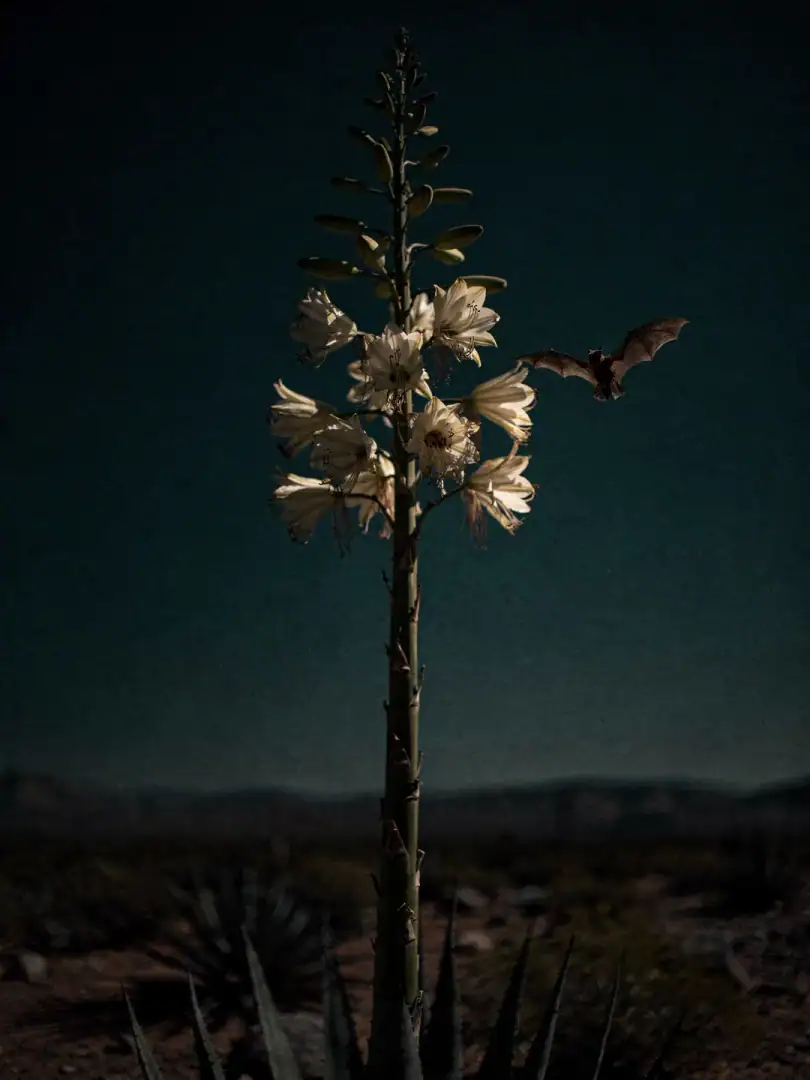
Night-blooming agaves usually open their flowers only at dusk and produce abundant nectar, precisely tailored to one particular visitor: the lesser long-nosed bat, botanically Leptonycteris yerbabuenae. It flies long distances between Mexico and the southwestern United States, always following blooming agaves and cacti that provide it with food along the way.
While drinking the nectar, the bat brushes off pollen and carries it to the next flower, often miles away. This creates genetic mixing between widely separated plants, something pure clonal propagation via offshoots can never achieve. Without blooming agaves, the bat loses vital refueling stops along its journey.
What's Lost When Nothing Blooms
When nectar is missing over long stretches, migration becomes harder for the bats, with consequences for their populations. At the same time, the agaves themselves lose something too: without pollination, no seeds form, and without seeds, a species' genetic diversity stays limited to whatever offshoots are already in circulation.
This compounds exactly the problem already described in the chapter on Blue Agave: a species made up entirely of clones is more vulnerable to disease and pests, because it lacks the range that only seed-based propagation can provide. Flowering and genetic health are thus more closely linked than they might appear at first glance.
The Bat-Friendly Seal
Since 2016, the "Bat Friendly" initiative, backed in part by Mexico's UNAM university, has certified tequila and mezcal producers who deliberately let a portion of their agaves flower instead of cutting off every quiote. The usual quota is at least five percent of the plants per operation.
For producers, this means a small economic sacrifice, since flowering plants no longer yield alcohol. In return, they help sustain bat populations and allow seeds to form again, from which genetically more diverse agaves can grow than through pure clonal propagation.
Other Nighttime Pollinators
Besides the lesser long-nosed bat, moths and occasionally hummingbirds also visit blooming agaves. Their effect on pollination, however, remains minor. The flowers are tailored to bats anyway: they open only at night, smell musty rather than sweet, and carry their nectar deep inside long, funnel-shaped blooms. That's a perfect match for the bat's long tongue, which can reach deep into the flower without touching the stamens.
This is why the loss of flowering agaves hits bats particularly hard. Other visitors only benefit incidentally from the rare blooms. For years, researchers have observed how the migratory routes of the lesser long-nosed bat align with the few remaining flowering areas, from southern Mexico all the way to the southwestern United States. If a sufficient number of blooming plants is missing at any one point along the route, the entire migration becomes riskier. A single missing stop can prove decisive for the whole journey.