Harvest by Hand
The Jimador
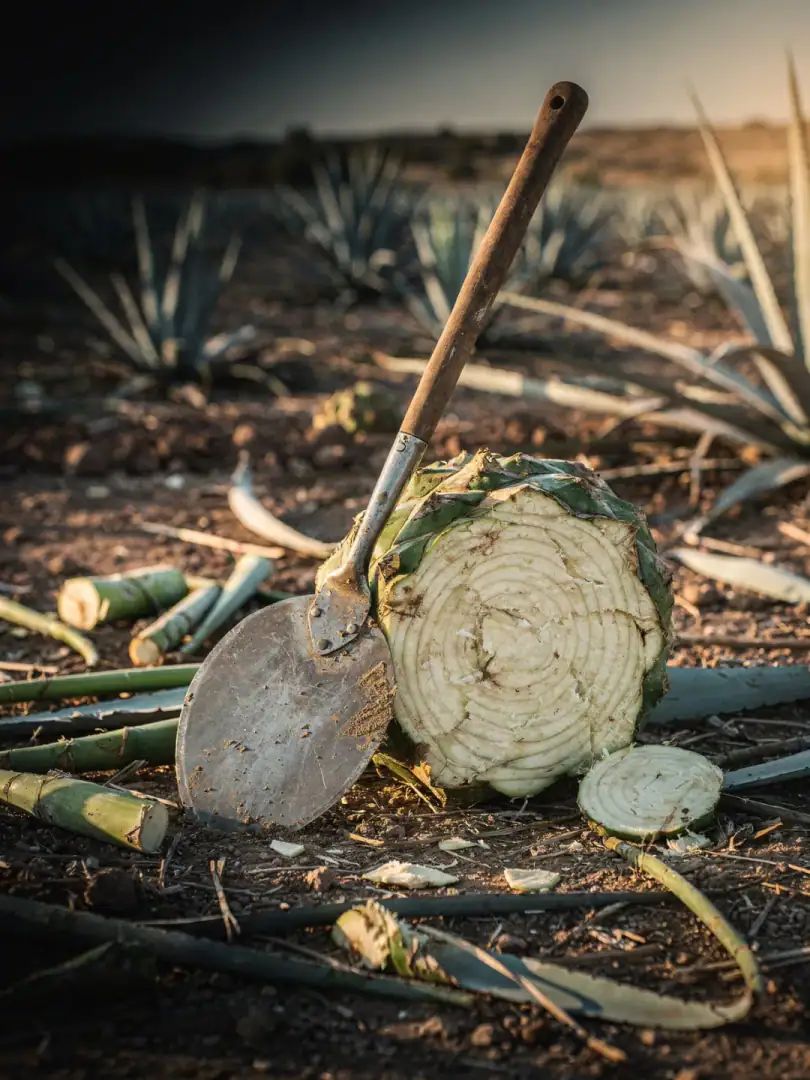
The jimador is the field worker who uses a sharp blade called a coa to cut away the spiny leaves of a ripe agave until only the round core remains: the piña, named for its resemblance to a pineapple.
What a Jimador Does
In Mexico, cutting away the agave's leaves is called jima, and whoever performs this work has carried the title jimador for generations. Before the actual harvest begins, he examines each plant individually: the color of the outer leaves, their firmness, and sometimes whether a flower stalk has already begun to stir.
Only once these signs are right does the real work begin. It's physically demanding, often under a blazing sun, on uneven ground, and with sharp, spiny leaves that can quickly cause cuts. In the major growing regions of Jalisco, the jimador has long been an iconic figure of tequila culture, depicted on labels and throughout the industry's advertising.
The Coa: One Tool, Many Techniques
The jimador's most important tool is the coa de jima: a long wooden handle with a round, very sharp blade at the end. With it, the jimador strikes away the agave's leaves all around, close to the core, in a practiced, sweeping motion that leaves little waste.
An experienced hand can accomplish in a few minutes what would take a beginner hours, all while damaging the valuable core as little as possible. Because each agave species grows differently, the technique varies slightly: smaller wild agaves demand more finesse than the large, uniform rows of Blue Agave.
Why the Quiote Gets Cut Off
When an agave begins forming its flower stalk, many jimadores step in before it really gets going: they cut it off early, a practice often called "capar" or "desquiotar" in Mexico. Without a flower to invest in, the plant holds onto its sugar reserves in the core for longer.
This technique effectively extends the time during which the piña can accumulate sugar, and is used deliberately to delay the harvest moment without letting the plant wither. It shows just how closely harvest, ripening biology, and economic calculation are intertwined when it comes to agave.
From Rosette to Piña
Once the plant has been stripped of all its leaves, what remains is a rounded, often slightly ridged core whose shape recalls a pineapple, which is why Mexicans call it a piña. For cultivated Blue Agave, a piña typically weighs between forty and ninety kilograms, with older specimens weighing considerably more.
For some wild agaves, the piña turns out smaller, while for the large Agave salmiana it can reach well over a hundred kilograms. These cores then move on to the oven, where, as described in the previous section, the stored inulin finally becomes fermentable sugar.
A Craft Learned From Childhood
No one becomes a jimador overnight. Most grow up with the work. Fathers and grandfathers cut agaves before them, often within the same family for generations. Anyone wanting to learn the craft starts out as a teenager simply standing by and watching. Only after years alongside experienced hands is he allowed to wield the coa himself. In the end, it comes down to feel: how deep the blade needs to cut so as little as possible of the valuable core is lost.
In the region around the town of Tequila, this skill is celebrated publicly. At festivals and fairs, jimadores compete against one another, showing how fast and cleanly they can strip an agave of its leaves. Such competitions make visible what usually happens unseen out in the fields. It's work that demands strength, practice, and a trained eye in equal measure. Despite all the machinery now in use, it remains, to this day, overwhelmingly hand labor.