Time Makes Sugar
Maturation Time
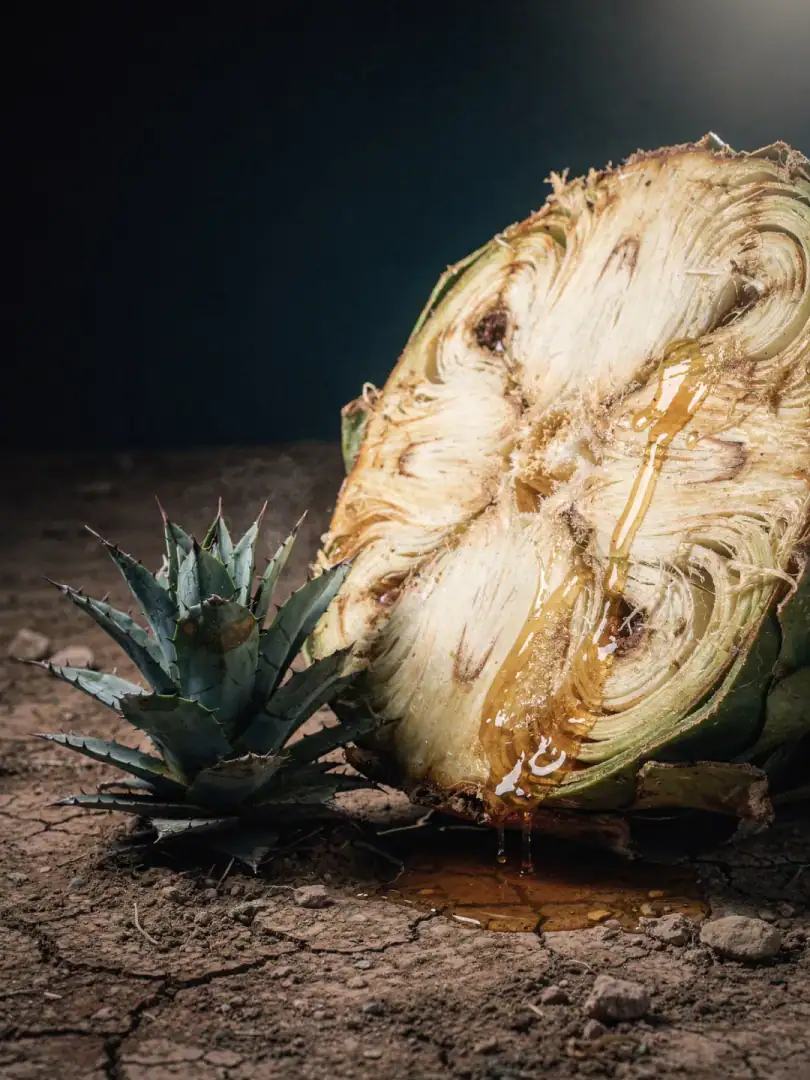
An agave can take anywhere from five to thirty years to mature, depending on species and location. During this time, it builds up long-chain sugars in its core, sugars that only become fermentable once cooking breaks them down for yeast to work with later.
Why an Agave Needs Years to Mature
Unlike wine grapes or grain, which ripen within a single season, an agave grows over years, often over decades. It lives in dry, nutrient-poor soils, where growth is inherently slow. Rather than quickly producing leaves and water, it spends a long time channeling its energy into the solid core at its center.
How long this takes depends heavily on species and location. Cultivated Blue Agave for tequila matures in roughly six to eight years, Espadín for mezcal at a similarly quick pace. Wild mountain agaves like Tobalá or Tepeztate, however, as described in the previous chapter, often need double or triple that time.
Inulin: The Sugar That Isn't Quite Sugar Yet
Over the years, an agave doesn't actually store sugar in the classic sense at first, but rather inulin, a long chain of fructose molecules known as a fructan. Yeast can't do anything with this chain until it's broken down into its individual building blocks. That's exactly why the harvested piña must be cooked before fermentation, whether in an earthen pit, a masonry oven, or an autoclave.
Only heat splits the long chains into simple, fermentable fructose. This fundamentally sets agave spirits apart from wine, where the grapes already supply finished sugar. For agave, cooking isn't a flavor step you could skip, it's a chemically necessary transformation without which no fermentation could take place.
The Signal to Harvest: The Quiote
Experienced harvesters don't recognize ripeness from a calendar, but from signs the plant itself gives off: the color of the leaves, their tension, and whether the flower stalk, the quiote, has already begun to stir at the center. Once it starts growing, everything changes.
When an agave begins to flower, it redirects all its stored sugar into the stalk to form blossoms and later seeds. For harvesting, this is bad news, because it's exactly the sugar that distillers need that gets lost. That's why harvesters often step in shortly before flowering, as the next section explains in more detail, to catch the core at the peak of its sugar content.
Wild Agaves Take the Longest
The wilder and more unprotected an agave's growing conditions, the longer its maturation usually takes. On barren rock, without irrigation, and competing with other plants, it grows more slowly than a well-tended row in a field. Some mountain agaves like Tepeztate therefore reach an age at which other crop plants would long since have been harvested several times over.
This long wait is one of the main reasons why mezcal from wild agaves is so much more expensive than standard bottlings made from Espadín or tequila made from Blue Agave. Anyone waiting twenty or thirty years for a single harvest can't produce at the same pace as a field replanted every six to eight years.
How Producers Measure Sugar Content
Beyond outward signs like leaf color and the quiote, many modern operations also rely on a measurement: the Brix value, which indicates the sugar content of the sap. A small device, the refractometer, shows how much fermentable sugar a piña already contains, regardless of the plant's calendar age. Only once this value reaches a certain point is the agave considered ripe enough for harvest.
This measurement complements the experience of the jimadores, but doesn't replace it. Two agaves of the same age can have stored very different amounts of sugar, depending on how much rain fell or how sunny the slope was. Small, traditional operations still rely solely on a trained eye. Larger distilleries, by contrast, combine measuring devices with experience to pinpoint the harvest moment more precisely and catch fluctuations in sugar content early.