Filtered, Not New
Cristalino
A Cristalino looks like a Blanco but tastes like an aged Tequila. The trick isn't in the aging — it's in the final step afterward: filtration.
Clear Like Blanco, Aged Like Añejo
Cristalino starts as a fully aged Añejo or Extra Añejo, from which almost all the color is subsequently removed. What remains is an almost crystal-clear liquid that still carries the flavors of barrel aging — vanilla, a touch of caramel, a hint of wood.
For many newcomers, this is confusing: the eye expects the fresh taste of a Blanco from a clear Tequila, but the palate is served the roundness of an Añejo.
This reversal of expectation and taste makes Cristalino a popular entry point for people accustomed to clear Tequila who are curious about the flavors of longer aging without jumping straight to a dark Añejo.
How the Filtering Works
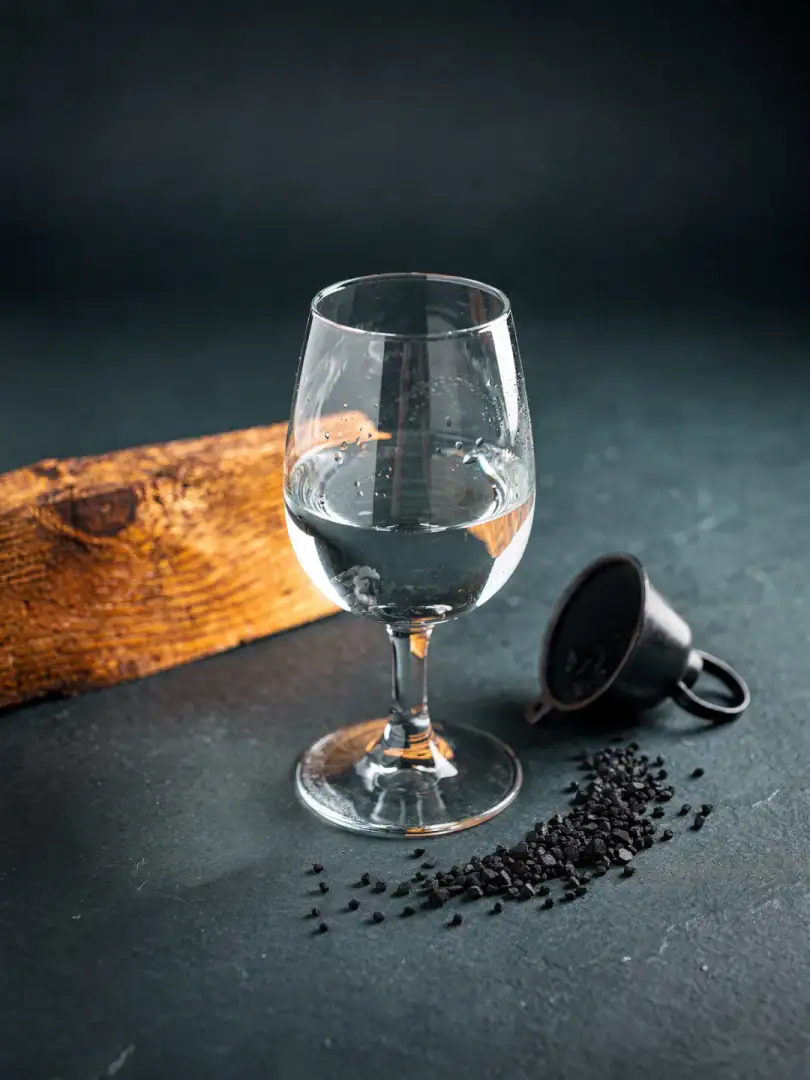
Decolorization usually happens via activated charcoal: the aged Tequila is slowly passed through carbon filters that bind the color pigments while letting most of the aromatic compounds through. The result isn't a new spirit — it's the same Añejo with a different appearance.
Depending on the intensity of filtering, more or less of the original wood character survives. Some Cristalinos end up tasting almost like a mild Añejo, others more like a flavored Blanco.
The exact filtering technique varies from distillery to distillery and is often treated as a trade secret. Some use multiple filtration passes in sequence, others combine activated charcoal with additional fine filters to remove a lot of color while losing as little flavor as possible.
No Dedicated NOM Class
As common as the term is in retail, Cristalino doesn't appear as a separate class under NOM-006. Legally, the underlying class — usually Añejo or Extra Añejo — must still appear on the label; "Cristalino" is only an addition to it.
Anyone who reads the back label carefully will always find both pieces of information: the genuine, legally protected class and the marketing term describing what was done to it afterward.
This dual label text also protects buyers: even if the marketing term "Cristalino" disappears or changes, the legally protected class designation remains and can be compared with other bottles of the same class.
With Mezcal, the Term Travels Too
"Cristalino" has also started appearing occasionally on Mezcal shelves, even though the six official classes under NOM-070 don't recognize this word either. The situation mirrors that of Tequila: a marketing term layered on top of the actually mandatory class.
For buyers, this means the same thing in both cases: Cristalino is a promise about processing, not a substitute for the mandatory declaration of the aging class itself.
Critics of both spirits also complain that "Cristalino" is sometimes used to visually dress up a younger, less extensively aged Añejo. A look at the actual printed aging class therefore remains the more reliable clue.
Additives in Cristalino
An aged Añejo may already contain the usual Abocamiento additives before filtering. These include caramel coloring, oak extract, glycerin, or sugar syrup, together up to the roughly one percent by weight limit cited in several sources. This rule applies to Cristalino just as it does to any other Añejo, since filtering doesn't change the underlying class.
The activated charcoal filter mainly removes color pigments, not necessarily every additive. Added caramel coloring largely disappears from the finished Cristalino as a result, while sugar syrup or glycerin can pass through the filter relatively unchanged. This isn't visible on the label, since Abocamiento remains, overall, information with no labeling requirement for Tequila.
Where the Trend Comes From
Cristalino became established mainly over the past decade, as bars and consumers increasingly sought Tequilas that could be sipped neat as well as used in modern cocktails, without altering the look of a classic long drink.
Because production requires an extra filtration step after the actual aging, Cristalino is usually priced above a comparable, unfiltered Añejo from the same distillery — the additional effort translates directly into the shelf price.