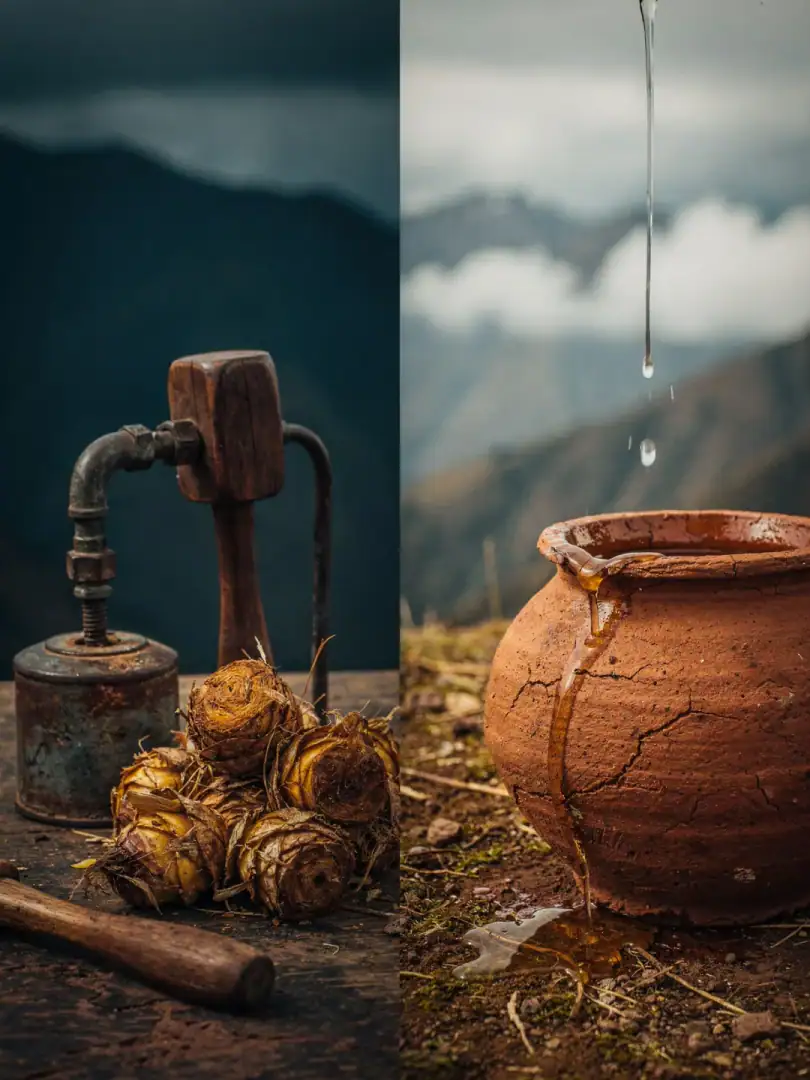
Two relatives
Cocuy and Miske: the relatives in South America
Outside Mexico too, countries protect their agave spirits by law. Venezuela protects Cocuy Pecayero, Ecuador protects Miske – two independent traditions that share with Tequila and Mezcal only their plant world.
Cocuy Pecayero: Venezuela's protected agave
Cocuy Pecayero is made from Agave cocui. It's confined to the Parroquia Pecaya in the state of Falcón. Since May 2001, it has been protected under the Venezuelan standard COVENIN 3662:2001. Oversight comes from the national intellectual property office, SAPI.
Production remains highly artisanal to this day. The piñas, the cooked agave hearts, are roasted beforehand. They're then crushed by hand with a wooden mallet. The mash ferments in wooden vats. Distillation takes place in handmade alambiques, self-built stills.
The standard recognizes two types. Tipo I is pure Cocuy with no additives. Tipo II may contain up to 20 percent added sugar. Unlike with Mezcal, such a blend is therefore explicitly permitted here.
Miske: Ecuador's newest denomination of origin
Miske grows high in the Ecuadorian Andes, between 1,800 and 3,000 meters above sea level. The species used are Agave americana and Agave cordillerensis. On October 6, 2022, Miske was declared Ecuador's seventh denomination of origin. It's protected by the national intellectual property office, SENADI.
The decisive difference from Tequila, Mezcal, and Cocuy lies in the very first step. Miske isn't distilled from cooked piñas. Instead, producers use the raw sap of the mature agave, known as Tzawarmishky. Because the plant doesn't need to be cooked, Miske skips the entire oven or earthen-pit phase entirely. It's exactly that phase that determines the smoke and roast aromas in the Mexican spirits.
What the three still share
Cocuy, Miske, and the Mexican family all descend from agaves. All carry a name protected by law. That name may only be used by a specific territory using a specific species. None of the three names may be used outside their home country for a different drink. The same holds for Tequila and Mezcal outside Mexico.
The difference lies in the details. Cocuy, under certain conditions, even allows added sugar. Miske skips the cooking step altogether. Together, both show that agave is no longer purely a Mexican story.
When the name reaches further than the protection
The term Cocuy is used far more broadly in Venezuela and neighboring Colombia than the denomination of origin allows. In the Guajira region, for instance, the Wayúu people produce their own traditional agave spirit, also called Cocuy, but from outside the protected Parroquia Pecaya. Only Cocuy Pecayero from Falcón may invoke the Venezuelan standard COVENIN 3662:2001; all others carry the name without that legal protection.
Miske grows mainly in the southern Ecuadorian province of Loja, near the border with Peru, where rural communities have used the agave for generations. The raw sap from which Miske is made resembles, in principle, the aguamiel that elsewhere is fermented into Pulque, except that with Miske it's additionally distilled.
Both traditions remain small for now. Ecuador's entire Miske production is spread across a handful of mostly family-run operations, much like Cocuy Pecayero in Falcón. Both countries hope official protection will make foreign markets easier to reach, without changing the old methods.
As with Sotol and Bacanora, it isn't flavor but law that decides who may use which name. An agave spirit from Colombia, or from another Ecuadorian province, might taste similar, yet it may not call itself Cocuy Pecayero or Miske.
Two young names with a future
Both Cocuy and Miske are comparatively young denominations of origin. Miske has officially existed only since 2022. Both countries place great hope in the international export of these niche products.
For travelers, this means: anyone who tastes Cocuy or Miske discovers a still little-known side of the same plant family that has already achieved worldwide fame in Mexico.