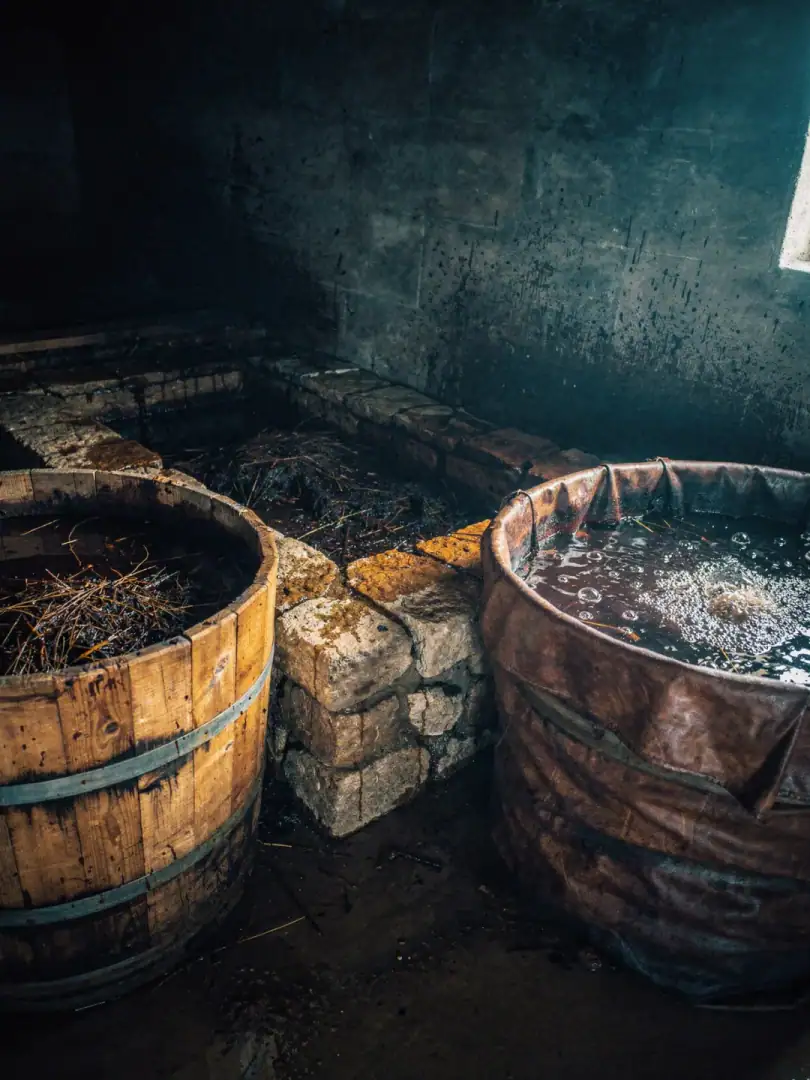
Yeast Meets Tradition
Fermenting in Vats of Wood, Stone, and Leather
Only fermentation turns sweet agave juice into alcohol. While tequila mostly uses cultivated yeast in steel tanks, traditional mezcal operations often rely on wild yeasts from the air and vats made of wood, stone, or even leather.
Wild Yeast Versus Cultivated Yeast
Wild yeasts live everywhere in the air, on the agave itself, and on the walls of the distillery. If the juice is left standing open, these yeasts settle in on their own and begin fermenting, though unpredictably in both pace and outcome.
Cultivated yeast strains, by contrast, deliver a predictable, consistent fermentation. Many tequila producers therefore deliberately use cultivated yeast, while traditional mezcal palenques, the small distilleries, often quite deliberately embrace the randomness of wild yeast.
Vats: Wood, Stone, Leather, Steel
The fermentation vessel itself shapes the flavor too. Wooden vats impart subtle tannic notes, stone pits carved into rock hold temperature especially stable, and in some regions of Guerrero, cowhides are even used as fermentation basins.
Large, industrial operations, on the other hand, mostly use stainless steel tanks. They're easier to clean, impart no flavor of their own, and allow precise temperature control, which would be hard to manage otherwise at very large volumes.
With or Without Fibers: Two Traditions
Many traditional mezcals ferment with a portion of the agave fibers left in the vat. This introduces additional yeasts and bacteria from the fiber surface into the process and produces the earthy, sometimes slightly animalic notes that mezcal connoisseurs seek out.
Tequila producers, by contrast, mostly separate the fibers completely before fermentation begins. The result is a cleaner, more precisely defined flavor that depends less on chance elements in the raw material than traditional mezcal does.
Why Fermentation Times Vary So Widely
With cultivated yeast and steel tanks, fermentation is often complete after just twenty-four to ninety-six hours. Wild yeast, by contrast, takes considerably longer and reacts strongly to weather, altitude, and even the time of day the vat was filled.
Some mezcal fermentations therefore stretch out over one to two weeks. This unpredictability isn't seen as a drawback within the scene, but rather as part of what makes every batch a unique, unrepeatable result.
How Climate and Altitude Shape Fermentation
Wild yeasts are sensitive to temperature, and it varies considerably between growing regions. In the cooler highlands of Oaxaca, open fermentation often proceeds more slowly than in the warmer lowlands of some tequila regions. Weather shifts, even within just a few days, can noticeably alter the outcome of a single batch, something that hardly ever happens in industrial fermentation with climate-controlled tanks.
Alongside yeasts, lactic acid and acetic acid bacteria frequently establish themselves during open fermentation. They produce slightly sour, sometimes cheesy or sharp secondary aromas that rarely appear in controlled fermentations using pure-culture yeast. For many mezcal lovers, these very unpredictable notes are part of the drink's character, while tequila producers generally treat such deviations as flaws and try to avoid them through strict hygiene at the distillery.
Why Cleanliness Is More Strictly Controlled for Tequila
Large tequila producers usually run their own laboratories, measuring the pH level, temperature, and alcohol content of the fermentation several times a day. If a value deviates too much, technicians step in immediately, for instance by cooling the mixture or adjusting the yeast dosage. This close monitoring is meant above all to prevent unwanted bacteria from disrupting fermentation and unpredictably altering the flavor.
Small mezcal palenques, on the other hand, often lack even the basic technical equipment for this. Many operations instead rely on the experience of the mezcalero, who can tell from the smell, the bubbling, and the taste when fermentation is complete. Both paths lead to drinkable, safe alcohol, yet only the industrial route delivers a nearly identical result from batch to batch.
For consumers, this means: a tequila from a major brand tastes almost the same from bottle to bottle, because lab testing and standards iron out deviations early on. A traditional mezcal, on the other hand, can differ noticeably from vintage to vintage, sometimes even from barrel to barrel. Anyone aware of these variations tends to buy mezcal the way they would a natural wine: expecting that no bottle tastes exactly like the last.