Raw instead of cooked
The diffuser: why it's controversial
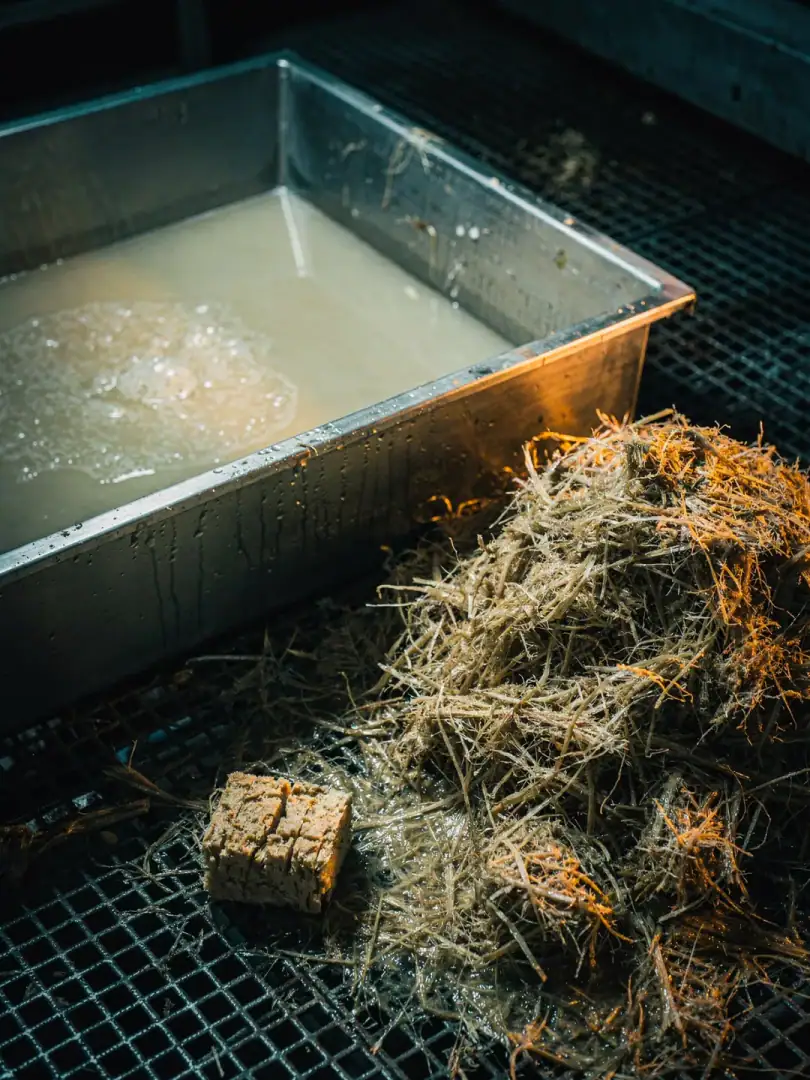
Some Tequila factories skip the oven and the autoclave entirely. They shred the raw, uncooked agave into fibers and wash the sugar out directly with hot water and acid. This method is called a diffuser, and few techniques are debated as heatedly among connoisseurs.
How a diffuser works
The harvested piñas are first shredded raw, meaning without any cooking, into fine fibers using a shredding mill. Only afterward do these fibers pass through the actual diffuser, a system that uses hot water and diluted acid to literally wash the sugar out of the fiber material.
The acid takes over part of the work otherwise done by heat in the oven: it chemically breaks down the inulin. Only after this washing step is the resulting sugar solution heated at all, usually briefly and with far less energy than in a stone oven or autoclave.
The criticism: no real cooking
Critics say the diffuser skips exactly the step that gives Tequila its character: the slow roasting of the agave. Without this roasting, the caramel-like, earthy notes that distinguish traditionally cooked Tequilas are missing, and the result often tastes more neutral and industrial.
Supporters counter that the diffuser uses raw material more efficiently and produces less waste. For very large brands bottling millions of bottles a year, that's an economic argument that keeps the debate between purists and industry alive to this day.
Why diffuser Tequila is still called Tequila
However loud the debate, it changes nothing legally. Standard NOM-006 prescribes no particular cooking method, it only requires the correct agave species and the correct origin. A diffuser Tequila meets both requirements just as much as one cooked in a stone oven.
That's why even very large, diffuser-based producers may call their product Tequila without restriction, regardless of what purists think of the method. The protected name safeguards origin and plant above all, not a particular craft or a particular flavor direction.
Why a diffuser Mezcal can never be called "Artesanal"
With Mezcal, the situation is different. Standard NOM-070 explicitly divides Mezcal into three tiers, and only the simple base tier, "Mezcal," allows diffuser, autoclave or oven at the producer's free choice.
The "Artesanal" and "Ancestral" tiers, by contrast, explicitly require traditional ovens or earthen pits. A Mezcal processed with a diffuser may therefore never bear the "Artesanal" seal, even if the agave, region and alcohol content would otherwise meet the standard.
Why diffuser Tequila is hard to detect
The word diffuser never appears on the label, because NOM-006 has no labeling requirement for the cooking method. The only mandatory disclosure is whether the product is one hundred percent agave Tequila or Mixto. How the piña was cooked remains invisible to consumers, unless the distillery mentions it voluntarily in its own marketing.
That's why it's usually independent reviews and circles of connoisseurs who try to distinguish diffuser Tequilas from traditionally cooked ones. They rely on distillery visits, producer statements and trained tasting, not on official inspections. Large companies vary in how openly they discuss this: some name their process openly, others prefer to speak more generally of modern, efficient production methods.
The debate over the diffuser runs parallel to another discussion in the industry. That one concerns permitted additives such as caramel coloring, oak extract or sugar syrup. Together these may make up to one percent of the weight, again with no labeling requirement. Both topics reveal the same underlying conflict: the standard strictly regulates origin and plant, but leaves consumers little insight into the exact production method. Anyone who cares about a particular process must research it themselves or ask the distillery directly.