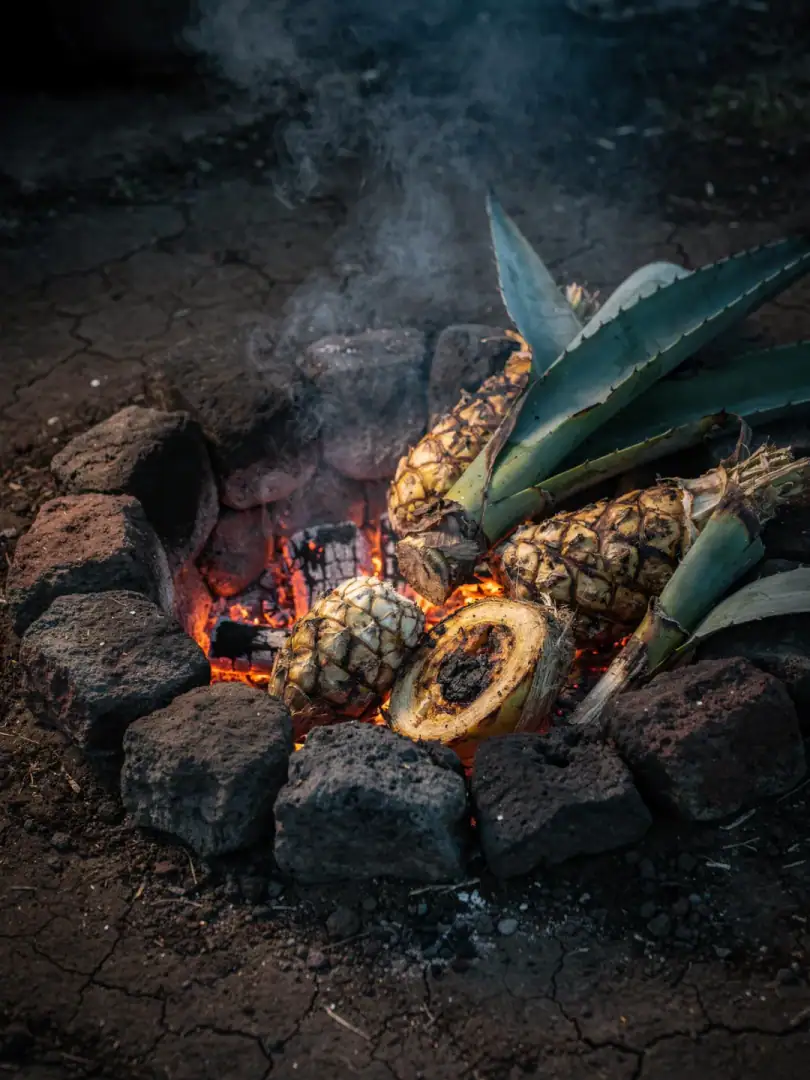
Fire, stone, days
The earthen pit: where Mezcal's smoke comes from
Where Tequila steams in a closed oven, traditional Mezcal is often cooked over a fire burning underground for days. This earthen pit is the reason why many Mezcals taste of smoke, an aroma a regular Tequila never acquires.
How an earthen pit is built
Workers dig out a round hole, often two to three meters deep, and line it with volcanic rock. Firewood is stacked on top and lit until the stones are glowing hot and the embers collapse in on themselves.
The cut piñas are placed on these hot stones, often layered with agave fibers in between. Finally, everything is covered with leaves, mats and a layer of earth so that heat and smoke stay trapped inside rather than simply escaping.
Days in smoke: what happens to the sugar
Under the earthen cover, the piñas cook for three to seven days, depending on the size of the pit and the quantity of the load. As in the stone oven, the heat converts inulin into sugar, but unlike there, the agave is in direct contact with wood smoke.
It's precisely this contact that binds smoke particles and roasted aromas to the piña, often intensified by the type of wood: oak or mesquite each impart different nuances. That's why Mezcal tastes noticeably different from pit to pit, even within the same region.
Why Tequila never gets this smoke
Tequila is processed exclusively in closed ovens, autoclaves or via diffuser, never in an open earthen pit. The agave therefore never has direct contact with wood fire or smoke, which is why a pronounced smoky flavor in genuine Tequila is always a warning sign.
So if you taste a strongly smoky agave spirit, you're very likely drinking a Mezcal, not a Tequila. Standard NOM-006 simply doesn't allow this method for Tequila, regardless of how any individual brand might wish to taste.
Sotol also ends up in the pit
Surprising for beginners: Sotol, which comes from the Dasylirion plant rather than an agave, is also traditionally cooked in an earthen pit. The plant family differs, but the cooking method is very similar to that of Mezcal.
This shows that the earthen pit is not an exclusive Mezcal tool, but a cooking technique shared by several Mexican agave-spirit traditions, even though very different names and standards may end up on the labels.
Why every pit has its own signature
How an earthen pit is ultimately constructed varies from region to region and even from producer to producer. In Oaxaca, the volcanic rock found in abundance locally is often used, while elsewhere river stones or other local rock types serve the purpose. For covering the pit, some palenques use fresh agave leaves, others turn to banana leaves, mats woven from palm fiber, or simply compacted earth. Which material gets used mostly depends on what happens to grow and be available in the given area.
Experienced palenqueros often recognize the right moment to open the pit by the smell and color of the rising smoke, not by a clock or thermometer. This knowledge is usually passed down through generations within a family and is rarely written down. Building, loading, and later excavating an earthen pit is also hard physical labor performed in intense heat, keeping several people occupied for days on end. It is precisely this manual work and the barely standardizable experience that makes every batch unique to some degree. That's why pit-cooked mezcal is more often produced on a small scale. It also usually costs more than industrially cooked alternatives.
Compared to an enclosed oven, significantly more heat escapes unused into the surroundings in an open earthen pit. This makes the method less energy-efficient and helps explain why no large industrial operation cooks this way today. For small palenques, which produce only a few hundred liters a year anyway, this extra effort barely registers against the aroma they gain in return.