Juice from Fibers
Milling: Tahona, Mill, Mazo, and Shredder
Once cooked, the piña still isn't a liquid. Only milling presses the sugary juice out of the fibers, and depending on tradition, this happens using a ton-heavy stone wheel, a wooden mallet, a mill, or an industrial shredder.
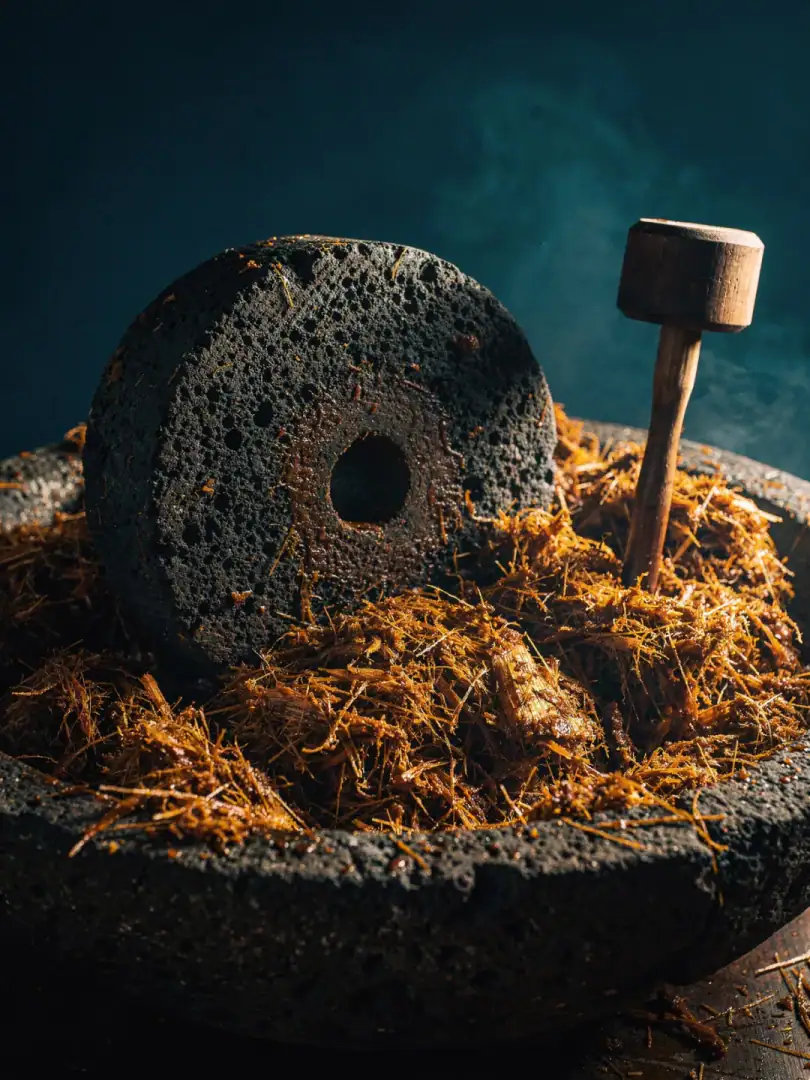
The Tahona: A Stone Wheel Turning in Circles
In traditional work, the tahona, a huge, usually round millstone made of volcanic rock, rolls over cooked piñas in a circular pit. In the past, a mule or horse pulled the wheel; today, small tractors handle the job at many operations.
The advantage: the tahona crushes the fibers without fully separating them, allowing pulp and juice to continue through the process together. This often gives the final product more body but takes considerably more time than a mechanical mill.
The Mazo: Crushed by Hand
Some teams work even more traditionally, using the mazo, a heavy wooden mallet with which they crush the cooked piña pieces by hand. This method is extremely labor-intensive and yields only small quantities per day, which is why it appears almost exclusively in Mezcal Ancestral.
Anyone who has ever watched a mazo team pound rhythmically for hours on fibrous piña pieces understands why Ancestral mezcal is sold in small batches at higher prices. Manual labor of this kind can hardly be replicated on a large scale.
Mill and Shredder: The Fast Routes
Chilean or Egyptian mills work with rotating rollers, replacing animal or human muscle power with a motor. They're explicitly permitted for Mezcal Artesanal and are considerably faster than the tahona or mazo.
The shredder goes even further: rotating blades tear the piña into fine fibers within minutes. Tequila and simple, industrial mezcal rely almost exclusively on such mechanical methods, since they're what make high output volumes possible in the first place.
With or Without Fibers: Why It Matters for Flavor
Whether the shredded fibers travel along into fermentation or get pressed out beforehand noticeably changes the flavor. Fibers left in the vat often contribute earthier, more complex notes, since aromas continue to release from the fiber material during fermentation.
Industrial methods usually press out the juice completely and ferment it fiber-free, yielding a cleaner, more consistent result. Both approaches are technically valid; they simply lead to different characters in the finished spirit.
What Happens to the Fibers After Pressing
After pressing, a large heap of spent fiber remains, known as bagazo. Throwing it away would be pure waste, so most operations find a second use for it. Many distilleries burn part of the dry bagazo to fuel their own ovens or stills, saving on fuel costs. Others compost the fibers and later return them to the agave fields as fertilizer, improving the soil over the years.
In some regions of Mexico, small workshops even process bagazo into paper, building material, or simple handicraft items, often for the local market or for tourists. Mezcal operations that ferment with fibers in the vat naturally have less bagazo left over for such byproducts than tequila factories, which press the juice almost entirely fiber-free. How an operation handles its leftovers therefore often reveals something about its size and working methods, too.
Farmers near many distilleries also use dried bagazo as feed supplement for cattle and other livestock, since it still contains remnants of fiber and sugar. In some villages, artisans also process the fibers into simple bricks or wall cladding by mixing bagazo with clay. How much of it ultimately gets reused strongly depends on the size of the operation and demand in the respective region.